
We are all shaped by our parents’ heritage. When one is descended from immigrants, the cultural heritage is often complex. This heritage, and the degree to which it is lost or maintained over time, is one of the more intriguing features of postcolonial societies such as Australia, New Zealand, Canada and the United States.
My father’s family emigrated from northern England to Australia in the late nineteenth century, and both of my paternal grandparents were born in Sydney. I believe my mother’s family emigrated from Hamilton, near Glasgow, to Brisbane in about 1900, although my grandfather was orphaned by age 12 and had a difficult early life which included the care of his younger siblings.
Both families appear to have undertaken the difficult journey halfway around the globe to secure a better life than the economic and social opportunities available “back home” could provide. There may also have been a religious dimension to their decision, given that all four grandparents held nonconformist convictions and were drawn to similar expressions of the Plymouth Brethren movement in early twentieth-century Australia. However, neither family seems to have left behind diaries, letters, or other personal records explaining why they chose to emigrate to Australia or describing the circumstances of their journey.
My father expressed little interest in his family’s heritage, and harboured no desire to explore his family’s cultural roots, either through family history research or by visiting England. He unconsciously embraced the identity of an Australian citizen “of British origins.” He knew, vaguely, where he came from, but had learned not to ask questions about his distant origins. The Bensons are, on the whole, rather private people.
By contrast, many descendants of Scottish migrants retain an enduring affection for a homeland they have never seen, and this was certainly the case for my mother. It was a deeply felt but strangely general affection. She entertained an abiding interest in Scotland and Scottish heritage – an interest principally inculcated by her father and his memories and stories of the Scotland he left behind at the age of four.
I recall my mother referring to Robert the Bruce and Sir Walter Scott, though not Robert Burns. She taught my brother and I to appreciate Scottish tartan, although we had no family tartan of our own. If there ever was one, it is lost in the Highland mists.
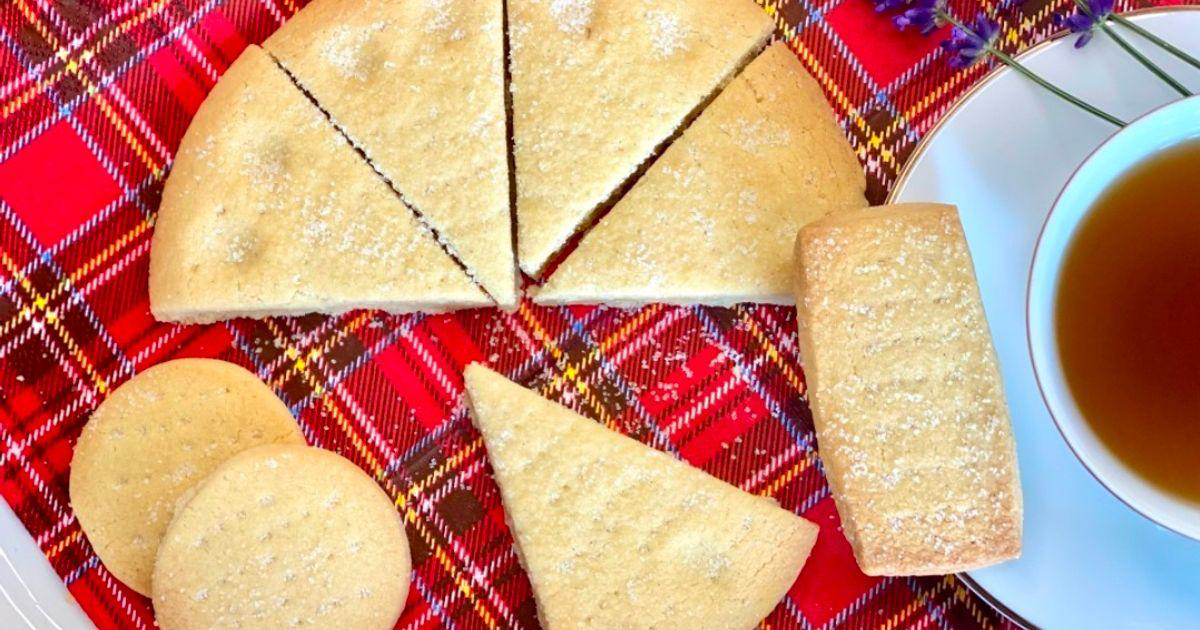
Mum often baked home-made Scottish shortbread, and in childhood we ate regular meals of lamb mince fried with onions and herbs and accompanied by diced carrots, peas and mashed potatoes. I accepted this as normal fare but recently learned that this dish was a typical example of Scottish home cooking and features in several Scottish cookbooks. I tasted haggis for the first time at The Clansman, a Brisbane restaurant, in the late 1980s, probably because of my identification with Scotland through my mother.
I also remember listening, again and again, to Scotland the Brave, Scottish Soldier, and other traditional Scottish songs to the accompaniment of bag pipes and snare drums on an LP record in our loungeroom in Wollongong as a small child. It was the only LP of Scottish music we owned, and handsomely rewarded any thrift associated with its purchase.
Mum loved to tell the story of an interview she had as a young woman for a medical receptionist job in Brisbane. Aware of her Scottish heritage by way of her surname, which was McCrindle, the owner-operator asked a final question: “Are you for the Macdonalds or the Campbells?” Aware that her future employment probably hung on her response, but unaware of the cultural politics involved, she gambled on the even odds and answered, “Macdonalds,” whereupon she got the job.
It turns out that the long feud between Clan Macdonald and Clan Campbell arose from competing loyalties, contested land claims, and rival political ambitions in the Scottish Highlands. The Campbells generally supported the Scottish Crown, while many Macdonalds defended older clan independence. Tensions culminated in episodes such as the 1692 Massacre of Glencoe, leaving a legacy of deep distrust, bitterness, and enduring rivalry. For the record, I like to believe my mother’s choice was the ethically correct one.
There does seem to be something distinctive about the strong attraction of the descendants of Scottish people to their cultural heritage. In Australia today, generations after their ancestors crossed oceans to start a new kind of existence, Scottish surnames continue to fill clan societies, Highland gatherings, Burns suppers, pipe bands, folk festivals, and genealogical organisations. Tartans are worn with pride, especially at significant family gatherings. With notable exceptions, family histories are carefully preserved. Scottish songs are sung with a surprising degree of emotional investment given the geographical and historical distance involved.
Why is this so? On one level, the answer is straightforward. Humans tend to preserve the memories of their origins. Scottish migrants contributed enormously to the development of many modern settler societies, establishing churches, schools, universities, businesses, farms, and civic institutions. Their descendants wish to honour that inheritance. Yet Scottish nostalgia often carries an emotional intensity that exceeds ordinary interest in family history. It possesses a quality of yearning. Scotland is not merely an ancestral homeland but an object of longing.
Migration involves loss and an element of grief as well as hopes and dreams. Families leave landscapes, languages, stories, customs, relationships, and patterns of life that cannot easily be recreated elsewhere. Over time, memories are transformed, with the harsher realities gradually receding while the more attractive features assume greater prominence. The homeland is idealised, remembered not as it actually was, but as it “should” have been.
Thus the Scotland celebrated in diaspora communities is often less a historical reality than a cultural imagination shaped by literature, music, folklore, and collective memory. It is a land of mist-covered mountains, rugged coastlines, ancient clans, heroic struggle, loyalty, courage, and belonging. Such images certainly possess some basis in reality. Scotland is a place of extraordinary natural beauty and rich cultural tradition; the Scotland of nostalgia is a selective construction of place.
Cultural memory tends to overlook painful religious conflict, poverty, political division, social hierarchy, and the economic pressures that encouraged Scots to leave their homeland. The Highland Clearances, industrial deprivation, sectarian tensions, and challenging weather conditions rarely occupy the centre of nostalgic celebration. I’m not suggesting that nostalgia is dishonest, but that memory is never merely an archive of objective facts. It is also a repository of selected and refracted meaning. We remember what helps us understand who we believe we are.
One of the most powerful carriers of such meaning is food. For many descendants of Scottish migrants, cuisine functions as a tangible link to an ancestral homeland that may otherwise feel distant and abstract. A family recipe often evokes a stronger sense of cultural continuity than a history book. The smell of baking shortbread, the preparation of mince and tatties, or the ceremonial serving of haggis on Burns Night can summon memories, stories, and emotions that span generations.
A key feature of traditional Scottish cuisine is its simplicity. Much of it emerged from a climate, economy, and social environment where resources were limited. Potatoes, oats, root vegetables, onions, dairy products, and inexpensive cuts of meat formed the backbone of everyday cooking. Dishes such as Scotch broth, mince and tatties, stovies (a dish made with potatoes, onions, leftover roast meat and beef dripping), Cullen skink (soup made from smoked haddock, potatoes, onions or leeks, and milk or cream), oatcakes, and potato scones were not created for luxury or novelty but for sustenance. They reflected thrift, ingenuity, and a deep familiarity with local ingredients.
Even iconic foods such as haggis tell a story about making the most of what was available. Whatever contemporary diners may think of its ingredients, haggis represents a culture that learned to waste little and value resourcefulness. It embodies a practical wisdom forged under often difficult conditions. The same may be said of Scottish shortbread. Made from a handful of basic ingredients, it transforms simplicity into something memorable. Cheese and onion sandwiches, leek and potato soups, bannocks (heavy flatbreads traditionally made with barley), and other humble dishes occupy a similar place in the Scottish imagination. They are celebrated because they are familiar.
Nostalgia attaches itself to ordinary life. People yearn for concrete realities such as kitchens, family tables, shared meals, familiar sounds and smells, iconic clothing and remembered conversations. Scottish cuisine is one of the most accessible ways of preserving the idea of Scotland. The homeland can be tasted.
Moreover, cultural nostalgia fosters continuity across generations, strengthens communities and encourages gratitude toward ancestors whose sacrifices created opportunities for those who followed. In a world of frantic mobility, moral fragmentation, and social change, cultural traditions provide a reassuring sense of roots. Scottish cultural preservation keeps alive stories, music, customs, values, and culinary traditions that might otherwise disappear.
Yet nostalgia has limitations. It may tempt us to live emotionally in a past that never truly existed. It may encourage a sentimental attachment to symbols while neglecting the realities of the present. It may transform heritage into escapism. Nostalgia may also mistake its object. Descendants of Scottish migrants like me, who don’t feel entirely at home in the world, may believe that we are yearning for Scotland. Yet Scotland may actually be the symbol of a deeper longing for a mythical homeland of the mind.
Homecoming is among the most evocative themes in literature. From Homer’s Odyssey to modern migrant narratives, the return home is presented as the resolution of a fundamental human tension. We imagine that somewhere there exists a place where we truly belong, where our fragmented lives might be gathered together and made whole. Actual homecomings rarely satisfy these expectations.
The migrant who returns discovers that the homeland has changed in multiple ways. The migrant has also changed. The remembered place and the actual place no longer coincide. The longed-for home proves elusive. For many descendants of migrants, then, Scotland is conceptually distant and beyond the reach of objective analysis. It cannot be fully possessed; it remains a place of imagination and wonder.
The famous song Scotland the Brave that I listened to many times as a child, eloquently captures this dynamic. Although often viewed as a clear expression of national pride, its emotional power arises from a more complex source. The song is filled with admiration for Scotland’s landscapes, people, and traditions, but beneath the celebration lies a profound note of longing. The singer gazes toward a homeland that is cherished because it is distant and perhaps beyond recovery. The mountains, glens, and valleys are not being described but remembered. Scotland is a lost home.
Here are the full lyrics:
Hark when the night is falling
Hear! hear the pipes are calling,
Loudly and proudly calling,
Down thro’ the glen.
There where the hills are sleeping,
Now feel the blood a-leaping,
High as the spirits
of the old Highland men.Chorus:
Towering in Galic Fame
Scotland my mountain home
High may your proud standards gloriously wave
Land of my high endeavour, land of the shining river
Land of my heart forever, Scotland the brave.High in the misty Highlands,
Out by the purple islands,
Brave are the hearts that beat
Beneath Scottish skies.
Wild are the winds to meet you,
Staunch are the friends that greet you,
Kind as the love that shines
from fair maiden’s eyes.Far off in sunlit places,
Sad are the Scottish faces,
Yearning to feel the kiss
Of sweet Scottish rain.
Where tropic skies are beaming,
Love sets the heart a-dreaming,
Longing and dreaming
for the homeland again.
This magnificent song resonates because it touches a longing that extends beyond questions of nationality. The homeland is a metaphor for a more complete and beautiful life than the one we currently inhabit. It evokes the hope that somewhere beyond the disappointments, compromises, and dislocations of ordinary existence there remains a place of perfect belonging, meaning, and peace.
Of course, no homeland can entirely fulfil such expectations. Every nation, culture, family tradition, and inherited memory is marked by imperfection. The dream of complete homecoming continually recedes before us. We never truly arrive home.
Thus the enduring appeal of Scottish nostalgia reveals a quality central to the human condition. We are creatures of memory and hope. We carry within us an intuition of home while never being fully at home. We remember places that shaped us and imagine places that might complete us. The homeland, whether Scotland or elsewhere, symbolises that deep yearning.
The pipes, the songs, the stories, the landscapes, and even the humble dishes of the Scottish table endure because they speak to something universal in the human soul. They remind us that beneath our historical identities and celebrated individuality is a deeper longing to discover a common home.
To journey hopefully really is better than to arrive.
Rev Dr Rod Benson is General Secretary of the NSW Ecumenical Council and a minister of the Uniting Church in Australia serving at North Rocks Community Church in Sydney.
Image source: AI

