
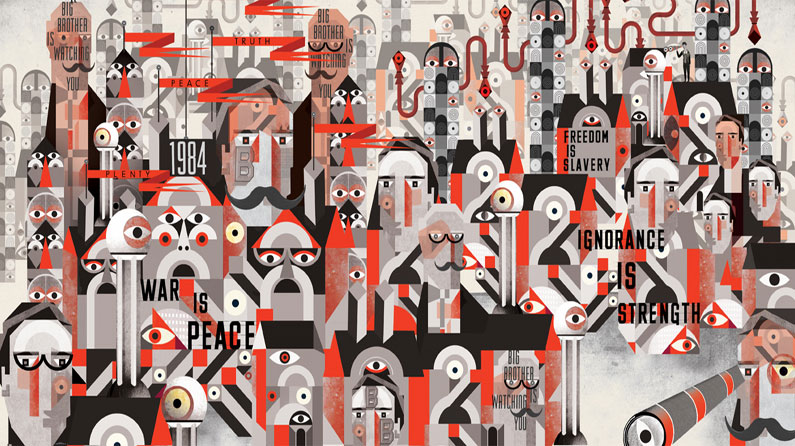
I first read 1984 in 1985. Orwell’s great novel was assigned by my school curriculum for analysis and sober reflection, as it should be for every student in every school. If you have not yet read it, know that our world can turn from bliss to unimaginable horror in less time than it takes to organise a political protest, that Big Brother really is coming for you, and you should attempt to read the book before the apocalypse hits.
[Spoiler alert: This article discusses plot details]
Among the defining political novels of the twentieth century, Nineteen Eighty-Four occupies a singular place in modern consciousness for its relentless depiction of the corruption of objective truth and the absolute triumph of authoritarian government. Published in 1949 by the English journalist and former soldier George Orwell, the novel echoes the horror and devastation of the Second World War, the rise and collapse of European fascism, Orwell’s disillusionment with Stalinist communism, and anxieties about the expanding power of modern bureaucratic states.
Almost eight decades on, the novel remains deeply relevant to all but the most agrarian and reclusive human communities. Contemporary democratic societies are not identical to Orwell’s fictional Oceania, yet many of the negative tendencies he identified have become increasingly recognisable within politics, media, and technological culture. In some cases, the existential threats of the world we inhabit today have surpassed those of Orwell’s dystopian vision, especially in the light of unforeseen advances in technology and the resulting opportunities and challenges.
Orwell’s central concern is often misunderstood. He was not simply sounding a warning about the potential of governments to become excessively autocratic and oppressive to their citizens. History has repeatedly shown this to be true. His deeper fear was what modern political systems would seek to do once they acquired the ability to substantively shape human consciousness.
The political world of 1984 is divided into three fictional superstates (Oceania, Eurasia and Eastasia), all engaged in endless war for the political purpose of expending surplus resources, maintaining a permanent state of panic, and keeping their respective populations unified in hatred against a foreign enemy. The Party in Oceania demands of its citizens not merely outward obedience but inward surrender. People are expected to internalise ideological contradictions through what Orwell famously called “doublethink”: the capacity to accept mutually contradictory claims simultaneously while abandoning the idea of objective truth.
The novel’s famous slogans capture this logic with disturbing clarity: “War is Peace,” “Freedom is Slavery,” and “Ignorance is Strength.” These paradoxes serve as ordinary propaganda, shaping public perception, mobilising action, neutralising dissent, and reinforcing power. But they also explicitly represent the systematic destruction of rational coherence. Orwell feared a society in which political power no longer needed to persuade people logically because it had already undermined confidence in the existence of stable truth altogether. This trend has arguably been growing alarmingly in the real world in recent years.
As a journalist and combat soldier, Orwell witnessed firsthand the effects of ideological manipulation during the Spanish Civil War, where Soviet-aligned factions distorted events and persecuted rivals while claiming moral purity. The Moscow show trials, the cult of Joseph Stalin, and the falsification of Soviet history further shaped Orwell’s imagination and strengthened his convictions regarding the dark side of authoritarian government. Although elements of fascism informed the novel, 1984 is best understood as a broader critique of totalitarian systems in which the state seeks comprehensive control over politics, culture, language, and memory.
One of Orwell’s most enduring insights concerns language. “Newspeak,” the Party’s artificial language, is designed to narrow the range of possible expression and therefore diminish the capacity for independent thought. Orwell understood that language shapes moral imagination. If societies lose the vocabulary needed to discuss freedom, justice, or dissent, public thought becomes correspondingly impoverished. Of course, control of human thought cannot be completely reduced to the manipulation of language, but in many cases malevolent political manipulation arguably begins with the corruption or simplification of language.
This concern has striking contemporary relevance for us in 2026. Political discourse across many democracies increasingly operates through slogans, tribal identity, and emotional signalling rather than careful reasoning. Public debates often reward emotive expression over reasoned argument and outrage over complexity. Competing ideological communities inhabit separate informational universes, each with its own narratives and assumptions, each increasingly excluding alternative voices and creating vast “echo chambers” of ideological slop. Orwell feared this fragmentation of shared reality and its longterm impact on human society.
Yet we need to exercise caution when drawing modern parallels. Contemporary liberal democracies and other forms of government are not equivalent to Oceania and its enemies. Orwell’s fictional world involves systematic torture, complete information monopoly, abolition of privacy, and overt state terror on a scale beyond most modern societies. Simplistic comparisons risk diminishing the distinctive horror of genuine totalitarianism. On the other hand, it is not hard to find evidence of all of these evils in our daily news feeds. Orwell would counsel us to beware lest we find ourselves on the slippery slope into totalitarian horror and unable to arrest our fall.
Technology is perhaps the area where Orwell’s vision appears most prophetic, though not always in the ways popularly imagined. Orwell imagined the “telescreen,” a device through which the Party could monitor citizens continuously. Today billions of people voluntarily carry smartphones capable of collecting enormous quantities of behavioural and security data, including location patterns, social networks, online preferences and passwords. Governments and corporations now possess unprecedented capacities for surveillance and behavioural analysis. Facial recognition systems, predictive algorithms, and artificial intelligence have intensified ethical questions about privacy and autonomy.
At the same time, contemporary surveillance differs in significant ways from the surveillance depicted in Orwell’s fictional world. In 1984, surveillance is overwhelmingly state-directed and coercive. In modern societies, surveillance often operates commercially and consensually through convenience, entertainment, and digital participation. The danger may therefore be more subtle than Orwell anticipated. What we face today is not imposed control but voluntary immersion within systems of behavioural influence; and the further we proceed down this path, the more difficult it will be to regain autonomy and privacy.
Orwell’s concerns also resonate within literature and media culture. He feared the political manipulation of history and the pressure toward ideological conformity. Contemporary cultural debates increasingly involve struggles over memory, representation, and moral legitimacy. Historical figures and literary texts are often reassessed through modern ethical frameworks, sometimes illuminating genuine injustices, sometimes reducing complex realities to simplified ideological categories.
The novel also addresses concerns about religion and social cohesion. In Oceania, political power assumes quasi-religious status. “Big Brother” functions less as a conventional ruler than as an object of ritual devotion and emotional submission. Politics has become religion. Modern political movements sometimes display similar tendencies, whether on the left or the right, demanding total moral allegiance while treating dissenters not merely as opponents but as heretics. And bureaucratic government assumes religious status with the state as provider, the liturgy of paperwork, the priesthood of technocrats, and various forms of dogma, orthodoxy and heresy arising as differences of opinion are reframed as moral corruption.
Perhaps Orwell’s deepest insight concerns the transformation of human relationships under the conditions of totalitarian government. The Party is committed to destroying trust, intimacy, friendship, and independent loyalty because such bonds create spaces beyond political control. In contemporary societies, hyper-polarisation, digital isolation, and constant online performance can similarly erode social trust and civic identity. Social media systems frequently reward conflict and emotional intensity because these generate engagement and attention.
Implicit throughout the novel is a sense that truthfulness, memory, love, and ordinary human decency remain indispensable safeguards against every kind of tyranny. Rebellion against the system by the main character, Winston Smith, begins with the simple insistence that reality may in fact exist independently of political slogans.
And yet, 1984 is an especially dystopian novel. The tragic truth of the novel is that Winston never makes a discovery that enables him to successfully rebel. Instead, the system successfully crushes his rebellion, extinguishes his personality, and relentlessly compels him to love Big Brother.
Winston believes he has found keys to resistance, but each discovery is ultimately revealed to be a trap or an illusion managed by the Party. He believes he makes three critical breakthroughs that will help him overthrow the system.
First, he is convinced he has found evidence of Party falsehood. He finds a scrap of a 11-year-old newspaper photograph proving that three executed Party leaders (Jones, Aaronson, and Rutherford) were in New York when the Party claimed they were committing treason on Eurasian soil. This is concrete proof that the Party rewrites history. However, fearing the Thought Police, he destroys it in a memory hole.
Second, Winston realises that the working-class majority (the Proles), who make up 85 per cent of the population of Oceania, are the only force large enough to destroy the Party. He writes in his diary, “If there is hope, it lies in the proles.” Yet he is aware that they lack the political awareness to rebel, noting, “Until they become conscious they will never rebel, and until after they have rebelled they cannot become conscious.”
Third, Winston believes he has discovered an underground resistance movement led by Emmanuel Goldstein. He receives from a friend a copy of its manifesto, The Theory and Practice of Oligarchical Collectivism, which explains how the bureaucratic system maintains permanent power, and this gives him hope that the day may come when such power is overthrown by valiant individuals such as himself, working with others of similar conviction and insight.
The brutal reality is that every “discovery” Winston makes is entirely orchestrated and controlled by the Party’s Ministry of Love. Winston’s trusted ally, O’Brien, is actually his chief torturer. O’Brien reveals that he helped write Goldstein’s book as a piece of state-controlled propaganda designed to entrap citizens committing thoughtcrime.
In Room 101, faced with his worst nightmare, Winston’s final psychological defence shatters. He betrays Julia, his lover, screaming for the Party to torture her instead of him. This act destroys his moral core and his capacity for human love. The novel ends with Winston sitting defeated in the Chestnut Tree Cafe. His memory, intellect, and personality have been completely erased. The system has comprehensively defeated him.
Orwell structured the novel in this way to serve as a stark warning that, once a totalitarian bureaucracy achieves total technological and psychological control, individual rebellion becomes effectively impossible. He recognised that the gravest threats to freedom may arise not only from overt authoritarian politics and the rise of dictatorship, but from the gradual erosion of truth, language, privacy, and trust within scientifically and technologically advanced societies.
What concrete actions, then, can readers realistically take to reverse the dystopian trends that Orwell identifies in 1984 and that we might perceive arising in our own time and place? Here are five suggestions.
First, defend the integrity of objective truth. Orwell’s great fear was not simply political oppression but the collapse of the perception of objective reality. Readers can resist this tendency by cultivating habits of intellectual honesty: such as careful checking of information sources, reading across ideological divides, refusing to spread misinformation, and willingness to revise opinions when confronted with credible evidence. Free societies depend upon informed and altruistic citizens who care about whether statements are true or false.
Second, protect language from manipulation by political and cultural elites. In Nineteen Eighty-Four, “Newspeak” narrows thought by narrowing vocabulary. Readers can resist similar tendencies by valuing careful use of language, nuanced discussion, and meaningful public debate. This includes resisting the persuasive power of empty slogans, reductive tribal labels, and emotionally manipulative rhetoric. Rich and diverse language helps to sustain a rich and diverse moral imagination.
Third, preserve privacy and technological autonomy. Orwell anticipated the dangers of constant surveillance. Modern readers can respond by becoming more conscious of problematic digital habits and adopting practices such as limiting unnecessary data sharing, understanding how platforms shape behaviour, supporting privacy protections, and exercising discernment about algorithm-driven media consumption. Technological convenience should not automatically override human freedom and dignity.
Fourth, strengthen real human relationships and local communities. In Orwell’s novel, the Party seeks to isolate individuals and destroy independent loyalties in multiple ways. One practical response to such pressures in our own context is to cultivate strong families, friendships, neighbourhoods, religious communities, and civic institutions. Healthy social bonds create life-giving spaces of trust and solidarity that resist political manipulation, cultural fragmentation and the effects of deep psychological anxiety.
Fifth, cultivate moral courage and champion independent thought. Orwell believed tyranny advances when people become too fearful, distracted, or socially conditioned to speak honestly. Readers can resist dystopian tendencies by practising small acts of integrity: asking difficult questions, defending intellectual freedom, listening carefully to opponents, and refusing to conform merely for social approval. Winston Smith’s rebellion begins with a simple but profound conviction: that reality exists independently of political pressure.
Finally, a word for Christians in 2026. What are the contemporary theological implications of 1984? Orwell was not writing as a Christian apologist; his relationship with Christianity was complex and often ambivalent. Yet his great novel functions as a powerful negative parable, depicting what human society looks like when truth, memory, transcendence, and human dignity are severed from any reality higher than political power. I believe Christians can learn at least six important lessons from the novel.
First, truth matters more than power. One of Orwell’s central insights is that tyranny begins when power determines truth rather than truth judging power. The Party’s ultimate claim is its unique authority to define reality. If the Party says two plus two equals five, then reality must submit and accept the falsehood as truth.
Christian faith begins with the conviction that truth is objectively grounded in God rather than in human institutions. Governments, churches, corporations, media organisations, and political movements all stand under a higher authority. The church serves society best when it refuses to allow partisan loyalties to replace the pursuit of truth. Christians should be among the first to admit facts that inconvenience their own tribe, and the first to reject falsehood even when it benefits their preferred causes.
As Jesus declared, “The truth will set you free” (John 8:32). Orwell understood the inverse proposition: falsehood enslaves us. Let us all find and follow the truth as it is embodied by Jesus our Master.
Second, language can be corrupted. Newspeak was designed to shrink the range of possible thought by shrinking the available vocabulary. While Orwell exaggerated for literary effect, churches face a similar challenge whenever theological language becomes distorted or hollowed out. Words such as “grace,” “justice,” “love,” “sin,” “repentance,” “salvation,” and “discipleship” can gradually lose their meaning through overuse, politicisation, or sentimentality.
The church’s task is not merely to preserve old words but to preserve their connection to reality. Christian preaching, teaching, and worship should cultivate linguistic integrity. Churches that lose theological precision eventually lose theological depth.
Third, memory Is an essential spiritual resource. One of the most chilling features of Oceania is the systematic destruction of memory. Historical records are continually rewritten. Citizens lose any stable point of reference from which to evaluate the present.
Christianity is, among other things, profoundly a religion of memory. The Bible repeatedly commands God’s people to remember. Israel remembers the Exodus. The church remembers Christ’s death and resurrection. The Eucharist itself centres upon the command, “Do this in remembrance of me” (Luke 22:19; cf 1 Cor 11:24).
Memory protects communities from manipulation because it anchors identity in realities larger than present circumstances. A Christian community that forgets its history, whether it is a denomination or a local congregation, is vulnerable to every passing fashion and ideological enthusiasm.
Fourth, humans are far more than political animals. Orwell recognised that totalitarian systems cannot tolerate rival loyalties. The Party seeks total allegiance. Nothing may compete with its authority—not family, friendship, romance, art, religion, or personal conscience. Christianity offers a profound challenge to this impulse because it insists that human beings belong ultimately to God.
By its very existence, the church performs an important social function. Whenever Christians gather for worship, they declare that neither the state, the market, nor ideology possesses ultimate authority. This does not require political withdrawal. Rather, it means maintaining a healthy distinction between the kingdom of God and every earthly kingdom. At the same time, the church must guard against any authoritarian or totalitarian impulse lest it go the way of passing earthly kingdoms.
Fifth, technological developments require moral wisdom. Many readers focus on Orwell’s predictions about surveillance technology. Yet the deeper issue is not technology itself but the moral frameworks governing its use. Christians in 2026 inhabit a world shaped by artificial intelligence, predictive algorithms, biometric monitoring, and unprecedented data collection. The church should neither panic nor uncritically embrace such developments.
Instead, Christians should ask questions rooted in theological anthropology:
- Does this technology enhance or diminish human dignity?
- Does it strengthen or weaken human freedom?
- Does it cultivate wisdom or merely efficiency?
- Does it deepen community or increase isolation?
Orwell reminds us that technological capability and moral progress are not the same thing.
Sixth, love is a form of resistance. Perhaps the most striking feature of 1984 is that the Party seeks to destroy authentic human love. Friendship is reframed as dangerous. Marriage is reduced to serve merely functional ends. Family becomes a surveillance mechanism. Trust between people disappears. The Party understands that genuine love creates loyalties beyond political control.
The New Testament repeatedly presents love not as sentiment but as a social reality that forms an alternative community. The church’s witness therefore depends not merely upon correct doctrine or public activism but upon its capacity to embody relationships characterised by forgiveness, hospitality, trust, and mutual service. A congregation marked by genuine love represents a quiet but powerful challenge to every system that treats people as instruments.
The deepest lesson of 1984 may be theological rather than political. Orwell depicts a world in which transcendence has vanished. There is no God above the Party, no objective truth beyond ideology, no hope beyond history, and no future except perpetual domination. Christian faith offers a radically different vision of reality grounded not in power but in love. History is not governed by Big Brother but by God who is unimaginably greater than any human creation or vision. Humans are not raw material for political projects but persons made in the divine image. Memory matters because God acts in history. Truth matters because reality is grounded in God’s character.
In that sense, Orwell’s novel functions almost as an inverted Christian parable. It shows what the world begins to look like when power occupies the place that belongs to God alone. For the church in 2026, that warning remains as relevant as ever. The challenge is not merely to oppose authoritarianism when it appears in public life. It is also to ensure that churches themselves never become communities where loyalty is valued above truth, conformity above conscience, power above service, or ideology above the living God.
In writing 1984, his most famous dystopian novel, George Orwell has encouraged us think in fresh, generative and hopeful ways for the future health and wellbeing of our species. It behoves us to take his dire warnings seriously, and to commit ourselves to work diligently for the defence of justice, love and peace in a world that shows alarming signs of a permanent turn to injustice, hatred and war.
Rev Dr Rod Benson is General Secretary of the NSW Ecumenical Council and a minister of the Uniting Church in Australia serving at North Rocks Community Church in Sydney.
Image source: Lesley Barnes (Creative Bloq)

