
A short address to Moore Theological College staff by Dr Rod Benson, 3 June 2024.
Today, my brief is to talk for five minutes about the unity of the Godhead, the nature of salvation, and the certainty of eschatological judgment. See John 5:15-24 (CSB).
As a child of church-going parents, I attended Sunday School where I learned many of the more exciting stories of the Bible and memorized selected verses in return for rewards. One of those early verses that has remained near the sedimentary surface of my memory is John 5:24. It’s a great verse to learn, but the back story is even more interesting.
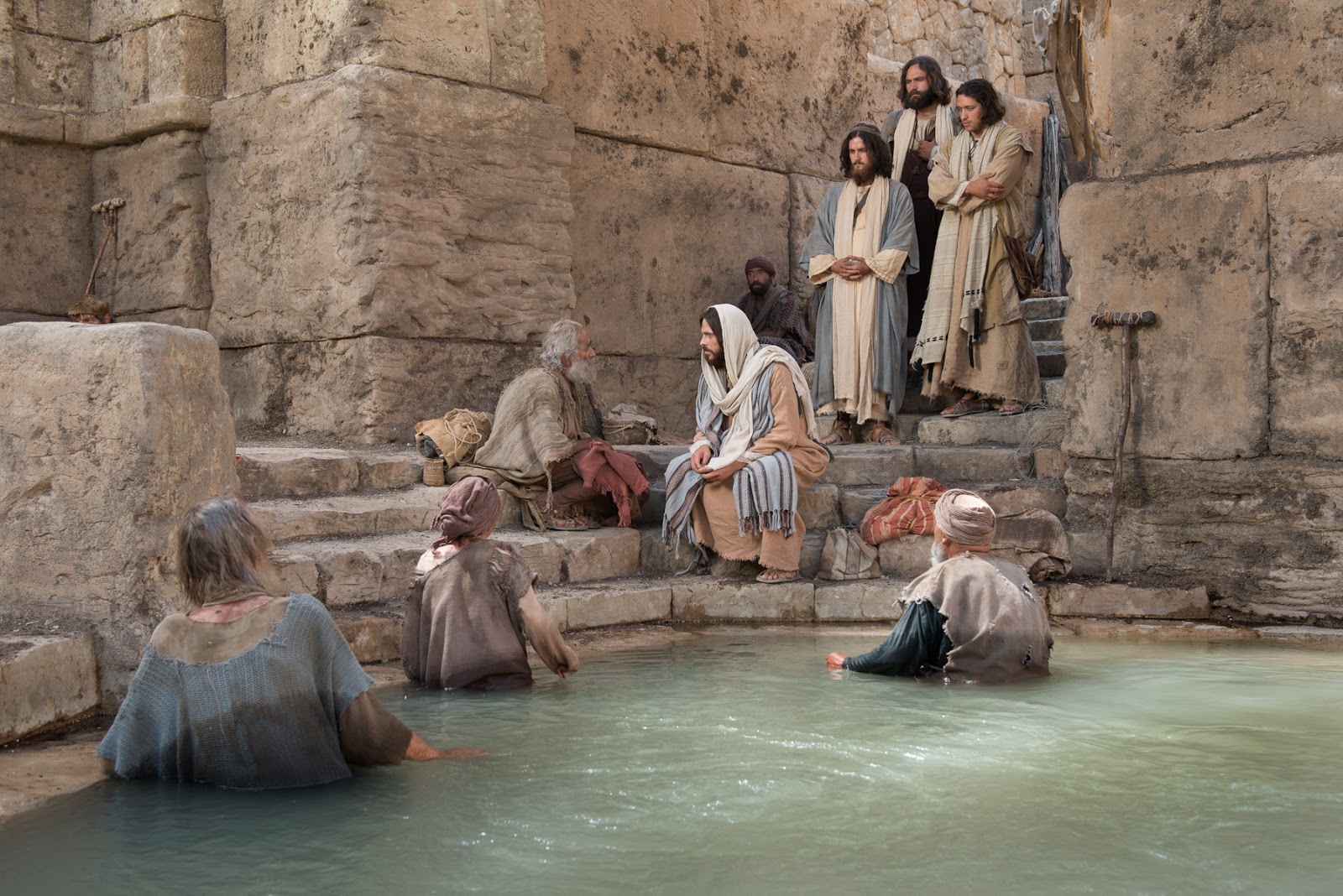
In John 5:1-9, Jesus travels from Galilee to Jerusalem, stops beside the Pool of Bethesda near the Temple Mount, and miraculously heals a man who has been disabled for 38 years.
This is not okay with the religious leaders. It’s all very well for messiahs to go about healing people, but this must not happen on the Sabbath, the designated day of enforced rest from work. Jesus’s response to the leaders turns their simmering envy and anger into murderous rage (vv. 19-24 cf v. 18). He makes three important claims.
First, Jesus describes his relationship with God as one of fundamental unity of nature, purpose, and will (vv. 19-20). In various ways, the Fourth Gospel reveals the unique relationship that has always existed between the Father and the Son (and the Holy Spirit).
And yet, Jesus is also the son of his mother Mary, and the son of a humble carpenter in far-off Nazareth. For us today, this is a reminder that Jesus is the unique God-man, “God manifest in flesh” (John 1:14) – not merely an exemplar who shows us how to live well (essential though that is), but a Saviour who rescues us from sin.
Second, Jesus accepts God’s sovereign power to give life, and claims that same power for himself (v. 21). Jewish people at the time took it for granted that God alone gives life and would raise the dead at the end of time. Now Jesus claims this power. As biblical scholar F. F. Bruce puts it, Jesus is not merely claiming to be
“an instrument in God’s hand for restoring the dead to life, as Elijah and Elisha were; he asserts that authority has been given to him to raise the dead not merely to a resumption of this mortal life but to the life of the age to come.“[1]
Third, Jesus claims that God has given him all authority to judge the world at the end of time (v. 22). The power Jesus displayed in the healing at the pool (vv. 1-9), and the even greater power he employs in chapter 11 when raising Lazarus from the dead, both verifiable through testimony, is the same power that gives spiritual life to everyone who trusts him, and the same power that will call the dead to life and judgment at the Last Day.
This power to give life, and the power to judge, are uniquely works of God. And here Jesus states that he is the rightful repository of such power, and of the authority and the honour that accompanies it.
But I want you to notice something that fundamentally sets these two powers apart.
Only God has the power to give life, to raise the dead, and to grant eternal life. None of us can do anything to effectually commend ourselves to God, or to earn the right to live forever. This is basic gospel truth (see, e.g., Rom 3:10, 23).
By contrast, each of us has the responsibility to do right and not wrong, to be of good rather than evil character. And everyone who stands before God and is judged to have failed to meet God’s perfect standard of holiness brings that judgment on themselves.
This is why Jesus, the unique God-man, came into our world: to save sinners, to enlighten us, to sanctify us, to prepare us for an unimaginably awesome future in union with God.
Hear verse 24, the verse I stoically memorised as a child, from the lips of Jesus: “Truly I tell you, anyone who hears my word and believes him who sent me has eternal life and will not come under judgment but has passed from death to life.”
Reference
[1] F. F. Bruce, The Gospel of John: Introduction, Exposition, and Notes (Grand Rapids: Eerdmans, 1994/1983), 129.
Image source: https://asacredrebel.com
 iDigress