
One of the less well-known mountains of the Hebrew Bible is Mount Hermon, the highest mountain in Israel. With a snow-capped summit of 2,814m (9,232 ft), Mount Hermon is 586 metres taller than Australia’s tallest peak, Mt Kosciuszko (Kunama Namadgi).
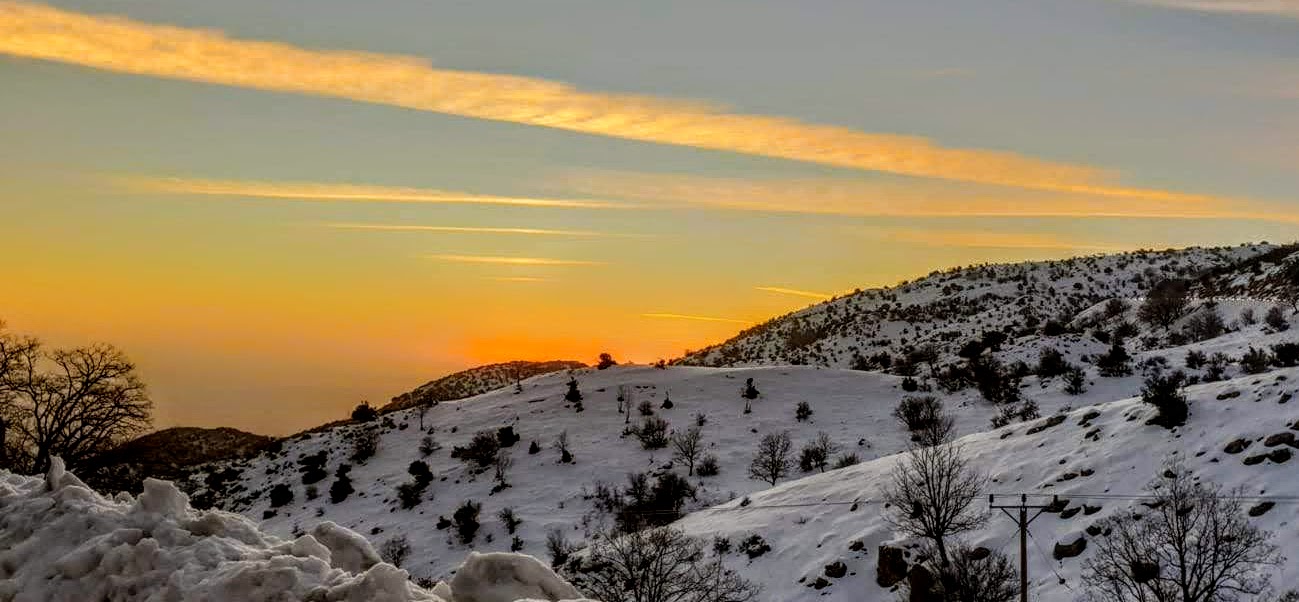
The mountain range is located at the north-eastern border of modern Israel, between Syria and Lebanon. Snow melt and abundant rainfall from Mount Hermon form the headwaters of the Jordan River.
The southern slopes extend to the Israeli-occupied Golan Heights, where there is now a popular ski resort.
Like many peaks in the region, Mount Hermon has a long association with sacred rituals. Archaeologists have found several ancient places of worship there. In the Epic of Gilgamesh, as Gilgamesh fights Humbaba, the Guardian of the Cedar Forest, they split open Mount Hermon and Lebanon with the heels of their feet (Tablet V).
In the Bible, Judges 3:3 (cf 1 Chr 5:23) refers to the mountain as Baal Hermon (“lord of Hermon”), suggesting that ancient Canaanite tribes used the area for religious purposes. After the conquest of Canaan, Mount Hermon marked the northern limits of the Promised Land (Dt 3:8; Jos 11:17; 12:1; 13:5).
In the apocryphal Book of Enoch, Mount Hermon is the place where the Watcher class of fallen angels descended to earth.
It’s also suggested by a few commentators as one of several possible locations for the transfiguration of Jesus mentioned in Matthew 17:1-8 (and also in Mark and Luke). 2 Peter 1:16-18 recalls this event and describes the location as “the sacred mountain.”
Several of Israel’s Psalms also refer to Mount Hermon: for example, Psalm 42:6, and Psalm 89:11f. Probably the best-known biblical text referring to Mount Hermon is the beautiful Psalm 133:
1 How very good and pleasant it is
when kindred live together in unity!
2 It is like the precious oil on the head,
running down upon the beard,
on the beard of Aaron,
running down over the collar of his robes.
3 It is like the dew of Hermon,
which falls on the mountains of Zion.
For there the Lord ordained his blessing,
life for evermore.
Even on the mountain slopes, life can grow hot and dry. The dew falls nightly, refreshing the grass and leaves, sustaining and cooling the plants, reducing stress, and building resilience for the day ahead.
The dew falls indiscriminately, reminding those who reflect on this psalm of God’s kindness and love toward Gentiles as well as toward Jewish people.
In ancient Israel, as people of faith travelled up to Jerusalem for the major religious festivals, they sang “songs of Ascent,” and some of these are recorded for us in Psalms 120-134.
These sacred community songs inspired pilgrimage, and reminded those who sang – and those who listened – of God’s mercy, grace, protection and redemption. Psalm 133 is the second-last of these songs.
In his commentary on the Psalm, Richard J. Clifford observes that “communal life is often difficult. There are difficult people, different opinions … and animosities, some of long duration. It is sometimes easier to go it alone … Seeing the community united, the psalmist draws on the resources of lyric poetry to portray its wonder. How marvellous a gift is their unity, their worship, and their blessings in the holy city.”[1]
After the return from exile, these songs gained even more significance and emotional impact as pilgrims walked up to the restored city and temple.
Nehemiah 12:27-43 describes the process of “going up” to Jerusalem, with two processions of pilgrims marching around the rebuilt city walls in opposite directions, meeting on the far side, re-entering the city, and proceeding as one into the temple precinct for a united service of praise to God. Psalm 133 fits that situation well.
As the people “go up,” the psalm draws attention to what is “coming down”:
- Fragrant oil poured on the head and running down the beard
- The “dew of Hermon” falling on the mountain
- The blessing of God coming down from heaven
The psalm employs these features as similes for members of a community living in harmony and tranquility:
- the pleasures of the oil
- the refreshment and potential for growth that the dew brings
- the abundant blessing of God experienced by people inspired by a shared purpose who walk and work together for the common good.
It’s not an impossible utopia. It’s not an unscalable peak.
It’s within the reach of all of us.
Sermon 792 copyright © 2023 Rod Benson. Preached at Moore Theological College, Sydney, Australia, on Monday 13 November 2023. Unless otherwise noted, Scripture quotations are from The Christian Standard Bible (Nashville: Holman Bible Publishers, 2020).
Reference
[1] Richard J. Clifford, Psalms 73-150 (Nashville: Abingdon Press, 2003), 261.
Image source: https://www.snow-forecast.com/resorts/mounthermon/
 iDigress