
John Calvin, The Doctrine of Election (trans. from the French by Robert White; Edinburgh: Banner of Truth Trust, 2022). 224pp + indexes. ISBN 9781800402652
Reviewed by Dr Rod Benson
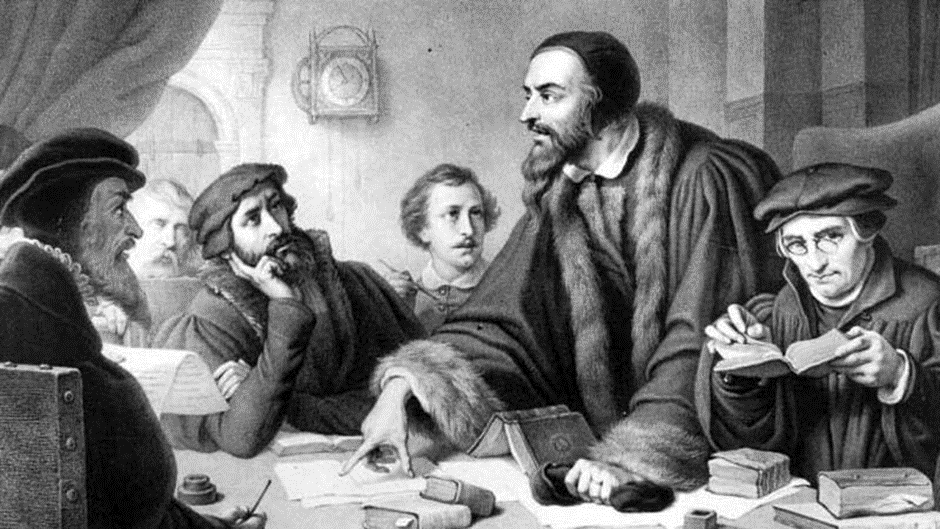
The biblical doctrine of election is fraught with controversy. The reasons for this are not hard to discover: there is, firstly, an apparent tension between determinism and free will in human experience that makes for endless conversation and dispute. Secondly, there is the idea of reprobation – that God elects some to salvation and (presumably) others to damnation.
Another problem is that so few people take the time to read the key theologians on the subject, and it is this problem that the present volume seeks to address.
I am familiar with Calvin’s works, principally The Institutes of the Christian Religion, and his commentaries on the books of the New Testament. I had never heard of Calvin’s book on The Doctrine of Election, and this is because such a book did not exist until the translator, Robert White, brought various passages on election in Calvin’s oeuvre together in the current volume.
A resident of Sydney, White was Senior Lecturer in the Department of French Studies at the University of Sydney. He made a commitment to Christ in 1958 while attending a university mission where John Stott was preaching. In 2014, Banner of Truth published his translation of Calvin’s Institutes from the first French edition of 1541. He has now produced a second book from the original French, distilling the Swiss Reformer’s thought on election.
Calvin treats the doctrine of election incidentally in the first edition of his Institutes (1536), in a discussion of ecclesiology. He defines the church as “the sum total of the elect.” In his Brief Instruction in the Faith (1537), he treats the doctrine in greater detail, and returns to the subject in his Commentary on Romans (1540), in the context of salvation history.
As one might expect, Calvin’s views on election are fully expressed in the revised editions of The Institutes (1539, 1541). In the final 1559 edition, Calvin lists four applications of the doctrine: it reveals the gratuity of grace by excluding human merit for salvation; it magnifies God’s glory since redemption is entirely the work of God; it eliminates pride and makes humility the only possible response to God’s goodness; and it reinforces faith or confidence in God’s promises.
While White could have drawn on Calvin’s treatment of election in The Institutes, he focused instead on “less accessible” records of spoken words addressed to mixed audiences. The result is a collection of texts arranged under four headings:
- A summary statement of the doctrine of election
- Election and reprobation
- Election in Christ
- Election in the context of God’s overarching purpose
These texts include material drawn from a set of addresses to a weekly Friday gathering of ministers and laypeople in Geneva in 1991-52 (published in 1562), four sermons on God’s choice of Jacob over Esau (Gen 25:12-28), four of a series of 48 sermons on the Letter to the Ephesians (on Eph 1:3-14), preached in 1558-59 and published in 1562), and a fifth sermon from the series, on Ephesians 3:9-12, on election in the broad context of divine providence.
A quality that sets this book apart is that White has freshly translated all of these texts from the nineteenth-century edition of Calvin’s collected works established by the Strasbourg Professors Baum, Cunitz and Reuss. Delightfully, White has also included English translations of the extempore prayers with which Calvin concluded his sermons – variations on a standard prayer of confession and aspiration.
Three appendices round out the book and place Calvin in a wider context: selected statements on election culled from contemporary or near-contemporary sources; brief discussion of critical reactions to Calvin’s teaching in reformed and Lutheran circles; and an examination of the place Calvin gives to the doctrine of election in his preaching and pastoral application.
Together, these documents throw fresh light on Calvin’s doctrine of election, his homiletical style, his pastoral theology, and his confidence in Scripture as the revealed will of God even when the teaching is difficult to receive. White is to be commended for giving us this important new resource.
To conclude, here is White’s translation of the prayer at the end of Calvin’s sermon on Ephesians 1:4-6 (p. 139):
Now let us cast ourselves down before the majesty of our good God, acknowledging our faults and begging him to make us feel them more and more. May we be ashamed of them so that, hating both our sins and our evil and perverse life, we may turn to him who alone can cure us. And as we have communion with him through our lord Jesus Christ, let us not stray to one side or another, but let us go direct to him.
And since we have been chosen in Christ, may we know that it is for his sake that we are upheld and preserved. May God more and more display his powers in us, until we have finished our race and attained the eternal inheritance which is our goal.
Since it is still far off, may God give us invincible strength always to persevere, until, fully renouncing the world and ourselves, we are so renewed in the image of God that it may perfectly shine forth in us, until we come to that glorious immortality which has been so dearly won for us.
Image source: Carl F. H. Henry Center.
 iDigress