
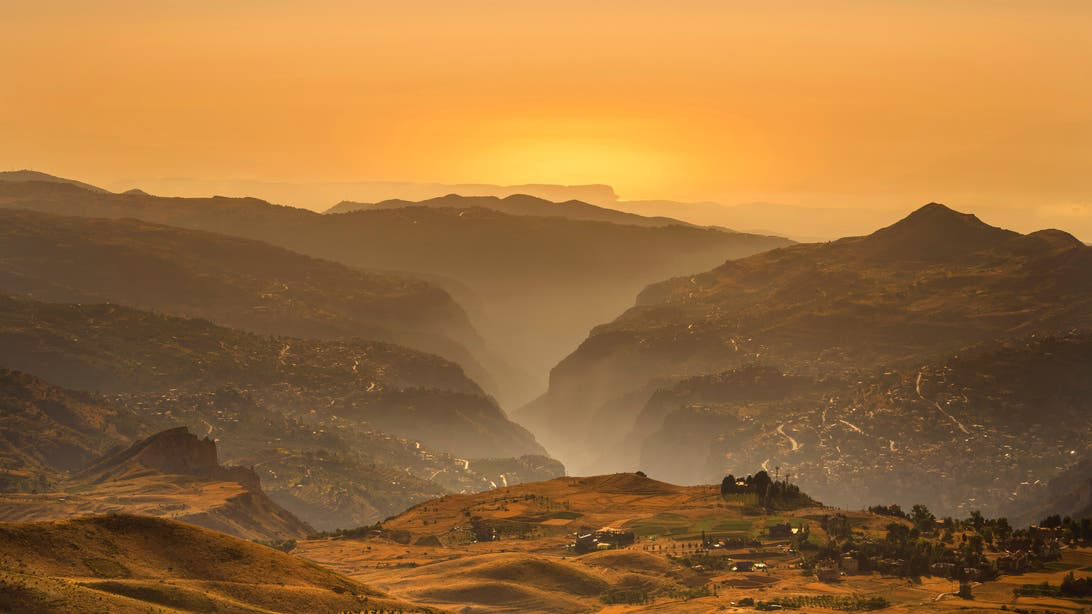
Advent is upon us, the end of the academic year approaches, and for our final reflection on mountains in the Hebrew Bible I want to take you to a special unnamed place.
There are many references to unnamed mountains in Scripture. For example, in Deuteronomy 12:2, Moses instructs Israel to “Destroy completely all the places where the nations that you are driving out worship their gods—on the high mountains, on the hills, and under every green tree.”
In Ezekiel 17:22f, the Lord God says to Israel:
I will take a sprig
from the lofty top of the cedar and plant it.
I will pluck a tender sprig
from its topmost shoots,
and I will plant it on a high towering mountain.
I will plant it on Israel’s high mountain
so that it may bear branches, produce fruit,
and become a majestic cedar.
Isaiah 30:25 associates a mountain with divine judgment. Then, in Isaiah 44:23, there is a quite different image:
Break out into singing, mountains,
forest, and every tree in it.
For the Lord has redeemed Jacob,
and glorifies himself through Israel.
But the best of all is Isaiah 40:1-4 (cf Luke 3:5). Listen to verses 1-2:
“Comfort, comfort my people,”
says your God.
2 “Speak tenderly to Jerusalem,
and announce to her
that her time of hard service is over,
her iniquity has been pardoned,
and she has received from the Lord’s hand
double for all her sins.”
It’s a message of good news in dark times. In chapter 39, exile in Babylon is imminent: in chapter 40, time has passed and we are looking back from a place of destruction and despair.
What happened to Jerusalem was the result of sin – both personal and national. Now, the survivors hear a voice of comfort in the midst of suffering and loss (vv. 1-2), and the welcome news of atonement for their sins (v. 2). Then, in verses 3-4, a new voice sounds, “a voice of one crying out:
Prepare the way of the Lord in the wilderness;
make a straight highway for our God in the desert.
4 Every valley will be lifted up,
and every mountain and hill will be levelled;
the uneven ground will become smooth
and the rough places, a plain.
This is the voice of a herald, or forerunner, bearing long-anticipated news. But this highway in the desert is not for refugees, pilgrims or settlers. The herald announces preparations for the imminent arrival of the King. Clear all obstacles! Make way! “Make a straight highway for our God in the desert!”
Why is this good news? Because ancient prophecies are being fulfilled, because God is their only hope, and because nothing can stop God’s arrival (cf Isa 52:7; 63:1). Isaiah 40:1-11 introduces all the major themes of chapters 40-66:
- Divine comfort in the midst of suffering and loss (v. 1)
- Provision of atonement for sin (v. 2)
- “the way of the Lord” (v. 3)
- The glory of the Lord (v. 5)
- The trustworthiness of God’s word (v. 8)
- The power and tenderness of Zion’s Saviour (vv. 10f)
As we reflect on Advent, on the coming of the universal King and Saviour, to Bethlehem, in that same power and tenderness, let us be clear: For us too, in the incarnation of our Lord Jesus Christ, ancient prophecies are being fulfilled, God is our only hope, and nothing can stop God’s arrival.
Hear this testimony of the same good news from the Gospel of John (1:1-4, 14, 23, 29):
In the beginning was the Word, and the Word was with God, and the Word was God. 2 He was with God in the beginning. 3 All things were created through him, and apart from him not one thing was created that has been created. 4 In him was life,[a] and that life was the light of men. 5 That light shines in the darkness, and yet the darkness did not overcome[b] it….
14 The Word became flesh and dwelt[h] among us. We observed his glory, the glory as the one and only Son[i] from the Father, full of grace and truth….
23 [John] said, “I am a voice of one crying out in the wilderness: Make straight the way of the Lord[l]—just as Isaiah the prophet said”….
29 The next day John saw Jesus coming toward him and said, “Look, the Lamb of God, who takes away the sin of the world!
Let us pray.
Lord Jesus, I pray that you will grace us with your presence in this season of Advent. Comfort us in our weakness, confusion and doubt. Challenge us to perceive your great salvation with fresh ears and eyes. Restore and revive us, so that we too may be heralds of the best of all possible news to friends and family this Christmas. We ask it for your greater glory, Amen.
Dr Rod Benson is Research Support Officer at Moore Theological College, Sydney. He previously pastored four Baptist churches in Queensland and NSW, and served for 12 years as an ethicist with the Tinsley Institute at Morling College.
Image source: Independent.
 iDigress