
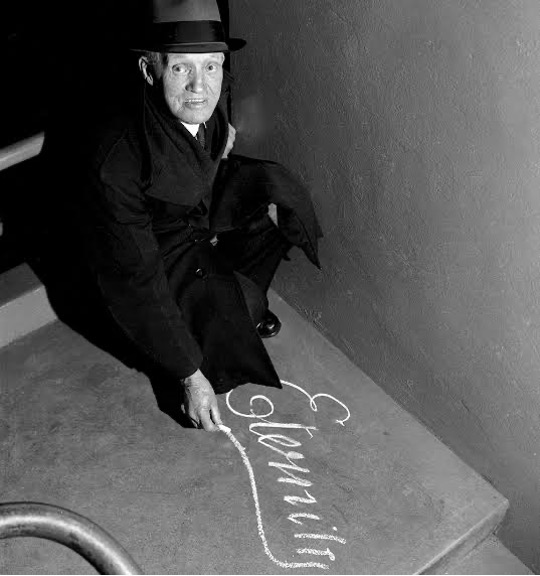
A diminutive figure crouches on the pavement in pre-dawn darkness, his right arm moving in rhythmic jerks. He stands, looks around, and moves on. Dressed in a black lounge suit and tie, with an overcoat over his left arm, his hat all but obscures a face like a character from a gritty Graham Greene novel.
The man is Arthur Malcolm Stace, known today to millions as “Mr Eternity.” Born at Redfern, Sydney, on 9 February 1885, he was the fifth child of William Stace, a labourer from Mauritius, and the Australian-born Laura Lewis. As a child, he lived in a Balmain slum, where alcoholism and violence were commonplace.
According to Stace, he was made a ward of the state at the age of 12, worked for two years in a NSW south coast coal mine, was imprisoned for public drunkenness, lost a succession of jobs, and turned to petty crime. His two sisters worked as sex workers and both brothers “died derelict drunkards.”[1]
On 18 March 1916, Stace enlisted with the Australian Imperial Force, serving as a private with the 19th Battalion in France, probably as a drummer and stretcher-bearer. Later in the war, he was posted to A.I.F. Headquarters in England.
Stace returned to Australia in February 1919 and was discharged medically unfit. He returned to his old ways. By his own admission, he was “always drunk, always broke, just one of a bunch of no-good derelicts.”[2]
Years passed and one day, possibly in early 1930, Stace heard a street preacher at Pyrmont whose rhetoric inspired him to stop drinking alcohol. The preacher’s identity is unknown, but Stace soon began helping out at a hostel for homeless men at Surry Hills administered by the Anglican Archdeacon R. B. S. Hammond (1870-1946). Stace may initially have been one of the homeless.
Established in the early 1900s, “Hammond’s Hostel” was part of Hammond’s mission to support men struggling with homelessness and unemployment. It offered affordable housing, meals and a sense of community. This social work later grew into HammondCare, a major Australian aged care and social services charity.
On 6 August 1930, Stace had returned to drinking methylated spirits and was desperate to find the power to overcome his addiction. As he related the story to a journalist in 1956, he entered the Regent Street police station and said to the sergeant on duty, “Put me away. I’m no good and I haven’t been sober for eight years. Give me a chance and put me away.” The sergeant ordered him to leave the station.
On the street outside, Stace met a group of men who were on their way to a men’s meeting at St Barnabas’ Church of England on Broadway in South Sydney. One of them said to Stace, “Come on, there’s a cuppa tea and something to eat at the church hall.”[3]And so he joined them.
The preacher that night was the rector, Archdeacon Hammond, and his sermon gave Stace “a glimpse of the possibility of deliverance from sin and shame.”[4] Stace prayed the sinner’s prayer: “God, be merciful to me a sinner” (cf Luke 18:13), and thereafter identified as an evangelical Christian.
Following his conversion experience, Stace began regular attendance at the Burton Street Baptist Tabernacle where he enjoyed the end-times evangelistic preaching of Rev. William Lamb (1868-1944), former pastor of the church, and other Baptist luminaries. One Sunday, Stace was present when the well-known military veteran, Rev. John G. Ridley (1896-1976) preached an evangelistic sermon drawing on the text of Isaiah 57:15 (KJV):
For thus saith the high and lofty One that inhabiteth eternity, whose name is Holy; I dwell in the high and holy place, with him also that is of a contrite and humble spirit, to revive the spirit of the humble, and to revive the heart of the contrite ones.
“Eternity! Eternity!,” cried Ridley from the pulpit. “Oh, that I could go out into the streets of this city of Sydney, and say to every person, ‘Eternity! Where will you spend Eternity?”[5]
Seated in the hard wooden pew, Arthur Stace’s eyes widened. An inspired idea dawned. If Ridley could not literally scour the streets of Sydney with the eternal evangel, he could. He had the time, the means, and the method. In pursuing his plan over the next 35 years, Stace unwittingly became “the most celebrated convert of interwar evangelism.”[6]
Click here to read Part 2.
Dr Rod Benson is Research Support Officer at Moore Theological College, Sydney. He previously pastored four Baptist churches in Queensland and NSW, and served for 12 years as an ethicist with the Tinsley Institute at Morling College.
[1] Chris Cunneen, “Arthur Malcolm Stace (1885-1967),” Australian Dictionary of Biography, 2006, available at https://adb.anu.edu.au/biography/stace-arthur-malcolm-8615
[2] John G. Ridley, “Eternity! Where?” undated pamphlet, Sydney, 3.
[3] Daily Telegraph, 29 July 2017.
[4] Ridley, “Eternity!”, 3
[5] Ibid., 2.
[6] Stuart Piggin & Robert D. Linder, Attending to the National Soul: Evangelical Christians in Australian History 1914-2014 (Clayton, Vic.: Monash University Publishing, 2020), 179.
 iDigress