
Arthur Stace was “born again,” as he would have described his experience, on 6 August 1930 at an evangelistic service at St Barnabas’ Church on Broadway, Sydney. He soon began attending the Burton Street Baptist Tabernacle where Rev. John G. Ridley (1896-1976) was a regular preacher.
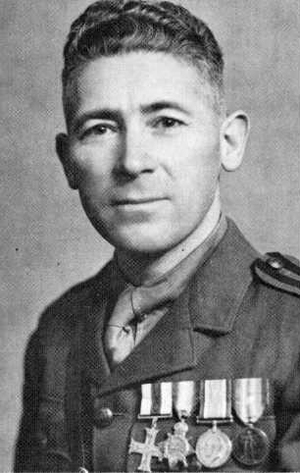
Ridley himself was converted, aged 19, at the Burton Street church prior to embarking with the A.I.F for war in October 1915. At the Battle of Fromelles, the first major battle fought by Australian troops on the Western Front, he barely survived a bullet to the throat. He was awarded a Military Cross for bravery under enemy fire at Bullecourt.
On return to Australia, “imbued with military zeal, unflagging loyalty, and a highly disciplined life,”[1] he trained for the Baptist ministry but, perhaps due to post-traumatic stress disorder, was obliged to engage in an itinerant ministry to isolated communities.
After marriage and the birth of a daughter, Ridley returned to Sydney where he became a popular speaker at conferences and conventions and in churches of various Protestant denominations. He wrote devotional literature and poetry and was a founder of the premillennialist magazine The Herald of Hope.
One Sunday evening at Burton Street in 1932, Ridley preached from Isaiah 57:15 on the greatness of God and the imperative of a positive response to the revelation of God’s mercy in Christ. The sermon inspired Stace to commence what would become his life’s work.
As he later explained, “[Ridley] repeated himself and kept on shouting, ‘Eternity! Eternity!’ and his words were ringing through my brain as I left the church. Suddenly I began crying and I felt a powerful call from the Lord to write ‘Eternity.’ I had a piece of chalk in my pocket and I bent down right there and wrote it. I have been writing it ever since, at least fifty times a day.”[2]
Rising from sleep before dawn, Stace wrote under cover of darkness while the streets were deserted. It is estimated that he wrote the word more than half a million times, reaching many thousands of people who may never have heard an evangelistic sermon or seriously considered the prospect of life after death. Though not permanent, his copperplate inscriptions remained legible for days, sometimes weeks.
As well as Sydney, Stace wrote on pavements in Wellington (central NSW), Cessnock, Newcastle and Melbourne. In a 1964 radio interview, he claimed that Council officers had sought to have him arrested 21 times for “defacing pavements.” On some of these travels, he also conducted church services. For example, in July 1952, Ridley and Stace travelled to Molong in the NSW Central West for ministry. After Ridley had departed, Stace addressed a Christian Endeavour rally at Molong and on the following day conducted the services at Wellington Baptist Church.[3]
His identity remained secret until 1956 when Rev. L. M. Thompson of the Burton Street church “discovered” the street artist at his work and persuaded him to tell his story to The Daily Telegraph, a popular Sydney newspaper.[4]
There is another possible explanation for the inspiration behind Stace’s pastime. In his history of Australian Baptists, the title of which pays homage to Stace’s graffiti, Ken Manley observes that American revivalist Ira D. Sankey popularised a song titled “Eternity.”[5] In his autobiography, Sankey explains that the song was inspired by Robert Annan of Dundee who wrote the word in chalk just before losing his life saving a drowning child. Manley suggests that Ridley may have repeated the story in his sermon.[6]
Although single for much of his life, Stace married Ellen Esther ‘Pearl’ Dawson at St Barnabas’ Church on 22 January 1942. The official record gives his occupation as “missioner.” The couple had no children, and Pearl died, aged 66, in 1961. Stace passed away on 30 July 1967, aged 83. They share a burial plot at the Eastern Suburbs Memorial Park, Sydney. On the gravestone are the words, “Rewarded and rejoicing in the presence of their Lord,” and at the foot of the grave is that one word, “Eternity,” in Stace’s distinctive copperplate script.
Click here to read Part 1.
Dr Rod Benson is Research Support Officer at Moore Theological College, Sydney. He previously pastored four Baptist churches in Queensland and NSW, and served for 12 years as an ethicist with the Tinsley Institute at Morling College.
References
[1] Quoted in Hubert Watkin-Smith, “Ridley, John Gotch,” in Brian Dickey (ed.), The Australian Dictionary of Evangelical Biography (Sydney: Evangelical History Association, 1994), 322.
[2] H. E. Evans, Soldier and Evangelist: The Story of Rev. John G. Ridley, M.C. (Eastwood, NSW: Baptist Historical Society of NSW, 1980), 64.
[3] Wellington Times, 24 July 1952, 2.
[4] Daily Telegraph, 1 August 1967, cited in Evans, op. cit., 64.
[5] Ira D. Sankey, Sacred Songs and Solos (London: Marshall, Morgan & Scott, 1908), no. 1043.
[6] Ken R. Manley, From Woolloomooloo to ‘Eternity’: A History of Australian Baptists. Volume 1: Growing an Australian Church (1831-1914) (Milton Keynes, UK: Paternoster, 2006), 5.
 iDigress