
Psalm 12:1-8
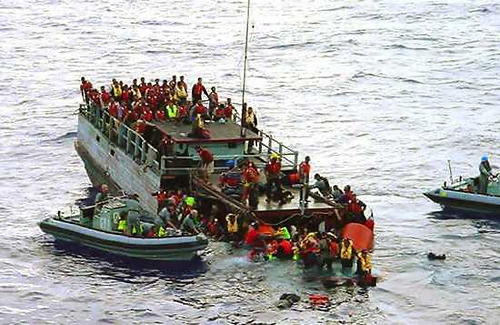
I have had the privilege of sitting with asylum seekers at Villawood Immigration Detention Centre in Sydney, and at the Curtin Immigration Detention Centre in remote north-western Australia, as the asylum seekers shared their stories of oppression, fear, hope, despair and perseverance against the odds, and dreams of a better life.
Several of those I spoke to later tragically ended their lives. Hundreds more have drowned during their attempt to escape their homeland and find a place of freedom and peace.
The people I met, mostly well-educated professionals, were denied basic human rights at home and by the Australian government. For those who were sent to offshore detention at Christmas Island, Manus Island, and Nauru, the situation was far worse. Today, there are still more than 100 asylum seekers detained on Nauru.[1]
In January, the United Nations Human Rights Committee found that Australia had violated human rights treaties by arbitrarily detaining asylum seekers in harsh and inhumane conditions, and by denying detainees the right to challenge detention in court.
But injustice and human rights abuse is a global problem. On February 27 this year, for example, after detaining 40 Uyghur men for more than a decade, the government of Thailand deported the men to China where they face persecution for their religious beliefs – a violation of their human rights.
In the U.S., several states have enacted legislation imposing restrictions on people who identify as LGBTQ+, limiting access to healthcare, accommodation and ID documents, a denial of their rights.
And in February, the Minns government in NSW enacted a bill to criminalise protests “near” places of worship and expanded police powers to disrupt protests irrespective of the focus or target – a denial of the right to peaceful assembly and a development likely to have unfortunate unintended consequences.
All of this pales into relative insignificance, however, when we consider the experience of people who woke up this morning in Gaza, Syria, Ukraine, Burkina Faso, Ethiopia, Yemen, and Myanmar, where foreign aggression or civil war is a daily reality, where people are starving, and where the rule of law no longer applies.
People in these regions face social dislocation, humanitarian disaster, and existential threat leading to fear, rage, and despair, and potentially depression, and a sense of utter hopelessness.
All who suffer abuse at such scale may well share the cry of the psalmist in Psalm 12:1, “Help, Lord, for no faithful one remains; the loyal have disappeared from the human race.” The “faithful” are those who reflect the faithfulness of God in their words and actions. They seem to have disappeared, leaving a lone “voice in the wilderness,” a voice of reason, a voice of faith, but also the voice of one who feels completely forsaken.
Sadly, this is far from rare in biblical history: Micah 7:2 says, “Faithful people have vanished from the land; there is no one upright among the people.”
Isaiah 57:1 is darker still: “The righteous person perishes, and no one takes it to heart; the faithful are taken away, with no one realizing that the righteous person is taken away because of evil.”
And 1 Kings 19:10, where the prophet Elijah cries out in anguish to God: “I have been very zealous for the Lord God of Armies, but the Israelites have abandoned your covenant, torn down your altars, and killed your prophets with the sword. I alone am left, and they are looking for me to take my life.”
In Psalm 12, the problem is malevolent communication that delivers power to the corrupt and drives away good people. Verse 2 speaks of empty talk, smooth talk and double talk. Verse 3 describes big talk without foundation, and verse 4 refers to irresponsible or proud talk. The psalmist recognises what is wrong with the world, and longs for things to be different.
Jewish theologian Martin Buber suggests that the origin of all conflict between humans is the result of
conflict between three principles in man’s being and life, the principle of thought, the principle of speech, and the principle of action. The origin of all conflict between me and my fellow man is that I do not say what I mean, and that I do not do what I say. For this confuses and poisons, again and again.[2]
In the world of Psalm 12, too, evil appears endemic; it feels relentless, pervasive, debilitating, overwhelming. The noise of the lies, flattery, deception, boasting, and arrogance swirling around this one righteous person reaches a peak, and triggers something we have not yet encountered in the Book of Psalms:
God himself speaks – with unmistakable clarity, empathy, and justice: “Because of the devastation of the needy and the groaning of the poor, I will now rise up … I will provide safety for the one who longs for it” (v. 5).
This God of Israel, whose perfect character has shaped the psalmist’s moral life, and provided a secure foundation for perseverance thus far, now speaks words of comfort and assurance to the one who suffers. And the one who is suffering from the malevolent behaviour of others hears these gracious words, and recognises their source.
“The words of the Lord,” he testifies in verse 6, “are pure words, like silver refined in an earthen furnace, purified seven times.” The words of God are precisely the opposite of the malevolent speech that has led to the present distress. The words of God are pure, clean, clear, good, trustworthy, just, compassionate, merciful. The words of God are God’s answer to the psalmist’s cry for help in verse 1.
Psalm 12 is a reminder that sincere faith in a great God, the God revealed in Scripture, is a sure comfort when everything goes wrong, or when everything is taken away, and evil appears to have won. Practical trust in God gives birth to prayer, and prayer brings clarity and hope that reorients our situation and gives us the courage to take one more step forward, knowing that we are not alone.
Take a look at verse 7: “You, Lord, will guard us; you will protect us from this generation forever.” God comes to the rescue, not necessarily taking away the problem, but guarding and protecting.
At the same time, I’m sure it was no accident that the person we meet in this psalm is a person of faith. They have a personal awareness of the Living God. They are aware of God’s presence in the world, and seem accustomed to asking God for help, believing that God does answer prayer. They have an awareness of the objective nature of morality, and the consequences of wrongdoing in both personal and social dimensions.
And they have invested time and effort in cultivating virtue. They live in a corrupt society, but they have not fallen into the habit of expressing empty talk, smooth talk, double talk, big talk, or proud talk.
That moral distinctiveness may have come at considerable cost, but it was worth it. Among other training in virtues, they practiced what Paul commended centuries later in his Letter to the Philippian Church:
Finally, brothers and sisters, whatever is true, whatever is honourable, whatever is just, whatever is pure, whatever is lovely, whatever is commendable—if there is any moral excellence and if there is anything praiseworthy—dwell on these things (Php 4:8).
The last verse in Psalm 12 comes as a bit of a surprise. What is the point of virtue, faith, and prayer if the bad people keep on winning, and “what is worthless is exalted by the human race” (v. 8)?
As Christian readers of Psalm 12, we know that evil does not always win, year in, year out, until the end of time. In Christ, God has definitively dealt with sin and evil, as we will vividly remember when we break bread in the Lord’s Supper, and as we recall most vividly at Easter.
We may live in a city where the faithful are routinely run out of town, in a world scarred by the absence of peace and tranquillity, the absence of godly morality in high places, the absence of respect for human rights. But it takes just one person of faith, one person of prayer, one person who stands up for what is right, to make a difference.
And that person could be you, it could be me.
“The wicked prowl around, and what is worthless is exalted by the human race,” but the Lord “will provide safety for the one who longs for it,” and “will guard us … and protect us from this generation forever” (vv. 8, 5, 6).
Sermon 801 copyright © 2025 Rod Benson. Preached at North Rocks Community Church, Sydney, Australia, on Sunday 6 April 2025. Unless otherwise noted, Scripture quotations are from The Christian Standard Bible (Nashville: Holman Bible Publishers, 2020).
References
[1] See https://www.amnesty.org.au/nauru-detention-centre-must-be-urgently-evacuated-in-light-of-un-ruling/, dated 10 Jan 2025, accessed 5 Apr 2025.
[2] Martin Buber, The Way of Man According to the Teaching of Hasidim (Secaucus, NJ: Citadel, 1966), 29, quoted in Gerald H. Wilson, The Psalms (Grand Rapids: Zondervan, 2002), 1:268.
Image source: Sydney Morning Herald
 iDigress