
The fool says in his heart, ‘There’s no God.’” (Psalm 14:1; cf Ps 53:1).
Psalm 14 opens with these famous words. No one likes to be called a fool. But these words, as I read them, are neither an attack on a specific person nor a rebuttal of a rational argument against theism. The psalmist is expressing his view of the world, his perception of reality.
For the psalmist, there are two kinds of people: the wise and the unwise. We are introduced to both in Psalm 1. The unwise person (let’s call him Phil) lives by the conviction, “God has no effective place in my life.”
It’s not necessarily a public statement but “in his heart.” It’s an inner conviction. In ancient Hebrew anthropology, the “heart” was the centre of one’s moral and ethical decision-making.
Phil has dethroned God, perhaps through a gradual process of almost passive change, or in a sudden decision arising from an existential crisis, or in response to peer pressure. Phil looks out at the world, and looks within, and discovers the power of personal autonomy. He is free, sovereign, master of his own destiny.
Phil has become his own god. It feels good. It feels right. It feels true.
But the second part of verse 1 suggests a problem with this way of understanding reality and Phil’s place in it: according to the psalmist’s worldview, Phil is inherently “corrupt”; what he does with his life is “vile”; “there is no one who does good.”
And there’s a second problem: Phil’s dismissal of the idea of a supreme being has no impact on the objective reality of this supreme being, or on the objective nature of good and evil, or on Phil’s duty to do what is right and good and true.
The God in whom Phil no longer believes still “Looks down from heaven on the human race” (v. 2; cf Gen 6:5-7, 11-13; 11:5-7), and on Phil. He may not be aware of God’s presence, but God remains vigilant and aware of what is happening in Phil’s world, and in his mind and heart. And Phil has become what Scripture calls a “fool.”
There are many reasons today why people share Phil’s conviction about God. Here are nine:
- Science: The claim that science provides better explanations for life and the universe than religion.
- Evidence: The claim that there is no direct, testable evidence for God.
- Philosophical naturalism: The claim that everything can be explained by natural causes, so there is no need for God.
- The problem of evil: The claim that a good and powerful God wouldn’t allow suffering.
- Inconsistencies: The claim that religious texts and beliefs are full of inconsistencies.
- Disillusionment: The claim that religious institutions are corrupt or hypocritical.
- Moral autonomy: The claim that people can be moral without religion.
- Secularism: The claim that, in increasingly secular societies, critical thinking and postmodern approaches to truth make religion irrelevant.
- Identity: The claim that religion restricts personal freedom and identity.
There are good Christian responses to all of these claims. I have summarised these in a handout available at the door as you leave. My point here is to show that it is far from rare for people to exchange theism for atheism. There are many reasons why people say, in their heart, “There’s no God.”
There are many more who do believe in God, or they want to, but they ask, “Why is God not visible? Why does God not show himself clearly in an indisputable way? Surely that would settle it.” One answer to these questions is that if God did so there would be no need for faith. But that raises other questions: Who wants faith? Would it not be so much better to plainly see God?
I am convinced that there is a God, and that God has revealed himself to us clearly in the Library of Scripture, and definitively in Jesus. But one of the problems about belief in God, beyond the nine points I just mentioned, is that such belief involves something completely outside our experience, beyond our imagination, beyond our thoughts and beyond the limits of human language – which is natural when we are dealing with the greatest of all possible beings, one whose essence does not reside in this universe.
We struggle to speak of God in human language. We struggle to explain what it is like to know the Living God in human experience. We struggle to relate our small lives, our brief days, to the notion of God as depicted in Scripture. We struggle to accept that God is personal, and good, and love. The struggle is real.
Let me share two analogies that I have found helpful.[1] First, if you were to go outside and stare directly into the midday sun, unshielded by hand or tree or cloud, the overwhelming excess of brilliant white light would render you as blind as if you were plunged into absolute darkness.
You look around, and all you see is the sun’s after-image seemingly seared on the rods and cones in your retina. What has happened is that the intense light has overstimulated the photoreceptors in your eyes. It is like that in seeing God:
generally, the deeper we journey into intimacy with God, the deeper we are journeying into the Light, the more God seems to disappear and become harder and harder to picture or imagine. We’re being blinded, not by God’s absence, but by the blinding light of his presence. The darkness of faith is the darkness of excessive light.
Second, think of a baby in its mother’s womb. It is
so totally enveloped and surrounded by the mother that, paradoxically, it cannot see the mother and cannot have any concept of the mother … The baby has to be born to see its mother … The Scriptures tell us that we live, and move, and have our being in God. We are in God’s womb, enveloped by God, and, like a baby, we must first be born (death as our second birth) to see God face-to-face. That is faith’s darkness.
At their best, our minds can only produce a shadowy idea of the ineffable God, a mental concept far removed from the full reality. But because God is not only invisible and eternal, but wise and merciful and loving, we can know God because he chooses to reveal himself in the person of Jesus of Nazareth.
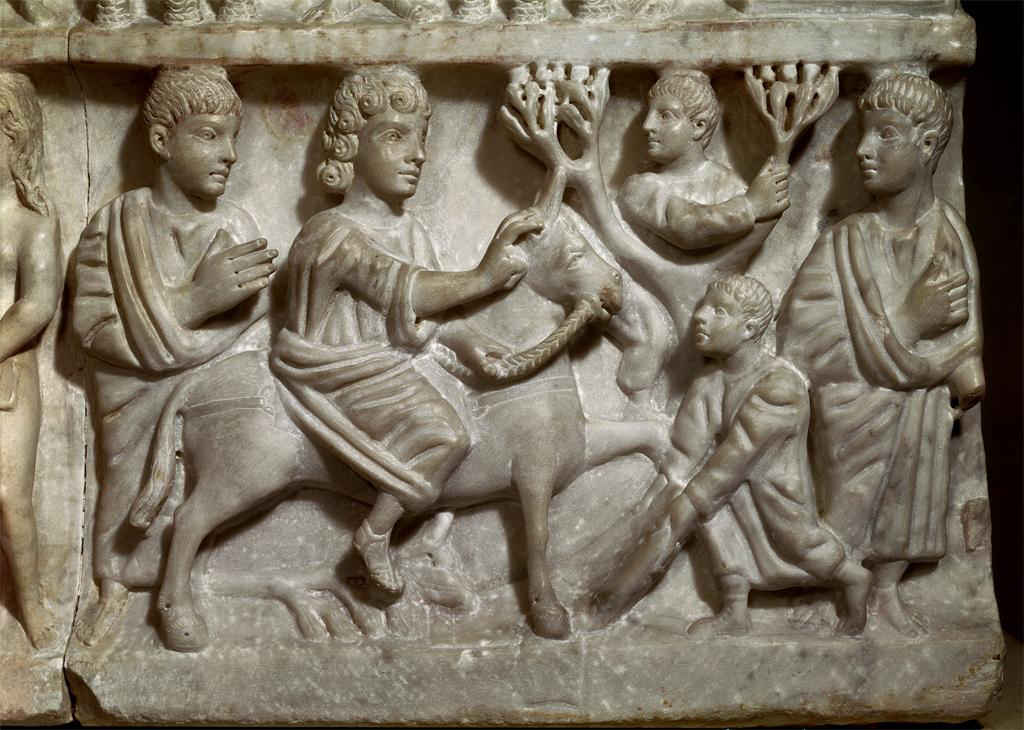
It is this Jesus whom we first glimpse as a newborn baby in Bethlehem, as a young man astonishing his elders at the Nazareth synagogue, as a teacher, healer, and breaker of social norms of first-century Israel, as a turner-upside down of religious rules, and as a prince of peace riding into Jerusalem on a donkey and subverting both the political establishment and the messianic expectations of the zealots among his apprentices.
The incarnation of Jesus, the Son of God, has bridged a gulf that reason alone could not. As the writer of the Letter to the Hebrews put it:” Long ago God spoke to our ancestors by the prophets at different times and in different ways. In these last days, he has spoken to us by his Son” (Heb 1:1-2a).
With the wondering crowd on the first Palm Sunday, as Jesus entered Jerusalem, we cry, “Hosanna! Save us!” (Mt 21:9).
With the humble man in Mark 9:24 we pray, “I do believe; help me overcome my unbelief.”
And with Paul the Apostle we exclaim, “Thanks be to God for his inexpressible gift” (2 Cor 9:15).
Sermon 802 copyright © 2025 Rod Benson. Preached at North Rocks Community Church, Sydney, Australia, on Sunday 13 April 2025. Unless otherwise noted, Scripture quotations are from The Christian Standard Bible (Nashville: Holman Bible Publishers, 2020).
Reference
[1] Ronald Rolheiser, Wrestling with God: Finding Hope and Meaning in Our Daily Struggles to be Human (New York: Image, 2018), 101.
Image source: https://www.italianartsociety.org
 iDigress