
We all heard the sad news on Monday of the passing of Pope Francis, a fine pope, in my opinion one of the best, showing by example how to follow Jesus with courage, fidelity, simplicity, and sacrificial love.
Two months after his election to the papacy in 2013, Francis warned of the danger of “[shutting] ourselves up in the parish, with our friends, within the movement, with the like-minded … A Church closed in on herself is … a sick Church. The Church must step outside herself.”
Recalling the image of Jesus in Revelation 3:20 bearing a lamp, knocking on a door, waiting for it to open – usually understood as the door to our hearts – Francis asks, “How often is Jesus inside and knocking at the door to be let out? And we do not let him out because of our own need for security.”[1]
He reinterprets the biblical metaphor, giving it new significance to serve the missional needs of God’s people today.
In Luke 24:13-35, Jesus does the same for two of his apprentices, not with a single verse but with the entire Hebrew Bible. The story occurs only in Luke’s Gospel, but has profound significance for biblical interpretation and salvation history. Four of the five events recounted in Luke 24 are not found in the other Synoptic Gospels. All four occur in the course of one long day. And not just any day, but the day on which Jesus rose from the dead.
There are two scenes at the empty tomb (24:1-11; 12), then the story of the two men on the road to Emmaus and their encounter with the risen Jesus (vv. 13-32), then “that very hour” they return to Jerusalem where Jesus makes another appearance (vv. 33-49), and Luke ends his Gospel with an account of Jesus, forty days later, being “carried up into heaven” (vv. 50-53; cf Acts 1:3).
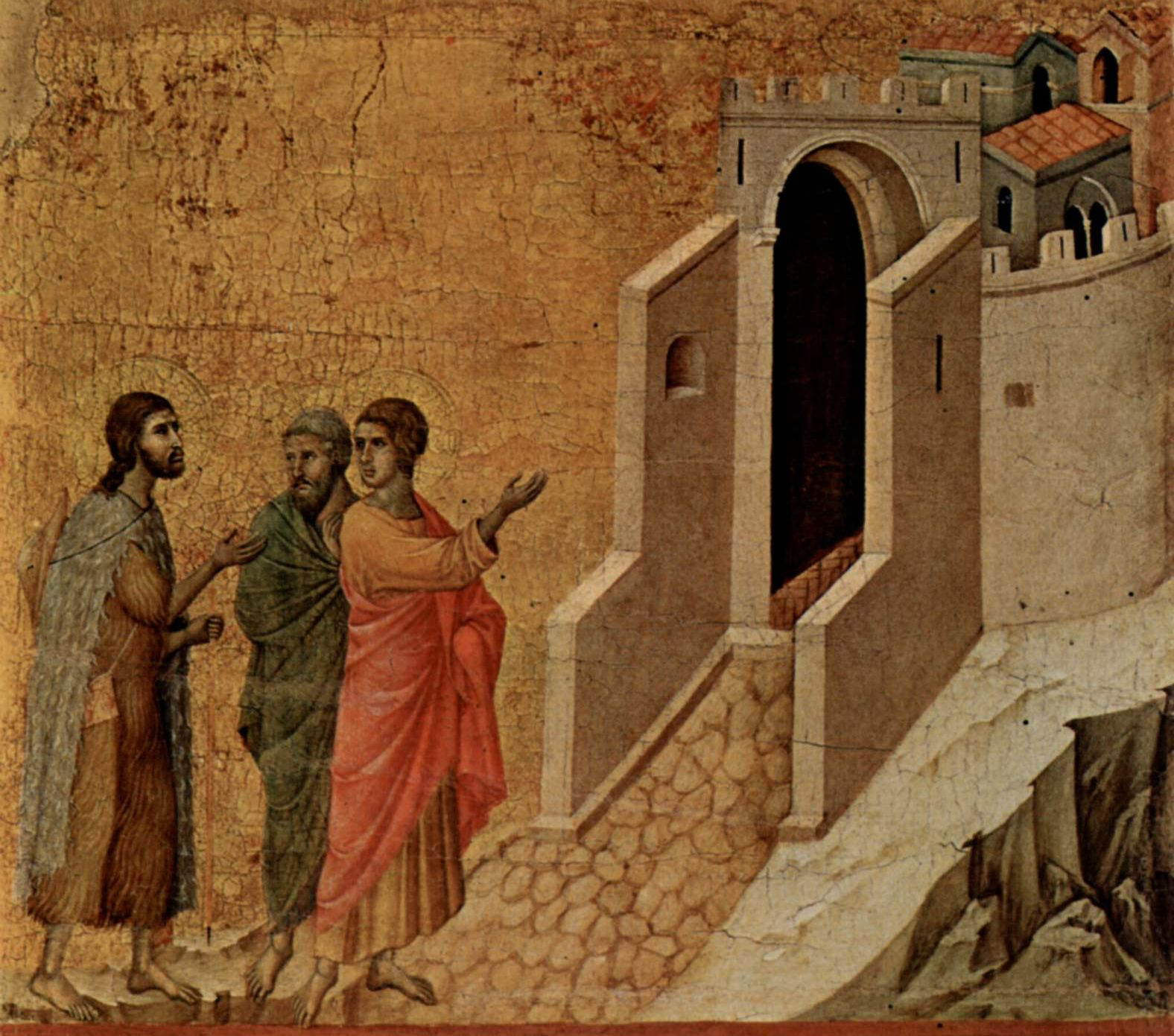
I want us to focus today on the story of the journey to the village of Emmaus, about 11 kilometres west of Jerusalem (vv. 13-32).
Two figures on the road: one is Cleopas; the other is unidentified. They are part of a wider group of apprentices of Jesus who had been in Jerusalem (v. 24). They look defeated. Their hearts are discouraged, their hopes dashed, their minds closed to the possibility of good news arising out of the horror and disappointment of the crucifixion and death of their master. Luke says they were arguing. They are unsettled, uncertain, insecure.
Then something extraordinary happens: “While they were discussing and arguing, Jesus himself came near and began to walk along with them. But they were prevented from recognising him” (vv. 15f).
Jesus asks what they are talking about. Cleopas explains that they were discussing “the things concerning Jesus of Nazareth,” whom they regarded as a mighty prophet, but who was sentenced to death and crucified (vv. 19f).
“But we were hoping that he was the one who was about to redeem Israel,” he says (v. 21a). And they mention news of an empty tomb and a vision of angels (vv. 22-24), but seem to dismiss this as “fake news.”
Jesus replies, correcting their “foolish” thinking, and assuring them that everything has happened according to plan. He says it was “necessary for the Messiah to suffer these things and to enter into his glory” (v. 26), and for the rest of the journey to Emmaus Jesus explains to them “the things concerning himself in all the Scriptures” (v. 27).
It all begins to make sense. The events of the past few days, and their understanding of the teaching and healing ministry of the rabbi Jesus are illuminated. The pieces of the puzzle begin to fall into place. But they are hungry for more.
Their destination approaches, and to their dismay this still unidentified rabbi indicates that his destination lies further afield. So they invite him to stay for a meal. So much in the Gospels happens on the way to a meal, during a meal, or just after a meal!
And then comes the second surprise of the evening. Verse 30 tells us, “It was as he reclined at the table with them that he took the bread, blessed and broke it, and gave it to them. Then their eyes were opened, and they recognized him, but he disappeared from their sight.”
What an experience! What an encounter! What a teaching! What a meal! What a guest!
Was it that Jesus folded back the kippah or tallit from his head? Was it the light from the homely candles after coming inside at dusk? Was it the marks of the nails in his hands that identified him? Was it the familiar way he addressed his Father in heaven as he blessed the meal, “Abba, thank you”? Or was it simply the way he became the host, taking the bread, blessing it, breaking it open, and giving it to the astonished guests?
These four actions – take, bless, break, give – are all explicitly mentioned in the descriptions of the Last Supper, and also in the story of the feeding of the five thousand and the four thousand.
Imagine their delight as they greet him! Imagine their joy at seeing rather than hearing confirmation of his resurrection! Imagine their awe as he continues the conversation from the road, and answers their questions, and encourages them. And then he is gone.
And they turn to each other, their faces glowing, and say, “Weren’t our hearts burning within us while he was talking with us on the road and explaining the Scriptures to us?” (v. 32). And they leave the table and rush back along the road to Jerusalem to tell the others what they had seen and heard. (vv. 33-35).
It’s easy to miss it, but in verse 27, and again in verses 44-45, Jesus models a distinctive way to read the Hebrew Bible. His teaching places him at the centre of salvation history. Everything leads up to him, depends upon him, and finds fulfilment in him.
John the Baptist got it. Apprentice Peter got it. No other Hebrew prophet applied the Scriptures to himself as Jesus does. Texts that may have appeared ceremonial, moral or historical take on new meaning in light of the incarnation, teaching, atonement, and resurrection of Jesus. The kingdom of God has arrived.
For the two from Emmaus, and for us, the truthfulness and reliability of the Hebrew Scriptures are just as sure as the resurrection of Jesus. The presence of Jesus, dead and buried, and now restored to new life, implicitly confirmed the truthfulness of his teaching, and that teaching explicitly linked the gospel events to the prophecies of the Hebrew Bible. As biblical scholar Craig Keener observes,
Jesus applied Scripture to his day in ways that often violated conventional religious understanding … Jesus’s concern was especially with the point behind the Law … Most distinctive, of course, is Jesus’s understanding of his own identity in light of Scripture.[2]
The very first verse of Luke’s Gospel refers to “the events that have been fulfilled among us.” The New Testament writings frequently refer to the Hebrew Scriptures being “fulfilled” – brought to completion – in new ways. Matthew especially observes this, repeating the phrase, “that the Scriptures might be fulfilled” (see Mt 2:17, 23; 4:14; 13:14; 26:54; 27:9).
Luke also emphasises that the apprentices of Jesus, post-resurrection, remain loyal, pious Jews. They are followers of the Way, but the Way has its origins in the testimony of the holy Scriptures of the Jewish faith, and draws so much of its distinctive teaching from those Scriptures, interpreted in light of the arrival of Jesus, whom the first Christians were certain was the promised Messiah (see Lk 23:56b; 24:53).
And we too are followers of the Way.
I want to conclude with a final thought from this remarkable story. Cleopas was not alone on the road to Emmaus. He walked with a friend. Jesus was alone, but he chose to join them on the road. They invited him home for a meal, where others were probably already assembled for dinner. Later that night, in a change of plans, the two returned to the other disciples of Jesus in Jerusalem.
Later still, Luke ends his Gospel with an image of the followers of Jesus returning from the Mount of Olives after the ascension of Jesus into heaven, filled with “great joy, and they were continually in the temple praising God” (24:52f).
As Eugene Peterson puts it:
there are no solitary Christians in the world of salvation. There are no do-it-yourself Christians. There are no self-help Christians. There are no Lone Ranger Christians. The moment the adjective intrudes it cancels the noun. Salvation is not a private deal with God … Any understanding of salvation that separates us from others is false and sooner or later cripples our participation in what God in Christ is doing in history, saving the world.[3]
Sermon 806 copyright © 2025 Rod Benson. Preached at North Rocks Community Church, Sydney, Australia, on Sunday 27 April 2025. Unless otherwise noted, Scripture quotations are from The Christian Standard Bible (Nashville: Holman Bible Publishers, 2020).
References
[1] Address of the Holy Father Francis, Saint Peter’s Square, Rome, 18 May 2013. Available here.
[2] Craig S, Keener, Spirit Hermeneutics: Reading Scripture in Light of Pentecost (Grand Rapids: Eerdmans, 2016), 218.
[3] Eugene H. Peterson, Christ Plays in Ten Thousand Places: A Conversation in Spiritual Theology (Grand Rapids: Eerdmans, 2005), 211.
Image source: Duccio, Jesus and the two disciples On the Road to Emmaus, 1308–1311, Museo dell’Opera del Duomo, Siena.
 iDigress