
Last week, I suggested that, in his inaugural sermon at the Nazareth synagogue (Lk 4:16-21), and in the Beatitudes which must have been taught very soon after, Jesus echoed the words of Isaiah 61:1-7. I said that Jesus came to change the world, to turn the world upside down, to right wrongs, to pour out compassion, to normalise mercy and establish justice, to fill the universe with love.
That’s an impressive mission statement. Over the next eight weeks, we will reflect together on each of the Beatitudes, how they relate to the person and mission of Jesus, and how they apply to our lives.
At least since the time of John Chrysostom (c.347-407), the Beatitudes have been seen not as random statements but as “a golden chain.”[1] It’s a golden chain in two parts: the first four Beatitudes illustrate our relation to God, and the second four address our relation to others and our social duties.[2]
The first four announce blessing upon people “whose situations are destitute and cause for despair,” while the second set of four “announce blessing upon those who act [in solidarity with the destitute and desperate] with mercy, integrity, peace and justice.”[3]
The phrase “poor in spirit” occurs only here in the New Testament, but behind all of the Beatitudes is a rich theological tradition. For example, the first four Beatitudes echo Isaiah 61:1, 2, 7, 3; and the last Beatitude echoes Isaiah 61:11 – the prophetic passage that Jesus selected as the basis for his first sermon at the synagogue in Nazareth (see also Ps 34:18; 71:4, 12f; and Lk 1:52).
Practicing these virtues is a way of participating in God’s gracious deliverance, of joining Jesus in his mission to bring God’s longed-for kingdom of justice and peace into the here and now, into our local communities and families, into our hearts.
In Luke’s version of the Beatitudes, the first reads, “Blessed are you who are poor, because the kingdom of God is yours” (Lk 6:20b).
So here’s the question: in his teaching, does Jesus have in mind the spiritually poor, the psychologically poor, or the economically poor? Does Luke reduce the promise to mere economics? Does Matthew reduce it to personal spirituality? Does one Evangelist (i.e., writer of the Gospel) seek to correct the meaning of the other?
There is a third option: perhaps it is both.
New Testament scholar Scot McKnight suggests that “the socioeconomic rootedness of the word ‘poor’ (ptōchos) [in Luke’s text] does not permit exclusively the spiritual poverty interpretation, and the ‘in spirit’ [in Matthew’s version] demands that this be more than simple economic oppression.”[4]
Similarly, New Testament scholar Frederick Dale Bruner warns us to avoid spiritualization on one side and secularisation on the other. Bruner concludes that, in his original speech to his apprentices that day on the mountain, “Jesus incorporated both Matthew’s spirituality and Luke’s sociality, getting the best of each. Just as we need two eyes to see in perspective, so with important sayings we need at least two witnesses to understand in perspective.”[5]
It is such a gift, in the providence of God, that we have not one but four versions of the life and teaching of Jesus in our Bibles.
Reformed and evangelical commentators tend to focus on the spiritual aspect of the First Beatitude. For example, the sixteenth-century Reformer John Calvin states, “He who is reduced to nothing in himself, and relies on the mercy of God, is poor in spirit.”[6]
Twentieth-century evangelical scholar and pastor John Stott takes a similar approach, arguing that “to be ‘poor in spirit’ is to acknowledge our spiritual poverty, indeed our spiritual bankruptcy, before God.”[7] Stott then quotes the third verse of the classic hymn, “Rock of Ages” by the Calvinist theologian Augustus Toplady (1776):
Nothing in my hand I bring,
simply to thy cross I cling;
naked, come to thee for dress;
helpless, look to thee for grace;
foul, I to the fountain fly;
wash me, Saviour, or I die.
Later pastor-theologians such as John Wesley and many others would have no problem singing this hymn with conviction.
On the other hand, Stott also observes that the First Beatitude contradicts “all nationalistic expectations of the kingdom of God.”[8]
To put that into the language of 2025, the promise of Jesus that the kingdom of God truly belongs to “the poor in spirit” rules out the validity of Christian nationalism, reconstructionism, and the political movement known as dominionism whose influence appears to reach into some churches and agencies such as the Australian Christian Lobby.
Stott reminds us that
the kingdom of God is given to the poor, not the rich; the feeble, not the mighty; to little children humble enough to accept it, not to soldiers [or, indeed, lawmakers] who boast that they can obtain it by their own prowess … the indispensable condition of receiving the kingdom of God is to acknowledge our spiritual poverty.[9]
While I take his point, it is clear that the phrase “the poor in spirit” has a long history of theological interpretation in the Hebrew Bible, especially in the Psalms, where it usually “refers to those who have confidence only in God, ground down as they are by longstanding social and political distress.”[10] Such people discover, to their astonishment, that God opens the door to God’s kingdom as a free gift! And grace delivers freedom, hope and joy!
You may not be feeling like a success today. You may not feel like a winner. You may not even feel virtuous, or empathetic, or Christlike. But if you are among those who, deep down, know that experience of being ground down by longstanding social and political distress, and you feel your poverty of spirit, and you listen to the voice of Jesus, and you recognise your place in God’s economy, then Jesus declares that the kingdom of God belongs to you.
There is more. Just as he did not hesitate to tell the Pharisees that they belonged to their father the devil (Jn 8:44), and did not hesitate to flip the tables in the temple in righteous anger at injustice (Mt 21:12f), Jesus today longs to turn our secular social value system on its head, aligning our values and institutions, our communities and nations, with the principles of justice and peace in God’s kingdom.
Let me quote Frederick Bruner again:
The purpose of every Command in the Sermon on the Mount is to drive its hearers back to the First Beatitude … Thus the Sermon on the Mount is actually the Sermon from the Valley. It starts low. It starts where most of us live if we are honest … The moment we begin to look back and down on those who have not come up as high or gone as far as we have in dedication, discipline, sensitivity, spirit, or intelligence … that very moment we have become rich in spirit and so fall out of the First Beatitude.[11]
In Luke’s version of the teaching of Jesus in the Sermon on the Mount, the verse immediately following his Beatitudes is this: “But woe to you who are rich, for you have received your comfort” (Lk 6:24).
How then can I know that I am among “the poor in spirit” rather than the rich or those who don’t care?
Looking within will not help, since my nature is bent toward self-preservation and self-justification. Seeking the opinions of others will be coloured by bias, flattery or ignorance. I need to forget about myself, look to Jesus, listen to him, and follow his counter-cultural Way. That’s not to discount the importance of self-reflection and self-care, but to place my trust in a power outside myself for purpose, wisdom and well-being.
In Mere Christianity, C.S. Lewis’s introduction to the Way of Jesus, Lewis writes:
Whenever we find that our religious life is making us feel that we are good – above all, that we are better than someone else – I think we may be sure that we are being acted on, not by God, but by the devil. The real test of being in the presence of God is that you either forget about yourself altogether or see yourself as a small, dirty object. It is better to forget about yourself altogether.[12]
I love the way Eugene Peterson renders Matthew 5:3 in The Message: “You’re blessed when you’re at the end of your rope. With less of you there is more of God and his rule.”[13]
Sermon 808 copyright © 2025 Rod Benson. Preached at North Rocks Community Church, Sydney, Australia, on Sunday 18 May 2025. Unless otherwise noted, Scripture quotations are from The Christian Standard Bible (Nashville: Holman Bible Publishers, 2020).
References
[1] John Chrysostom, Homilies on the Gospel of St Matthew. Part 1 (n.d.; trans. George Prevost; Oxford: Oxford University Press, 1843), 209.
[2] John R. W. Stott, The Message of the Sermon on the Mount (Leicester: IVP, 1988), 38.
[3] Jeanine K. Brown & Kyle Roberts, Matthew (Grand Rapids: Eerdmans, 2018), 57f.
[4] Scot McKnight, Sermon on the Mount (Grand Rapids: Zondervan, 2013), 39.
[5] Frederick Dale Bruner, Matthew: A Commentary. Volume 1: The Christbook: Matthew 1-12 (revised and expanded edition; Grand Rapids: Eerdmans, 2004), 159.
[6] John Calvin, Commentary on a Harmony of the Evangelists, Matthew, Mark and Luke, I (1558; trans. William Pringle, 1845; Grand Rapids: Eerdmans, n.d.), 261.
[7] Stott, Message of the Sermon on the Mount, 39.
[8] Ibid., 40.
[9] Ibid., 40.
[10] Michael Green, The Message of Matthew (Leicester: IVP, 1988), 90.
[11] Bruner, Matthew, 161f.
[12] C.S. Lewis, Mere Christianity (New York: Macmillan, 1958), 96f.
[13] Eugene H. Peterson, The Message: The Bible in Contemporary Language (n.p.: Navpress, 2002), 1248.
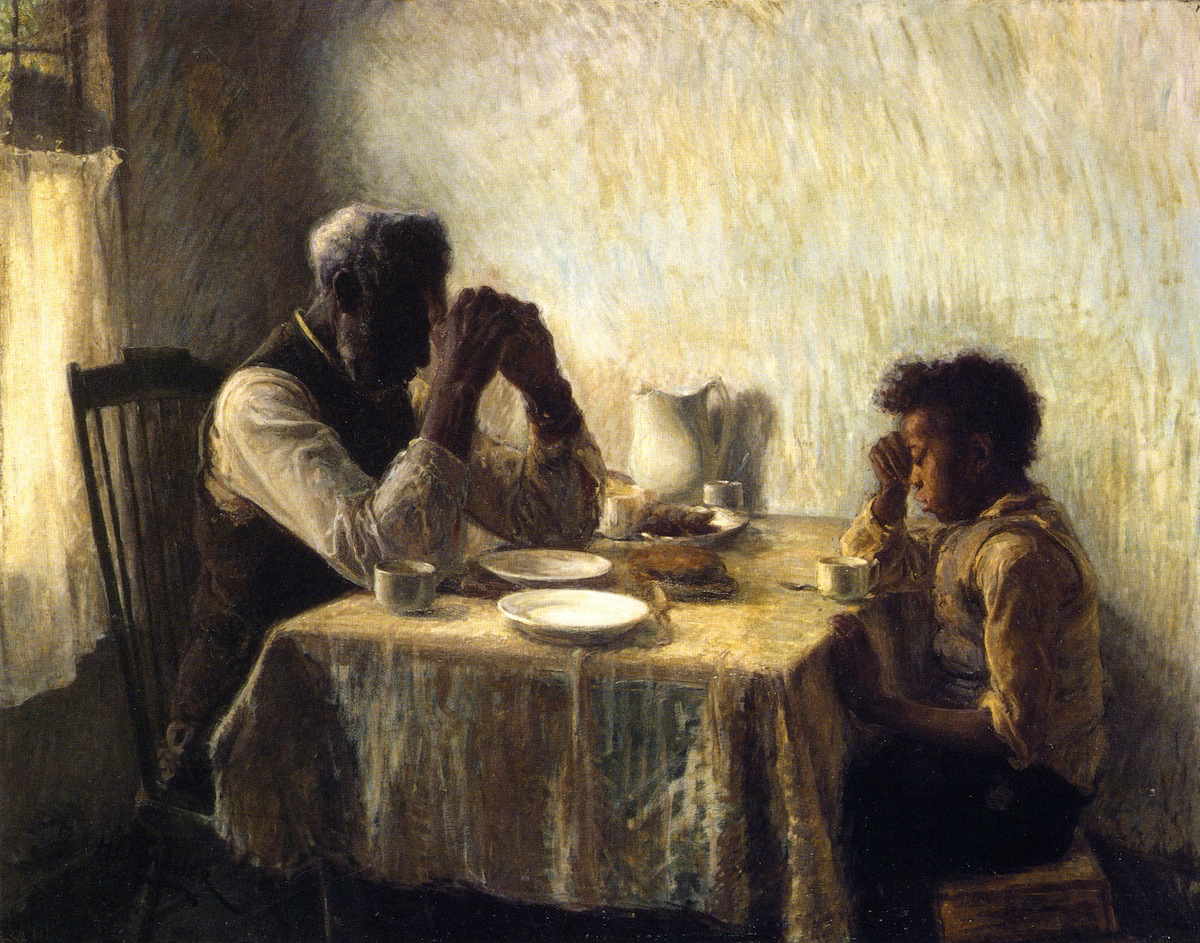
Image source: Henry Ossawa Tanner, “The Thankful Poor,” 1894. Public domain.
 iDigress