
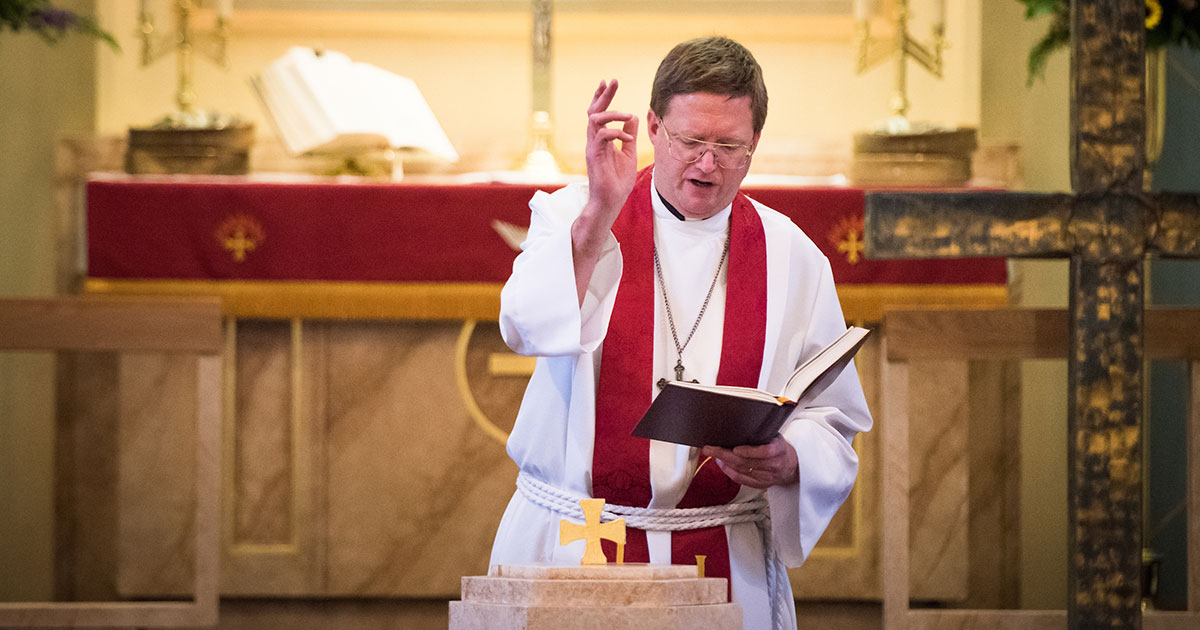
At the close of many services of worship, a leader stands and, often with one hand raised, palm facing the congregation, he or she speaks words of “benediction.” What’s in a benediction, and why are they important?
The Lord bless you and keep you;
the Lord make his face shine on you and be gracious to you;
the Lord turn his face toward you and give you peace.
In the New Testament, a benediction often appears near or at the end of a letter. The shortest is Hebrews 13:25, “Grace be with you all.” Almost as short is Romans 15:33, “The God of peace be with you all. Amen.”
Other New Testament benedictions include the following:
- “The grace of our Lord Jesus Christ be with you all” (2 Th 3:18).
- May the grace of the Lord Jesus Christ, and the love of God, and the fellowship of the Holy Spirit be with you all” (2 Cor 13:14).
- “May the God of hope fill you with all joy and peace as you trust in him, so that you may overflow with hope by the power of the Holy Spirit” (Rom 15:13).
- “May our Lord Jesus Christ himself and God our Father, who loved us and by his grace gave us eternal encouragement and good hope, encourage your hearts and strengthen you in every good deed and word” (2 Th 2:16-17).“May God himself, the God of peace, sanctify you through and through. May your whole spirit, soul and body be kept blameless at the coming of our Lord Jesus Christ. The one who calls you is faithful, and he will do it” (1 Th 5:23-24).
- “Now may the God of peace, who through the blood of the eternal covenant brought back from the dead our Lord Jesus, that great Shepherd of the sheep, equip you with everything good for doing his will, and may he work in us what is pleasing to him, through Jesus Christ, to whom be glory for ever and ever. Amen” (Heb 13:20-21).
It’s evident from these biblical examples that a benediction is a kind of blessing, with allusions to the rich theological heritage of the Christian church.
The Latin “bene” means “good” (as in the English word “benefit”), and “diction” means “pronouncement.” A benediction is a short invocation for divine blessing, help and guidance, usually given by a Christian leader to members of a congregation at the close of a service of worship.
Of course, where appropriate, we may also follow the literal example of the New Testament writers and append benedictions to our letters, emails, text messages and social media posts! But usually benedictions are reserved for closing a worship service, sending the people of God out into the world on their daily mission. In his book, Christ-Centered Worship, Bryan Chapell writes that
A benediction is not simply a Scripture verse with a nice sentiment or a summary of the Sermon’s message … A benediction is a blessing … it is often followed by a Charge (e.g. “Go in his peace,” or “Go now and serve God in this way with confidence that he goes with you to help you and to bless you”).[1] And it is customary for the members of the congregation to indicate their agreement with the benediction (and charge) by saying “Amen.”
A benediction is not about what we say or do for God, but what God will do on behalf of his people, his children, his spiritual family. A benediction “reminds us that it is God who has called us out of the world to worship him and [who] loves to extend more grace each time we gather in his name.”[2]
In one sense, a benediction marks the boundary between the formal worship service and what often immediately follows: a more informal time of greeting, fellowship, refreshment and parting. But a benediction also conveys the official endorsement of the church on all that has preceded in the service of worship; and it is not going too far to suggest that a benediction also conveys the blessing of our Lord Jesus Christ himself on his people for the work he now calls them to do.
On the other hand, benedictions are helpful but not essential. There is no indication in Scripture that corporate worship should or should not include a benediction.
Generally, the New Testament gives only very broad guidelines for how worship should be ordered in the life of a local church, and therefore very wide freedom (with responsibility, decency and reverence) for people to worship God according to the customs of their cultural and theological traditions. Other common ways to close a time of public worship, and convey or invoke divine blessing, include responsive readings of Scripture, choral benedictions, congregational hymns, and final prayers.
In addition to the standard biblical benedictions, thoughtful and sincere benedictions may also be crafted by Christians for use in worship, and in private devotional life, drawing on the theology and practice of the church. You will find many such benedictions in anthologies of prayers and other liturgical and devotional resources.
Now let me comment briefly on two New Testament benedictions which I have thus far omitted from mention: Philippians 4:23 and Jude 24-25. First, turn with me to Philippians 4. Paul began his letter to the Philippians with the invocation, “Grace and peace to you from God our Father and the Lord Jesus Christ” (Php 1:3). Now he ends the letter with the benediction, “The grace of our Lord Jesus Christ be with your spirit. Amen.” (4:23).
As Gordon Fee observes, Paul “book ends” his letters with an invocation of divine grace.[3] This is classic Paul. It was apparently common in Greek letters of his day to sign off, or say good-bye, with the greeting erroso (“be strong). Paul never does this; instead, he frequently invokes the grace and peace of God, and often qualifies such benedictions with the words “from our Lord Jesus Christ,” or similar.
Instead of seeking to be strong in our own human strength, using what skills and abilities and experience we can cobble together, Paul encourages us to look beyond ourselves to God, and to the grace and peace that only Jesus can provide.
Second, turn with me to the short letter of Jude, appearing just before Revelation, the last book in our Bibles. Look especially at vv. 24-25. Jude was one of the disciples of Jesus, later an apostle. We know very little about him, but we have this important though very brief letter, and he concludes the letter with this wonderful ascription of praise and confidence in Christ:
To him who is able to keep you from stumbling and to present you before his glorious presence without fault and with great joy— to the only God our Savior be glory, majesty, power and authority, through Jesus Christ our Lord, before all ages, now and forevermore! Amen.
It is a benediction, a doxology, and a prayer for God’s help. As Richard Bauckham observes in his commentary on Jude, “Having in the previous section stressed his readers’ responsibilities, Jude now assures them of the divine support and protection without which all their efforts will be fruitless.”[4]
Are you conscious of God’s faithful and bountiful support as you live from day to day? Are you aware of the reality of his personal protection from moment to moment? Jesus alone is the one who is able to keep you from “stumbling” – helping you avoid obstacles and other dangers that threaten to trip you up, and impede your progress, and prevent you from getting the job done. And Jesus alone is the one who will return to this world for you, and who will present you before the living God “without fault” and “with great joy.” Those are profoundly comforting and exciting words.
We will enjoy fellowship with God forever because Jesus has paid the penalty for our sins, and is therefore able to present us before his heavenly Father “without fault” – pure and holy. And he will do this with “great joy,” recalling everything that happened to enable us to reach that day, and revelling in the ultimate end of the work of salvation, planned so long ago, completed through the death and resurrection of Christ, consummated at his return.
The only appropriate response to this revelation, and this love, is worship. So we ascribe to God our Savior “glory, majesty, power and authority, through Jesus Christ our Lord, before all ages, now and forevermore! Amen!”
In conclusion, allow me to make three brief points. First, a benediction is a timely reminder that our confidence as Christians is in God alone, not in any institution, not in any particular human leader, and certainly not in our own abilities or resources or achievements.
This is why Paul and others constantly call us back to a full appreciation of the grace of God, mediated to us by Christ, in the power of the Holy Spirit. A benediction firmly and confidently focuses our hearts and minds on God who is at work in us, and in the church, and in the world.
Second, a benediction is a timely reminder of our responsibility to work to fulfil the great commission (Mt 28:18-20) in the light of the great commandment (Mt 22:37-40). Just as we gathered for worship together, so we are sent out individually, and as families, on mission for service in the world.
Third, a benediction is a timely reminder that our moments and our days are spent in community together, held in the loving and gracious embrace of God, and cared for by one another, by our pastoral leaders, and ultimately by the Chief Shepherd who loves us and gives himself for us.
I close with this quote from Bryan Chapell, and then we will sing the words of Jude 24-25 as a benediction:
In common practice, a Benediction may simply be the perfunctory close to a worship service, but with skilled attention a Benediction can be a powerful instrument of pastoral care. With a Benediction, a pastor [or service leader] can communicate the care of the Heavenly Father with such tenderness and power that the worshipers leave the service full of confidence and joy for their work in the world.[5]
A benediction, then, is a reminder of our reliance on and confidence in God; a call to arms, sending us forth with God’s grace into the world for mission; and a beautiful expression of pastoral care.
Sermon 691 copyright © 2016 Rod Benson. Preached at Lithgow Baptist Church, Australia, on Wednesday 7 September 2016. Unless otherwise noted, Scripture quotations are from The Holy Bible, New International Version (Grand Rapids: Zondervan, 2011).
[1] Bryan Chapell, Christ-Centred Worship: Letting the Gospel Shape our Practice (Grand Rapids, MI: Baker Academic, 2009), p. 254.
[2] R. Kent Hughes, The Pastor’s Book (Wheaton, IL: Crossway, 2015), p. 65.
[3] Gordon D. Fee, Paul’s Letter to the Philippians (Grand Rapids, MI: Wm B. Eerdmans, 1995), p. 461.
[4] Richard J. Bauckham, Jude, 2 Peter (Waco, TX: Word Books, 1983), p. 124.
[5] Chapell, op. cit., p. 254.
Image source: lcms.org
 iDigress