
Persecution for political or religious beliefs is never pleasant. I am grateful that we live in a time and place where human rights are respected and defended, and where persecution is unacceptable in law, and eschewed by the vast majority of our fellow Australians.
Sadly, that is not the case generally in our world today.
A recent report by the Christian agency Open Doors claimed that more than 380 million Christians faced persecution and discrimination in 2024, an increase of 15 million compared to the previous year. A shocking 3,100 Christians were killed because of their faith in 2024 in Nigeria alone.
“Far from being given equal protection as citizens, all too often Christians across the world are denied basic legal rights in societies hostile to their faith,” the report states.[1]
It’s important, however, to distinguish real persecution from actions and words that simply make us feel uncomfortable but are not actual persecution. There’s a world of difference, for example, between being beheaded because you refuse to renounce the strong conviction that Jesus is Lord and Caesar is not, and being asked to bake a cake for a “gay wedding.”
Over the past few weeks, we have seen how Jesus blessed “the poor in spirit,” “those who mourn,” those who are humble, those who “hunger and thirst for righteousness,” “the merciful,” “the pure in heart,” “the peacemakers,” and those who are “persecuted for the sake of righteousness” (Mt 5:5-10).
In verses 11-12, Jesus elaborates on the eighth Beatitude, giving examples of ways in which his apprentices will experience opposition. He concludes the introduction to his Sermon on the Mount by reminding them that, whatever happens, their “reward is great in heaven” (v. 12a). And he adds, almost as an afterthought, “For that is how they persecuted the prophets who were before you” (v. 12b).
What might Jesus have had in mind, from the Hebrew Bible he knew so well, as he said these words?
The Hebrew Bible relates many stories in which prophets – leaders of God’s people – are persecuted, rejected or killed for their faith. Prophets were keepers of godly morality, calling individuals, rulers, and the nation to accountability before God. Their messages were not always received with enthusiasm. They clashed with religious, political, and social norms as they confronted injustice, idolatry, and the corruption of the time.
We will look briefly today at seven: Moses, Nathan, Elijah, Isaiah, Jeremiah, Hosea and Amos. First up is Moses – considered a prophet and the lawgiver and leader of the Israelites during their liberation from Egyptian slavery. Despite his unparalleled role in Israel’s early history, Moses faced ongoing resistance and persecution from his own people and from Pharaoh, the supreme ruler of Egypt.
It began in infancy. Fearing the growing number of Hebrews in Egypt, Pharaoh issued a decree to kill all male Hebrew infants (Ex 1:22). To save his life, Moses’s mother hid him in a basket on the bank of the Nile River, where he was found and adopted by Pharaoh’s daughter.
As an adult, Moses turned his back on a life of privilege and crusaded against the unjust conditions imposed on his immigrant people. Moses’s direct challenge to Pharaoh’s authority was met with hostility. Pharaoh rejected Moses’s pleas and increased the burden of the their slave labour (Ex 5:10-19). Miraculous signs and wonders performed by Moses merely hardened Pharaoh’s heart, and he continued to resist the prophet’s demands for recognition of the social and religious rights of his people until a tipping point came in what we know as the great Exodus.
Moses also faced challenges from his own community. The Israelites grumbled and rebelled against his leadership, challenging his authority, doubting God’s provision, and calling for a return to Egypt (Ex 16:3, Num 14:1-4). His own family was not immune to such rebellion. His sister Miriam and brother Aaron criticized his leadership and challenged his unique relationship with God (Num 12:1-10).
Moses’s life, from his early persecution in Egypt to the many challenges he faced in leading the Israelites through the desert to the Promised Land, underscores the difficulties of being a true prophet.
Second, is the famous conflict between the prophet Nathan and King David. While David was generally viewed as a righteous king, his actions, especially concerning Bathsheba and the murder of her husband Uriah, were profoundly unethical. Nathan confronts David through the famous parable of the rich man who takes the poor man’s lamb, accusing David of being the unjust man in the story (2 Sam 12:1-7).
Nathan’s rebuke was a direct challenge to David’s royal authority, but David’s repentance spared him from suffering and possible death. Not all kings were as receptive to prophetic rebuke.
My third example is Elijah, who rebuked King Ahab and Queen Jezebel for their apostasy and their nefarious political and religious agenda, leading to multiple attempts on Elijah’s life, with the most famous account related in 1 Kings 18: and 19:1f.
Elijah’s stand against the prophets of Baal (1 Kgs 18) is a famous example. Alone, he confronted 450 prophets of Baal, calling them to a risky contest to prove whose god was the true deity. When the God of Israel answered Elijah’s prayer by sending fire to consume his offering, the Baal prophets were defeated, and Queen Jezebel put a price on Elijah’s head.
Not long after, the prophet Isaiah condemned injustice rampant in Judah, warning of divine retribution if the people did not repent. In Isaiah 1:15-17, the prophet relays God’s displeasure with their religious rituals while ignoring the plight of the oppressed: “Learn to do right; seek justice. Defend the oppressed. Take up the cause of the fatherless; plead the case of the widow.”
The king’s court and priests, who benefit from the status quo, view Isaiah’s messages as subversive and dangerous. This leads to persecution, especially under the reign of the evil King Manasseh.
The prophet Jeremiah accused his people of spiritual complacency and faced a severe backlash. In Jeremiah 7, he calls the temple a “den of robbers” and warns that the Israelites’ false piety will lead to disaster. His confrontation with the religious leaders, and his criticism of the people’s superficial worship, made him a target for those who wanted to maintain their power through control of religion.
Jeremiah was also persecuted for his warnings that the Babylonians would conquer Judah (Jer 37:11-16). His counsel to surrender to the Babylonians was seen as treason by political leaders, leading to his imprisonment and mistreatment.
Then there was Hosea. His prophecy about Israel’s unfaithfulness is framed as a personal tragedy: God calls Hosea to marry an adulterous woman as a symbol of Israel’s infidelity (Hosea 1:2-3). The personal nature of his message contributed to the antagonism he faced, as it exposed Israel’s apostasy in contrast to the intimacy of God’s desired relationship with the nation.
Finally, there is Amos, a shepherd and fig farmer from the southern kingdom of Judah who delivered a prophetic message to the northern kingdom of Israel during a time of prosperity. He preached harsh judgment against wealthy elites who had amassed riches by oppressing the poor. He condemned the complacency of the rulers and their indifference to the suffering of the common people.
In Amos 5:24, he famously declares, “But let justice roll on like a river, righteousness like a never-failing stream!” As a consequence, Amos too was persecuted, with the corrupt priest Amaziah urging King Jeroboam to arrest him and silence his message (Amos 7:10-13; see also Amos 3:15).
What can we say in response to this awful history? The persecution of prophets in the Hebrew Bible reveals deep-seated conflicts between the prophetic mission and the prevailing religious, social, and political orders.
The prophets were persecuted for exposing ethical failures, calling to account the established powers, and promising dire consequences for disobedience to God. Their messages of justice, repentance, and the exclusive worship of Israel’s God were often perceived as threats to the status quo, leading to their rejection, imprisonment, and sometimes death.
All who challenge the status quo, expose moral corruption, and call for repentance can expect to face resistance from those in power. Moses, Nathan, Elijah, Isaiah, Jeremiah, Hosea, Amos, and many others exemplify the courage and conviction required to fulfill the divine calling of a prophet, speaking truth to power, whatever the consequences. It is men and women like this that Jesus probably had in mind when he said those famous words in Matthew 5:10-12.
The persecution of the Hebrew prophets, and the opposition that Jesus and his followers experienced in the New Testament, reflects the enduring tension between ethical truths that demand a hearing and the power structures that seek to silence those truths.
Let there be more prophets among us today! Let us empower and encourage those with the audacity to speak truth to power! And for the prophets among us, never forget those words of Jesus:
“You are blessed when they insult you and persecute you and falsely say every kind of evil against you because of me. Be glad and rejoice, because your reward is great in heaven. For that is how they persecuted the prophets who were before you” (Mt 5:11-12).
Sermon 817 copyright © 2025 Rod Benson. Preached at North Rocks Community Church, Sydney, Australia, on Sunday 13 July 2025. Unless otherwise noted, Scripture quotations are from The Christian Standard Bible (Nashville: Holman Bible Publishers, 2020).
Reference
[1] Junno Arocho Esteves, “Christian persecution on the rise worldwide, new report says” Union of Catholic Asia News, 16 Jan 2025, available here.
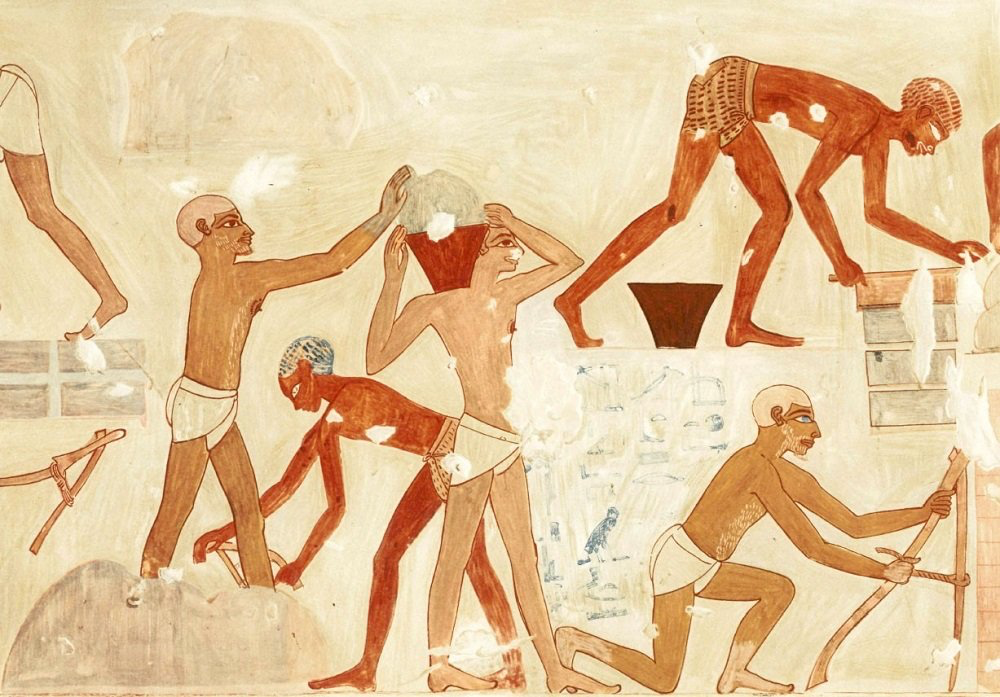
Image source: Detail of an illustration from N. D. G. Davies, Paintings from the Tomb of Rekh-Mi-Rēˁ (New York: Metropolitan Museum of Art, 1935), plate 17.
 iDigress