
Rev Dr Rod Benson, General Secretary, NSW Ecumenical Council
Fifth Theology Symposium: Nicaea at 1700: A Council for the Ages?
St Andrew’s College, Redfern, Sydney, 23 August 2025
Introduction
In 1914, Princeton theologian Archibald B. D. Alexander claimed that ethics was the crown of theology which “ought to be the end of all previous study.” He lamented a tendency to separate “truth” from “duty,” especially prior to the Reformation. He writes:
It was natural, and perhaps inevitable that the first efforts of the Church should be occupied with the formation and elaboration of dogma. With a few notable exceptions, among whom may be mentioned Basil, Clement, Alquin and Thomas Aquinas, the Church fathers and schoolmen paid but scanty attention to the ethical side of religion.[1]
Alexander might have mentioned Tertullian, St Augustine, Peter Lombard, and perhaps others.[2] Yet, throughout the church’s history, valour for ethics has frequently been eclipsed by the pressing concerns of those who are valiant for truth.
The Church has long compartmentalised its theology, separating moral theology from dogmatics.[3] In the Protestant tradition, ethical arguments frequently appeal to Scripture rather than to theology or philosophy, although as Luke Bretherton observes, “Scripture is not a revealed morality, but an angel with whom to wrestle.”[4] Appeals are still less likely to be made to creeds and confessions.
Yet, doctrine and ethics are profoundly interrelated. Doctrine provides normative authority for praxis, and offers safeguards against relativism, moralism, and cultural accommodation. Ethics demonstrates the practical application of doctrines (e.g., the imitation of Christ arising from what one believes about the nature and authority of Christ’s teaching and example), and appeals to doctrine for authority and rationale (e.g., the imperative of neighbour-love based upon convictions about the nature of divine love and the imago Dei).
Dutch theologian Herman Bavinck put it well:
In dogmatics we are concerned with what God does for us and in us. In dogmatics God is everything. Dogmatics is a word from God to us, coming from outside us and above us; we are passive, listening, and opening ourselves to being directed by God. In ethics, we are interested in the question of what it is that God now expects of us when he does his work in us. What do we do for him? Here we are active, precisely because of and on the grounds of God’s deeds in us; we sing psalms in thanks and praise to God. In dogmatics, God descends to us; in ethics, we ascend to God. In dogmatics, he is ours; in ethics, we are his. In dogmatics, we know we shall see his face; in ethics, his name will be written on our foreheads (Rev. 22:4). Dogmatics proceeds from God; ethics returns to God. In dogmatics, God loves us; in ethics, therefore, we love him.[5]
For Anglican theologian Alister McGrath, doctrine “defines what is distinctive, what is Christian, about Christian ethics. To lose sight of the importance of doctrine is to lose the backbone of faith and open the way to a spineless ethic.”[6] Similarly, Baptist theologian James McClendon suggests that “Without Christian life, the doctrine is dead, without Christian doctrine the life is formless.”[7]
The Council of Nicaea is rarely invoked in relation to moral theology, since the Creed from which it proceeded does not address ethical issues. To be properly Christian, moral theology requires a robust biblical-theological foundation, and Nicaea provides the first such conciliar statement. Almost all Christian traditions regard the Nicene Creed as authoritative, clarifying the biblical revelation in respect of key debates of the fourth century.
This paper outlines the manner in which Nicaea clarifies and codifies the trinitarian basis of Christian ethics, establishes the primacy of human dignity in its Christology, and offers theological tools for ethics through its statements on creation, resurrection, the gift of the Spirit, ecclesial unity, and eschatological hope. I have selected seven clauses from the Creed for reflection.
1. “One God, the Father, the Almighty”
The Nicene Creed is explicitly trinitarian, defining Christian faith as monotheistic, and referring to the deity as “the Father, the Almighty, maker of heaven and earth.” God is personal, omnipotent, and separate from the created universe. These qualities have implications for ethics. The Creed clarifies the moral imagination of the Church. Since the being of God is relational (“the Father”), and humans are created in the image of God, we may participate in some degree, as creatures, in the divine love, mutuality and self-giving as we imitate God (cf Eph 5:1f).
The Creator-creature distinction implies divine sovereignty and human accountability. Later in the Creed, the Son “is seated at the right hand of the Father” from whence he shall return “to judge the living and the dead” with justice. Morality is judged by an objective external standard.
Further, the communal life of the Trinity informs human virtues such as empathy, hospitality, mutual submission and love, expressed in a multitude of ways. As Robert Louis Wilken observes, “Christian life is trinitarian, oriented toward God the supreme good, formed by the life of Christ, and moved toward the good by the indwelling of the Holy Spirit.” [8]
2. “One Lord, Jesus Christ”
The section on Christ occupies 62 per cent of the Creed. That Jesus of Nazareth is “true God from true God … of one being with the Father” indicates that our allegiance to Christ infinitely surpasses all other allegiances and demonstrates Christ’s trustworthiness as Saviour and moral exemplar. His life is the definitive standard for human conduct. That Jesus “suffered death and … on the third day he rose again … [and] ascended into heaven” indicates his identification and solidarity with us.
Moreover, Christ’s embrace of full humanity affirms the dignity of all human life, and the intrinsic goodness of all creation. The incarnation represents God’s radical affirmation of human worth. Christ possesses the authority to call us to pursue distinctively Christian ethics because he is divine; we are empowered to obey and follow him because he is also human. The transformative elevation of human nature through regeneration and union with Christ leads to ethical as well as spiritual participation in the life of God.
Our freedom to identify with Christ enables character development – shaping our moral formation and informing our moral decisions. Christ’s humility and modelling of neighbour-love and love for God inspires loyalty, humility, service, and the voluntary relinquishment of privilege and power in pursuit of the common good. The incarnation of Christ arguably grounds all Christian ethics, and Nicaea strengthens this claim by clarifying the doctrine.
As Pope John Paul II put it, “each day the Church looks to Christ with unfailing love, fully aware that the true and final answer to the problem of morality lies in him alone.”[9]
3. “The Holy Spirit, the Lord, the giver of life”
The pneumatological section of the Creed grounds ethics in the dynamic presence of the Spirit of God and provides the sole reference in the Creed to divine revelation and the testimony of Scripture. The Creed rests not on its own authority, nor on earlier patristic authority, but on the supreme authority of Scripture, providing a definitive foundation for the practice of ethics in concert with the biblical revelation, and ‘guardrails’ defining the domain or scope of Christian ethics. To acknowledge the Spirit as “the giver of life” is to recognise our dependence upon God and accountability to God for all the resources we enjoy – life itself, and all the material, cultural and spiritual qualities that contribute to vital Christian humanism.
For the regenerate person, the Spirit indwells, renewing the mind and enabling the exercise of virtues such as the fruit of the Spirit (Gal 5:22f), moral courage, and wise decision making. The practice of Christian virtues is enabled and empowered by participation in the life of God. The Creed also situates ethical discernment within God’s historic acts of revelation, specifically “the Prophets”; thus, prophetic critique of unjust acts and structures, in the way of Jesus, is part of the Spirit’s mission in the world.
4. “Maker of heaven and earth”
The affirmation of God’s act of creation establishes the material universe as good, ordered, and purposeful. The special quality of humankind as made in the image of God affirms the dignity and equality of all, and charges humans with the vocation of responsible stewardship. Creation by God encourages a posture of living in harmony with a world designed by a wise and loving Creator. It inspires us to continue to pursue a creation mandate of care for the earth and its resources as a way of honouring the Creator and expressing gratitude for the gift of all that is (Gen 2:15).
The creation clause extends respect and dignity to all creatures. The entire material world, including our bodies, is morally good, though vulnerable to corruption and injustice – a denial of Gnostic and Manichaean dualism. By implication, the Creed sets moral limits on political imagination, economic practices, technological developments and social ethics. This clause in the Creed encourages ethical action to affirm the sanctity of life, resist dehumanising interventions, and promote compassionate care for the suffering and vulnerable.
5. “One holy, catholic and apostolic Church”
At first glance, this clause may seem unrelated to moral theology. Yet, it situates dogmatic theology within the life of a reconciled and reconciling community, a family of faith in which moral theology too may flourish. Christian ethics is anchored not in reason alone, nor in individual autonomy and private preference, but in communitarian life in the Trinity. Within an ecclesial context, faith and life are nurtured by, interpreted by, and made accountable to Scripture and its supreme Author. Such confessional solidarity empowers confident witness to justice and mercy in the life of the Church and the world.
As a “holy” community, the Church reflects divine holiness and commits to a moral distinctiveness shaped by humility, repentance and faith, cooperation and collaboration, and reconciliation across intersectional boundaries. As we say in the ecumenical community, “what draws us together is greater than what keeps us apart.”
To affirm the apostolicity of the Church is to honour the apostolic teaching and mission of God, which necessarily includes adherence to ethical commands and the practice of virtues in the face of strong pressure to embrace utilitarian and consequentialist ethics. The unity of the Church does not require uniformity, and diversity does not obliterate catholicity. We may learn important lessons from those who share our credal beliefs but who appear “other” to us in various ways.
Jose Míguez Bonino writes that dialogue and cooperation on ethical questions may reveal coincidences in relation to concrete questions and on general theological affirmations; and may also highlight deep differences in theological traditions in their approaches to ethical questions and how distinctive theologies play out in relation to practical ethics. Such differences
create tensions and make the road to united witness and action a difficult one. But they also have helped to see the richness of the common Christian heritage, to correct the one-sidedness or misunderstandings of each tradition as it has developed in particular historic circumstances and to find complementary relations. The frequently quoted slogan “doctrine divides, service unites” proves to be only partially true: service also reveals deep differences, but the urgency for common action leads to a deeper doctrinal unity.[10]
6. “The resurrection of the dead”
The ultimate reality for humankind and the whole creation is not death but life. For Christians, the Creed affirms the resurrection of the body as part of our identification with the risen Christ. Moreover, “The resurrection of Christ, upon which Christian ethics is founded, vindicates the created order in this double sense: it redeems it and it transforms it.”[11] Such eschatological hope inspires courage to live with authenticity and perseverance in the face of injustice, suffering and despair. The last word rightly belongs to God and not to oppressive structures and systems. The risen Jesus is Lord and Caesar is not.
Further, resurrection resists pressure to treat the body as morally irrelevant. Christians are compelled, for example, to defend the vulnerable, to resist corporate transhumanism, feed the hungry, heal the sick, house the homeless, and otherwise diligently work for justice and peace in every sphere of life. This has strong links to my earlier point about the image of God, and the intrinsic dignity of the human person.
There is hope beyond death: overcoming the challenges of injustice, suffering, intersectionality, and all forms of dehumanisation. Redeemed humanity, in Christ, has a glorious future as part of a redeemed creation. We shall be like him; “now we see through a glass darkly” (1 Cor 13:12). The resurrection of the body is a pledge of the eschatological fulfilment of human dignity inherent in creation.
7. “The life to come”
With the words, “[Christ] will come again in glory to judge the living and the dead,” the Creed frames judgment in the context of renewed life in the inbreaking kingdom of God. Evil will not prevail; injustice will cease; holiness and peace will reign. Such recognition of eschatological judgement reminds us of our ethical accountability to God. At our best, we shape our lives and communities in light of the end.
The Church’s moral life is a foretaste of the fullness of the kingdom of God. The dignity inherent in creation, affirmed in the incarnation, restored through the cross, vindicated by the resurrection, and glorified in the ascension of Christ, will finally be consummated in humankind’s ultimate union with God. This kingdom “will have no end.”
Far from being a relic of ancient Christological debates, the Creed serves as a vital theological and ethical anchor for Christian life. Its vision of God – triune, relational, incarnate, and saving – shapes how Christians conceive of human dignity, moral character, communal life, and social responsibility. The Creed comprises a firm foundation and a dynamic springboard for the practice of moral theology, calling the Church in all times and places to think and act in ways that reflect the glory of the triune God in a broken world.
Conclusion
The Creed is not a handbook of moral theology. The classic creeds were formed in polemical rather than pastoral contexts. They were formulated as dogmatic statements, not as guides for navigation of ethical and moral issues. While they do shape a worldview that informs ethics, they are silent on concrete moral questions. They presuppose rather than elaborate a Christian moral framework. Attempting to derive moral theology from the Creeds risks reductionism, ignoring the development of moral theology across the history of the Church.
On the other hand, the Creed bears witness to a biblically grounded theological anthropology that richly informs moral theology and ethical deliberation. Its affirmation of resurrection of the body constructs a moral horizon inspiring courage and hope in the face of moral challenges. Its affirmation of the relationality of the Trinity and the unity without uniformity of the Church adds weight to arguments for the practice of relational social ethics in a culture increasingly shaped by individualism, consumerism, and authoritarianism.
The Nicene Creed, along with other classic creeds of the Church, is a beautiful God-given resource undergirding moral theology and spurring on the Church to practice love and good works in a world in search of a moral compass and ultimate reality.
Thank you.
References
[1] Archibald B. D. Alexander, Christianity and Ethics: A Handbook of Christian Ethics (London: Duckworth & Co., 1914), 2.
[2] On developments in Christian ethics during the apostolic and patristic periods see Eric Osborn, Ethical Patterns in Early Christian Thought (Cambridge: Cambridge University Press, 1976); Wayne A. Meeks, The Origins of Christian Morality: The First Two Centuries (New Haven: Yale University Press, 1993); and J. Ian H. McDonald, The Crucible of Christian Morality (London: Routledge, 1998).
[3] Recent exceptions include Oliver O’Donovan, John Webster, James Cone, and Walter Brueggemann.
[4] Luke Bretherton, A Primer in Christian Ethics: Christ and the Struggle to Live Well (Cambridge: Cambridge University Press, 2023), 57.
[5] Herman Bavinck, Reformed Ethics: Created, Fallen and Converted Humanity (vol. 1 of 4; ed. John Bolt; Grand Rapids: Baker Academic, 2019), xxvi.
[6] Alister McGrath, “Doctrine and ethics,” Journal of the Evangelical Theological Society 34 (2), June 1991, 145.
[7] James McClendon, Doctrine: Systematic Theology (Nashville: Abingdon Press, 1994), i.
[8] Robert Louis Wilken, The Spirit of Early Christian Thought: Seeking the Face of God (New Haven: Yale University Press, 2003), 278.
[9] Pope John Paul II, Veritas Splendor, 6 August 1993, s. 85. Available at https://www.vatican.va/content/john-paul-ii/en/encyclicals/documents/hf_jp-ii_enc_06081993_veritatis-splendor.html
[10] Jose Míguez Bonino, “Ethics,” in Nicholas Lossky et al (eds), Dictionary of the Ecumenical Movement (Geneva: WCC Publications, 2002), 407f.
[11] Oliver O’Donovan, Resurrection and Moral Order: An Outline for Evangelical Ethics (second edition; Grand Rapids: Eerdmans, 1994), 56.
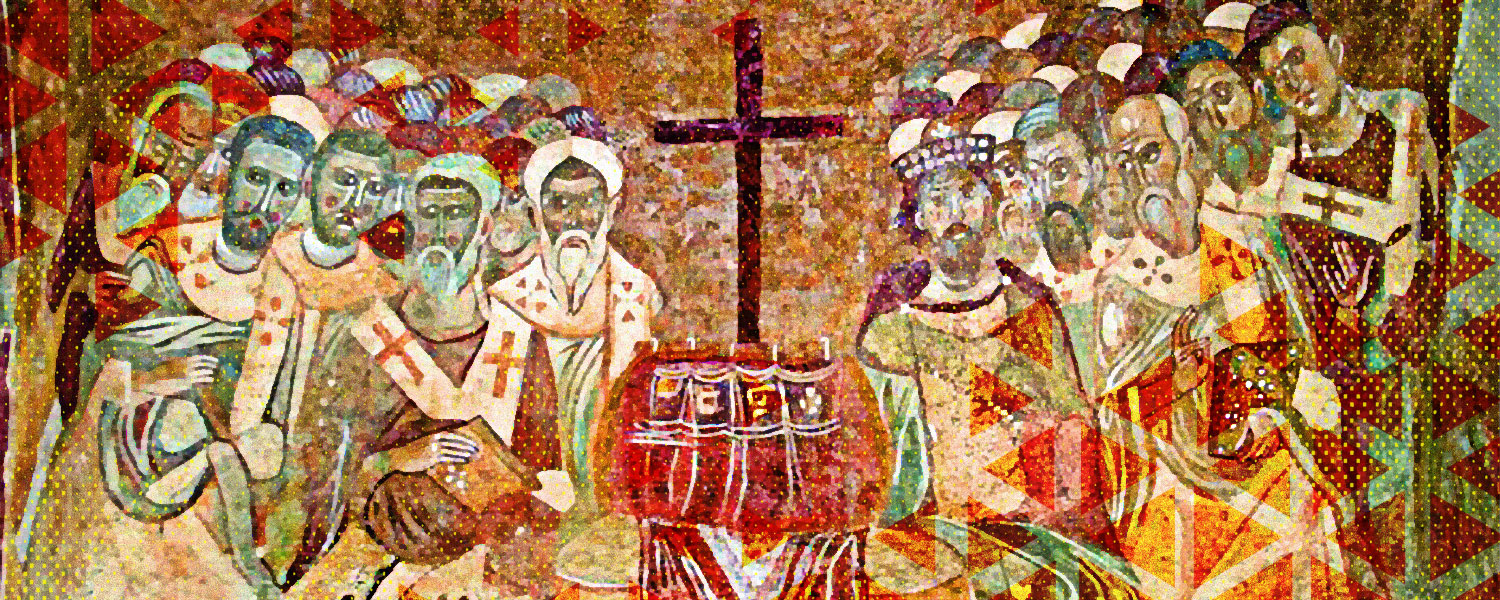
Image source: Illustration by Josh Koch from a fresco of the Council of Nicaea in the Basilica of St. Nicholas. textandcanon.org
 iDigress