
In the year 2000, the National Gallery in London held an exhibition of classical art depicting the life and death of Jesus of Nazareth. The BBC produced an accompanying television series and a beautifully illustrated book, which I purchased and which remains a treasured possession.
The title of the exhibition, series and book was Seeing Salvation. There’s an irony here, because Jesus came from a tradition that allowed no portraits, and there are no contemporary accounts of his appearance. And yet, in looking at images of Jesus, we are in a very real sense “seeing salvation.”
Of course, Jesus is only the most iconic and central “image” of salvation. There are many others. Scripture is replete with them. And salvation is a grand, glorious and multi-faceted theme in Christian tradition.
Today’s lectionary reading from the Hebrew Bible is Isaiah 35:1-10, and there the ancient Israelite prophet sets forth not a picture of a person but an imagined world that is seeing salvation after long years of defeat, disappointment and despair.
Back a few pages in chapters 31-32, we learn that Israel has forsaken God and turned to Egypt for aid. The prophet Isaiah sees a vision of hawks circling in the air above Jerusalem. They sense that the city is about to be destroyed, and they anticipate feasting on the flesh of men and beasts.
In chapter 33, Isaiah’s critical voice turns to the superpower of his day, Assyria, and sensationally predicts its fall. Ultimately, as Isaiah knows, every superpower will fall, taking much that is good with it as well as freeing servile states from bondage. But Isaiah also knows that it can be terrifying for God’s people when God takes action to effect regime change.
Chapters 34 and 35 give us a picture of final judgement, and God’s future for what a redeemed and restored world will look like, with an emphasis on reverberations in nature. Zion too has fallen, but will be restored. The people have been exiled, but they will return to the land.
Our text for today, Isaiah 35:1-10, is an amazing Hebrew poem, the “pinnacle” of the “visionary climax” of the final woe in Isaiah’s prophecy of chapters 33 to 35. It is a poem of hope, and “hope is the cordial the people of God need to keep them going.”[1]
Advent is a season of hope, anticipation, waiting and longing for resolution, for salvation. It is a longing to “see salvation.” You and I need whispers of hope, images of hope, images of salvation, just as much as the people in Isaiah’s day did.
Isaiah’s compatriots have no strength left, no resources, no recourse to justice to effect their deliverance from oppression. They cry out for vengeance, for retribution, but they are in reality blind, deaf, lame and mute (vv. 5f). They cannot save themselves.
But God comes to their rescue (vv. 4, 8-10):
Say to the cowardly:
‘Be strong; do not fear!
Here is your God; vengeance is coming.
God’s retribution is coming; he will save you…A road will be there and a way;
it will be called the Holy Way.
The unclean will not travel on it,
but it will be for the one who walks the path.
Fools will not wander on it.
9 There will be no lion there,
and no vicious beast will go up on it;
they will not be found there.
But the redeemed will walk on it,
10 and the ransomed of the Lord will return
and come to Zion with singing,
crowned with unending joy.
Joy and gladness will overtake them,
and sorrow and sighing will flee.
The “Zion” God has prepared for his redeemed people is a city of peace and safety, unending joy, and abundance beyond imagination. What is perhaps most significant is that God not only brings final and dramatic transformation to his people and their world, but that God chooses to dwell among them (note v. 2, and especially v. 4).
This beautiful poem in Isaiah chapter 35 is filled with imperative verbs that exhort Isaiah’s audience to radically recalibrate their worldview. God will be true to his promise to save his people from their enemies and establish justice on the earth – but God’s future is so much bigger and more inclusive than they could ever imagine.
Psalm 146 echoes the themes of Isaiah 35, celebrating the sovereignty, creativity and mercy of God:
5 Happy is the one whose help is the God of Jacob,
whose hope is in the Lord his God…7 executing justice for the exploited
and giving food to the hungry.
The Lord frees prisoners.
8 The Lord opens the eyes of the blind.
The Lord raises up those who are oppressed.
The Lord loves the righteous.
9 The Lord protects resident foreigners
and helps the fatherless and the widow,
but he frustrates the ways of the wicked.10 The Lord reigns for ever;
Zion, your God reigns for all generations.
Hallelujah! (Ps 146:5, 7-10).
There are times, however, when we lack the patience required to make sense of what God is doing. In a culture that conditions us to expect instant answers and rapid progress, the slow unfolding of God’s purposes often looks like failure rather than faithfulness.
We want the glorious promises of life in the kingdom of God to be fully manifest now. When prayers for healing go unanswered, justice is denied, and hope for reconciliation or renewal fades away, disappointment sets in.
We may expect swift transformation of interpersonal conflict as well as complex systemic problems at a global level, but this ignores the biblical realism about human resistance to divine grace and the long, slow, costly work required to bring about genuine sanctification and reconciliation.
Sometimes, we confuse God’s patience with absence or indifference to our plight. When we encounter severe suffering, apparent silence from heaven looks like abandonment.
But God’s seemingly slow timetable is itself a saving action, making space for repentance, personal growth, deeper faith, and inner transformation. And God is entirely trustworthy, wise, and good.
Even the great prophet of Jesus’s time, John the Baptist, had his doubts about God’s timing, and those doubts led him to doubt everything. In Matthew 11:2-15, John is no longer free and exercising his ministry in his beloved wilderness. He is in prison, unable to fulfil his ministry, about to be martyred, and he sends a message to Jesus asking, “Are you the one who is to come, or should we expect someone else?” (v. 3).
And Jesus replies to the messengers, in words that echo Isaiah 35 and other ancient biblical texts: “Go and report to John what you hear and see: The blind receive their sight, the lame walk, those with leprosy are cleansed, the deaf hear, the dead are raised, and the poor are told the good news” (vv. 4f).
John could no longer see salvation, but salvation was on the way. John’s circumstances blinded him to the truth, but Jesus reassured him that all would be well. John’s significant role in the outworking of God’s salvation seemed meaningless to John, but he was not seeing the bigger picture.
John thought of himself as a lone voice in the desert, pointing a few people to Jesus, amid overwhelming opposition. But Jesus thought of John as equivalent to the great eighth-century prophet Elijah (v. 14), and called John “my messenger” (v. 10). On Catholic icons, John joins Mary the mother of Jesus, “who also comes from the Old Covenant yet steps across into the New Covenant, the two of them at the right and left hand of the world’s Judge.”[2]
Seeing salvation is not easy; in fact, it can be very difficult. But that does not mean that salvation is far off, or tenuous, or merely a mirage. We know that God does come to his people. God does ransom, rescue, reconcile and renew. As we embrace the posture of quiet waiting this Advent season, take a look around with eyes of faith. Signs of salvation are all around us. Take courage, trust God, and spread the word.
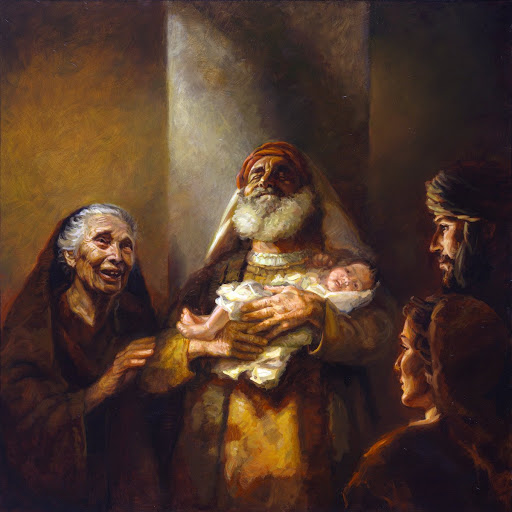
On this Third Sunday in Advent, I close my sermon with the beautiful, grace-filled, comforting words of the old priest Simeon as he takes the infant Jesus in his arms, and sees in him the Saviour of the world: “Now, Master, you can dismiss your servant in peace, as you promised. For my eyes have seen your salvation” (Lk 2:29f).
It is this text that Neil MacGregor chose to introduce his theme in the glossy BBC book Seeing Salvation. He writes, “In this child, Christians believe, the boundaries of the human and divine were permanently redrawn for us all.”[3]
In this Child, whose birth we eagerly anticipate, we see salvation. Thanks be to God.
Amen.
Sermon 839 copyright © 2025 Rod Benson. Preached at North Rocks Community Church, Sydney, Australia, on Sunday 14 December 2025. Unless otherwise noted, Scripture quotations are from The Christian Standard Bible (Nashville: Holman Bible Publishers, 2020).
References
[1] Alec Motyer, The Prophecy of Isaiah (Leicester: IVP, 1993), 273.
[2] Hans Urs von Balthasar, Light of the World: Brief Reflections on the Sunday Readings (trans. Dennis D. Martin; San Francisco: Ignatius Press, 1992), 17.
[3] Neil MacGregor & Erika Langmuir, Seeing Salvation: Images of Christ in Art (London: BBC, 2000), 7.
Image source: Artwork by contemporary Dutch artist Jan Van’t Hoff, published at https://maryloudriedger2.wordpress.com/tag/anna/
 iDigress