
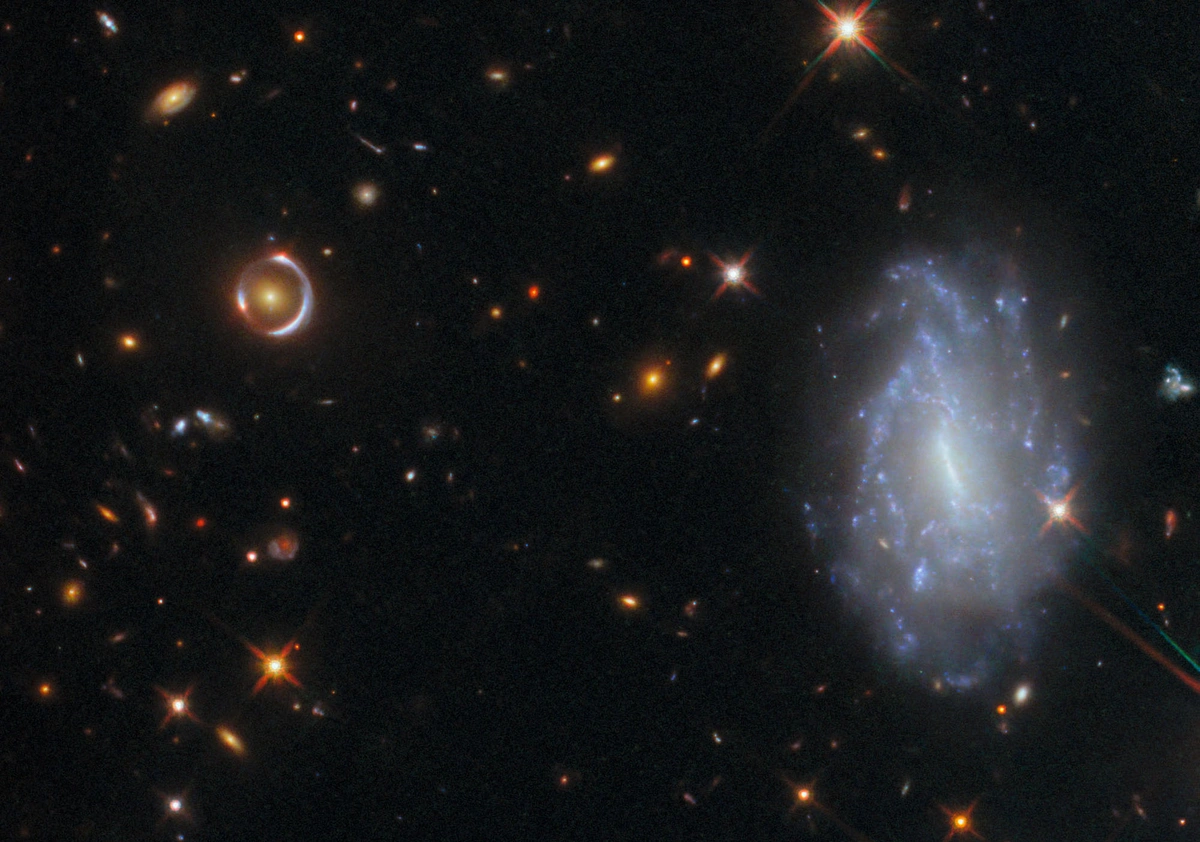
No galaxies, no sun, no Earth, no oceans, no flora or fauna, no history, no you or me. Only the living God, who is Spirit. The Bible begins with this breathtaking sentence: “In the beginning God created the heavens and the earth” (Genesis 1:1).
Those words serve as a doorway through which every conscientious reader of the Bible is obliged to pass. Before the story of Abraham, the law of Moses, the psalms of David, the visions of the prophets, and the good news of Jesus, we meet the Bible’s central character, God the Creator of everything that exists.
Before anything existed, God was. Out of sheer love, God creates. It’s not that God was lonely, or needed help, but because God is love and delights to give life where it is absent. Everything flows from this: our universe, our planet, our identity, our purpose, our calling, and our confidence in the face of adversity.
But creation is not just the opening chapter of the Jewish and Christian Scriptures. It is one of the great questions of our generation. We live in a world deeply shaped by physics, chemistry and biology; a world shaped by the discoveries and application of astronomy, medicine, genetics, neuroscience, and artificial intelligence.
And some of us quietly wonder: Can I continue to believe the Bible and still respect science as perhaps my great-grandparents did? Do I need to be a person of faith, and embrace the mysteries of faith, when science seems to explain so much about the world out there, and the world all around me, and the world within? What is the place of religion in an age of science and technology?
Creation begins with God
Genesis does not begin by describing mechanisms, processes, or timelines. It begins with God: “In the beginning God…”
God is not a character within the universe. God is the external source of all reality. And because creation begins with God, it is not random, pointless, or accidental. It is intentional, personal, and deeply loved.
The New Testament deepens this truth in a wonderful way. The Fourth Gospel opens with deliberate echoes of the Book of Genesis:
In the beginning was the Word, and the Word was with God, and the Word was God. He was with God in the beginning. All things were created through him, and apart from him not one thing was created that has been created (John 1:1–3).
The gentle travelling rabbi whom we meet in the Gospels, the one who heals lepers, and calms storms, and dies on a cross, is also the one who brought everything that exists – all matter, all antimatter, and every form of consciousness – into being.
There are hints of this for those with eyes to see. For example, Jesus turned water into wine because he created the conditions for both to exist, and his power, though self-restrained, was limitless. His miracles demonstrated his “glory,” his divine origin and identity.
For Christians, the doctrine of creation is what theologians call “Christological”: it is profoundly connected with Jesus, with his creative genius, and with the mission of God as Jesus announced it. To affirm creation is to affirm the lordship of Jesus Christ over all of reality, from the dust at our feet to the farthest galactic cluster.
“The first place was a voice,”[1] the voice of God, the sound of an infinitely powerful, infinitely creative, and infinitely loving being.
Creation is God’s self-giving speech
The British children’s author C. S. Lewis captures something beautiful in The Magician’s Nephew, the first book of The Chronicles of Narnia from a chronological perspective, although not the first published.
It’s a sad and dark book in some ways, but there is a scene in which Aslan, the Great Lion, the Christ-figure, sings and speaks a new world, of which Narnia is a small part, into existence. Stars burst into song, mountains rise out of darkness, grass unfolds. Trees, birds and animals emerge from the new ground. Everything comes alive because the Lion speaks.[2]
Lewis is not presenting a novel scientific model of creation. He is telling a deeper story: creation is personal. It arises in response to a voice: the voice of an all-powerful, wise and loving artist.
The first place was not a singularity. It was not an infinitely “small” point of infinite density from which the universe as we know it expanded. The first place was a voice, calling matter into being with loving intention and perfect wisdom. When God speaks, reality happens. “By the word of the Lord the heavens were made” (Ps 33:6). Science studies the how. Faith confesses the Who. And the two do not need to be enemies.
Science is a gift from God
At its best, science is the disciplined study of the world God created. The very possibility of science rests upon three basic assumptions that come, historically, from Christian belief:
- The world of matter is ordered rather than chaotic
- Nature follows discoverable patterns
- Our minds are capable of understanding those patterns.
Throughout history, thoughtful followers of Jesus from Augustine to Kepler, from Newton to modern Christians working in labs and research facilities have understood “science” as a way of paying close attention to the handiwork of God.
When a biologist studies DNA, they are exploring the astonishing complexity of living cells. When astronomers map distant galaxies, they glimpse the vastness of God’s power and creative imagination. When doctors understand physical and mental health more clearly, they participate in God’s healing purpose for the world.
The limitations of science
Science is great at describing processes, and uncovering relationships. Science can help alleviate suffering, promote holistic wellbeing, and enormously improve our quality of life.
But science cannot answer existential questions of meaning:
- Why is there something rather than nothing?
- What is humankind for?
- What makes a life good, or beautiful, or true?
- Why do love, justice, forgiveness, and hope matter to us?
These are theological questions. To find answers to such questions, we need to search for wisdom, revelation, and humility before God.
When science and faith appear to conflict, it may be due to a confusion of categories. Science is not designed to replace God any more than a map replaces the landscape. Science reveals the contours, but God gives the landscape existence.
Faith does not mean shutting our eyes to evidence. Faith means entrusting our lives to the God whose character is revealed in Jesus. If the first place was a voice, and that voice was the Logos, and the Logos is Jesus Christ then, as creatures of this all-powerful, infinitely creative, absolutely loving intelligence, our response is to bow in worship and follow him.
There are times when our interpretations of Holy Scripture require humility. And there are times when scientific theories require revision – or perhaps revolution. History shows that both theology and science grow as we learn more.
Creation invites worship and stewardship
Before Genesis 1:1 and John 1:1-5 are educational texts, they are calls to worship. When we read of God forming light, stars, seas, birds, animals, and humankind, the proper response is awe. And awe flows naturally into conscious responsibility.
If creation belongs to God, it is not ours to exploit and pollute. The earth is not disposable. We are not commodities. Animals, ecosystems, rivers, forests, and climates are part of the world God has made. Christians should be at the forefront of caring for creation – not because we worship nature, but because we worship the Creator. Stewardship, generosity, conservation, and gratitude are acts of discipleship flowing from grateful creaturely praise.
Sin has marred creation, but God has not abandoned it. In Christ, God is renewing all things. The one through whom all things were made is the same one through whom all things will be redeemed.
Our hope is not merely a return to the Garden of Eden. Our hope is resurrection as we follow the way of Jesus. Our hope is a regenerated will, a renovated heart, a reconciled humanity, a healed and whole world, and the fullness of God’s presence fully experienced through complete union with Christ.
As we begin a new year
As we enter 2026, we carry all kinds of uncertainties – political, technological, environmental, cultural, relational, personal. Our world feels fragile. The news cycle seems foreboding. Sometimes our faith too feels fragile.
But the opening words of Scripture, and the opening lines of John’s Gospel, invite us to begin the year grounded in something deeper: God is. God speaks. God creates. God sustains. God comes among us in the person of Jesus. The light of God shines, and the darkness does not overcome it.
So let us study God’s world with curiosity and awe. Let us read God’s Word with reverence and insight. Let us live every day with gratitude, courage, and humility.
And, like the Narnian world, coming to glorious life at the delicious sound of Aslan’s voice, may our lives, too, awaken to the reality of the living God, who speaks creation into being, holds it together in love, gifts it to us as stewards, and, in mercy and grace, leads the whole creation toward its ultimate destiny, a renewed and restored cosmos, and a perfect real-world garden-city in which every redeemed creature experiences the bliss of eternal union with God in Christ.
Sermon 843 copyright © 2026 Rod Benson. Preached at North Rocks Community Church, Sydney, Australia, on Sunday 4 January 2026. Unless otherwise noted, Scripture quotations are from The Christian Standard Bible (Nashville: Holman Bible Publishers, 2020).
[1] Christian Wiman, “The tune of things – Is consciousness God?” Harper’s Magazine, December 2025, https://harpers.org/archive/2025/12/the-tune-of-things-christian-wiman-consciousness-god/
[2] C. S. Lewis, The Magician’s Nephew (London: HarperCollins, 1998 [1955]), 106-126.
Image source: The Atlantic. A tiny patch of sky in the constellation Hydra. ESA / Hubble & NASA, D. Erb.
 iDigress