
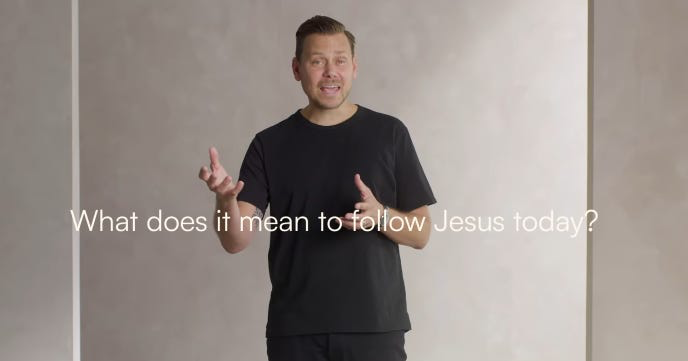
John Mark Comer’s Practicing the Way model of discipleship has been widely received as a timely, pastoral answer to the shallowness of modern Western Christianity. It encourages us to slow down, re-centre on Jesus, and practice the life he taught. Who could argue against that? Like any influential model, however, it attracts fair criticisms.
Here are six common critiques, followed by responses that defend the model without turning it into a fad, a brand, or a new law.
1. “It reduces discipleship to lifestyle aesthetics.”
The language of “rule of life,” “habits,” “formation,” and “rhythm” can sound like a curated spirituality for middle class consumers. It risks becoming “Christian wellness” with Jesus as the vibe.
This warning misreads Comer’s centre of gravity. The point is not aesthetic simplicity but actual apprenticeship to Jesus. The practices are not about appearing serene but about transformation. Done rightly, the practices dismantle performative spirituality, compelling us to confront impatience, lust, anger, anxiety, and ego. The model’s tools can be misused as lifestyle branding, but that’s a human problem, not an inherent flaw. When anchored in repentance, obedience, and community, the practices are the opposite of consumerism.
2. “It’s therapy-shaped rather than gospel-shaped.”
Critics worry that the model borrows too much from psychology and “self-help” framing, focusing on stress reduction, emotional regulation and resilience rather than biblical principles such as justification by faith, union with Christ, and the call to sanctification.
The gospel that Jesus proclaimed leads to human wholeness, to radical Christian humanism. This can be couched in psychological terms, but it is much more than psychotherapy. Historic Christianity has always cared about disordered loves, existential fear, and the healing of the soul. Psychological language can become an idol, but it can also serve as common-grace vocabulary that helps modern people name categories that Scripture exposes: anxious striving, enslaving desires, and restless hearts. If the model remains Christocentric, it is not therapeutic substitution but pastoral translation.
3. “It downplays doctrine and preaching in favour of practices.”
Some fear this model subtly implies that teaching is secondary: “Stop debating theology and just engage with practice.” That could produce shallow Christians with strong feelings and weak convictions.
Experience shows that practice without truth collapses into sentimentality, and truth without practice descends into hypocrisy. Comer’s emphasis is not anti-doctrinal but anti-disembodied. The Great Commission includes the imperative of teaching followers of Jesus to obey, not simply to know. Doctrine supplies the map; practices train the traveller. A rule of life must be built on theological foundations: God’s holiness, grace, sin, atonement, the Spirit’s work, the church, and the kingdom. Properly held, the practical challenges in Practicing the Way are not an alternative to preaching but its natural fruit, leading to personal transformation. Accumulation of knowledge alone does not produce the fruit of righteousness.
4. “It can become a new legalism”
A practice-heavy model may generate strong moral pressure, especially for anxious believers: “If you’re not doing silence, Sabbath and simplicity, you’re failing God.”
The danger is real, but spiritual disciplines have always carried this risk, from the rigours of medieval monasticism to modern evangelical devotional practices. The solution is to keep practices in their proper place: not as merit badges, but as the path to transformation that in turn enables and empowers mission. The model should be framed as wisdom that leads to love, not law that rewards sacrifice with social acceptance. The whole point of a shift to thinking of discipleship as “apprenticeship to Jesus” requires a model that emphasises voluntary (and sometimes challenging) practices.
5. “It’s too individualistic and neglects the biblical call to justice and mission.”
A private “formation” emphasis can drift inward, with an increasing focus on my peace, my rhythm, my inner life – while the poor, the oppressed, evangelism, and public discipleship remain optional extras.
True formation always spills outward. If silence does not produce patience with people, it’s not Christian silence. If Sabbath does not fuel mercy, it’s counterfeit rest. Comer’s model can and should be integrated into a robust theology of the kingdom: we practice the way of Jesus to become the kind of people through whom God blesses the world. In fact, practices strengthen Christian mission: prayer deepens courage, simplicity frees resources, community trains reconciliation, and Sabbath resists exploitative economies. The answer is not to abandon formation, but to ensure that it culminates in love of neighbour and the wider world.
6. “It isn’t sufficiently cross-centred”
Some interpret “apprenticeship” to mean “moral imitation”: the notion of Jesus as a moral example rather than a Saviour from sin. That could weaken one’s theology of the cross, the meaning of grace, and the dynamics of sanctification.
This is the most serious critique, but the easiest to answer well. We cannot follow Jesus rightly unless we first come to him as sinners in need of redemption from beyond our own resources. Apprenticeship is not self-improvement; it is Spirit-powered conformity flowing from union with Christ. That union is essential and comes first. The cross is not merely a pattern of self-giving; it is the decisive act that reconciles us to God. When churches teach Practicing the Way within a clear gospel frame based on biblical theology, the practices become grateful obedience to the God of grace.
The real deal
The potential vulnerabilities of Practicing the Way are real: aesthetic spirituality, therapeutic drift, doctrinal thinness, legalism, individualism, and cross-lite moralism.
Each critique is best addressed by anchoring the model biblically and theologically: drawing attention to the primacy of Jesus Christ, the centrality of the gospel of the kingdom, practical dependence on the Holy Spirit for growth in holiness and godliness, embedding the practices in the life of the local church, and an outward focus on holistic mission.
Practicing the Way is not a trendy new shortcut to holiness. It is an ancient and trustworthy path of Christian discipleship, translated into the lived context of our age.
Rev Dr Rod Benson is General Secretary of the NSW Ecumenical Council and a minister of the Uniting Church in Australia serving at North Rocks Community Church in Sydney.
Image source: Griffin Gooch
 iDigress