
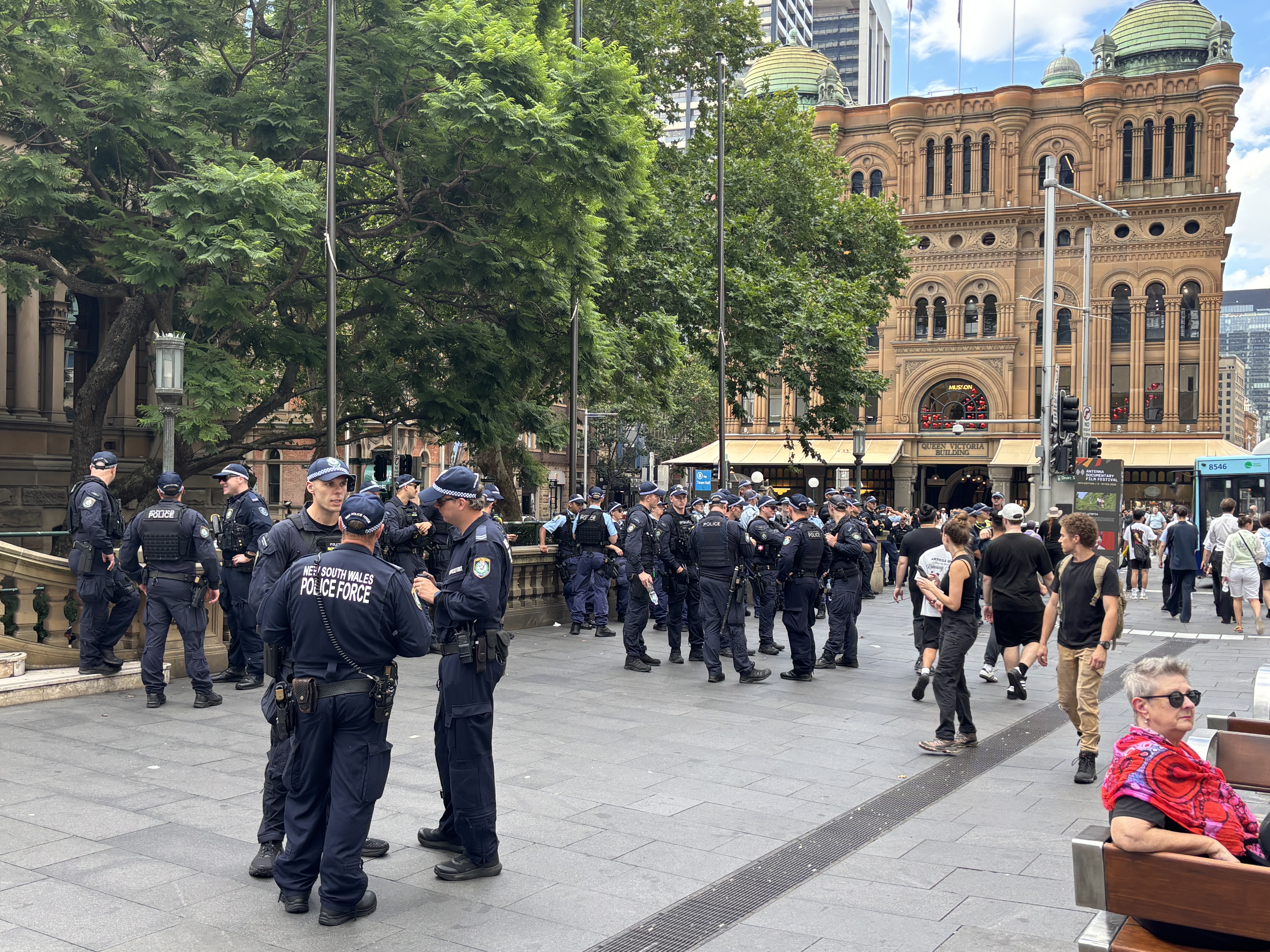
Attending the protest rally against Israeli President Isaac Herzog’s visit to Australia was not part of my plans for this evening. I left work at my city office around 4.15 pm and headed to Gadigal Station to avoid Town Hall where the rally was to be held. And then I saw a sea of “boys in blue,” and proceeded to investigate.
I have long held that the Israeli government is guilty of human rights abuses throughout its sovereign territory and in the West Bank and Gaza. For years, I served as a volunteer with the Australian board of the Ecumenical Accompaniment Programme in Palestine and Israel, coordinated by the World Council of Churches, commissioned to send volunteer peacekeepers to document alleged human rights abuses at Israeli checkpoints and other places of political tension in the region.
I visited Palestine and Israel three times, and never as a tourist, so I was privileged to see deeply disturbing things and speak to ordinary Palestinians in many contexts, all of them suffering state-sponsored violence, intimidation, and sometimes displacement. I have only high praise for EAPPI and the amazing contribution to universal human rights and peace work by its staff and especially the volunteers.
Passing down George Street, about as far as one could be from Jenin, Hebron, and Gaza, I walked to the main entrance steps of Sydney Town Hall. There, a lone woman stood holding a sign reading simply, “The Hague,” with a large arrow pointing to the right – a reference to prosecution for war crimes at the International Criminal Court.
I walked on, and into Town Hall Square, which was beginning to fill. By dusk, thousands had gathered, spilling around St Andrew’s Cathedral and onto George Street. Organisers later estimated the crowd at up to 10,000. People had come to register opposition to Herzog’s visit and to call for a ceasefire in Gaza, as well as for legal scrutiny of alleged violations of international law.
The composition of the crowd was notable. Families with children, students, faith groups, retirees and seasoned activists stood together. Placards called for civilian protection and an end to hostilities. Marshals reminded people to care for the vulnerable and maintain a calm, lawful presence. Whatever the strength of feeling, the emphasis was on order and nonviolence. Yet the scale of the police presence was impossible to ignore.
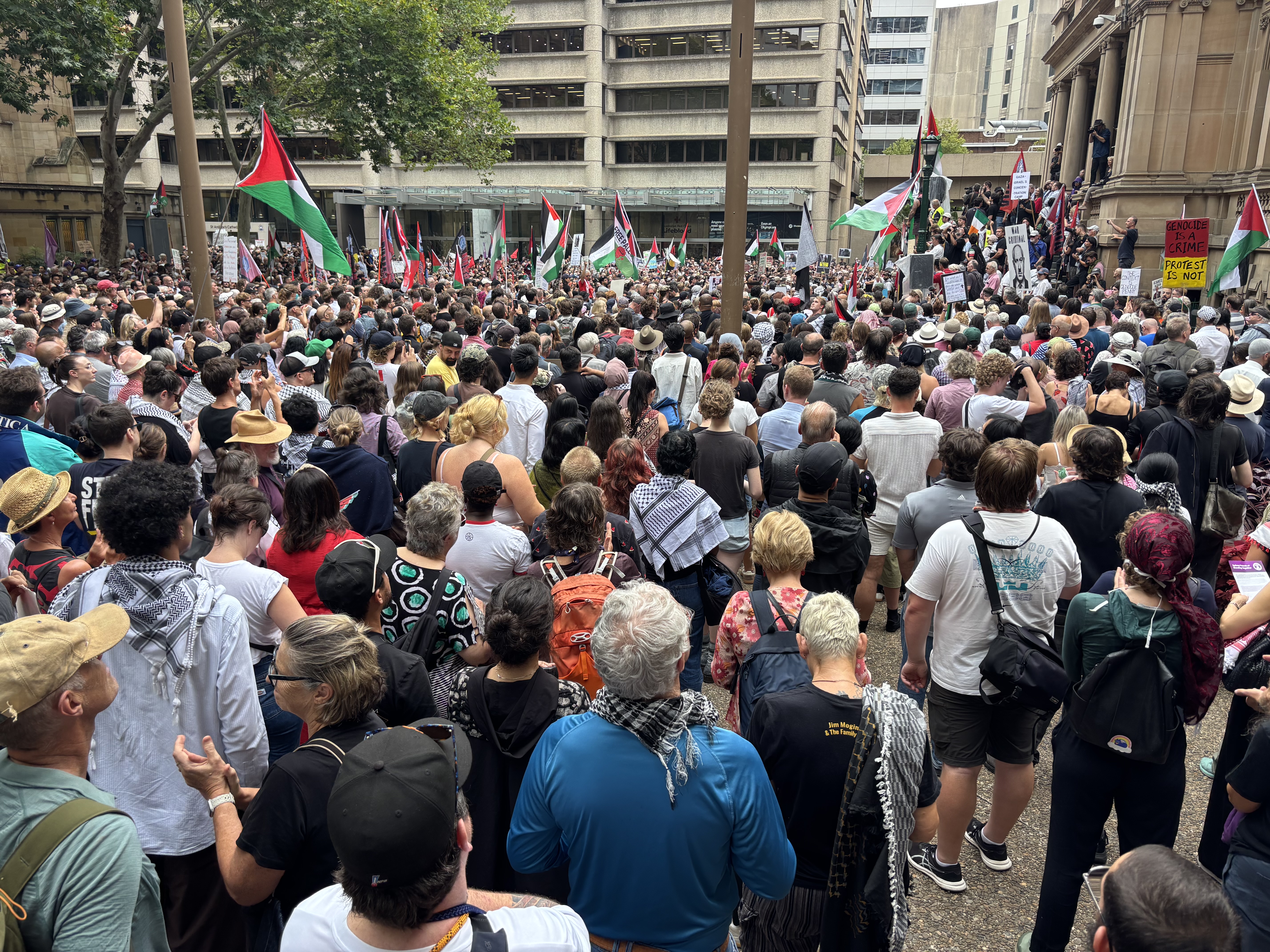
The primary intention of the gathering was arguably to demonstrate the voice of conscience rather than seek violent confrontation. People of diverse backgrounds wanted to send a loud and unequivocal message to Prime Minister Anthony Albanese and NSW Premier Chris Minns that it was offensive to have invited President Herzog to Australia.
The crowd’s united message was deeply felt horror at atrocities perpetrated by Israel in Gaza, and the inappropriateness of Australia to host a senior representative of a government they considered responsible for grave human rights abuses. Speakers criticised Australia’s diplomatic and defence ties with Israel, and drew parallels between histories of violent colonisation and alleged genocide abroad and at home.
The rally was also part of a broader pattern. Similar demonstrations took place in cities and regional centres across the country, some drawing unexpectedly large numbers. Even smaller communities reported substantial turnouts, suggesting the issue resonates beyond traditional activist circles. For example, a protest in the town of Lawson, in the Blue Mountains, drew an estimated 200 people.
While I was present, the atmosphere was peaceful. People listened to speeches, talked quietly, and held their signs aloft. Police largely stood back, though they did prevent further entry once the space filled. Shortly after 6:00 pm, I left with the impression of an orderly, disciplined gathering. I have nothing but praise for the organisers.
Later reports described a different scene: officers using force to disperse sections of the crowd, including the use of tear gas and pepper spray, and the forcible removal of protesters who were clearly at prayer. There is shocking video of these actions. The contrast between the calm I observed and the reports that followed highlights how quickly the character of a protest rally can change, and how fragile the line is between precaution and escalation.
On reflection, I am glad I was distracted on my way home from work tonight. Despite the violence that occurred later in the evening, I observed something unexpected and wonderful. What I saw and heard invites reflection on, among other things, the power and fragility of public protest. Democratic governments have a responsibility to protect public safety. They also have an obligation to safeguard the right to peaceful assembly. When the balance is lost, trust erodes and social cohesion quickly disintegrates. When that happens, everyone loses.
My experience at the Sydney Town Hall rally reminds me of the power and limits of civic protest. Thousands of Australians, many with no direct connection to the Middle East, chose to spend a weekday evening making their views known about a complex distant conflict. Whether one agrees with their position or not, the impulse to gather publicly and call for justice is a central feature of a healthy democracy. Long may we continue to enjoy these fragile freedoms.
Rev Dr Rod Benson is General Secretary of the NSW Ecumenical Council and a minister of the Uniting Church in Australia serving at North Rocks Community Church in Sydney.
 iDigress
What is shown on social media is is wilful criminal violence and it didn’t come from the protesters. People being repeatedly punched, randomly pepper sprayed, grabbed and bodily tossed from the posture of prayer and the tension -escalating whistle call to aggression. The police have lost enormous social capital this Monday evening. It cannot be unlost and trust cannot be returned. Everyone has lost enormously. And who knows how far and wide the loss ?