
It beggars belief that I need to spell out the reasons why I do not support a terrorist organisation whose aim is to annihilate the State of Israel, but here we are.
Almost every time I speak up in defence of the human rights of Palestinians, or criticise Israeli state violence against Palestinians and other Arab peoples, someone deflects from the core issues of violence and repression to ask why I don’t denounce Hamas, or why I allegedly hate Israel.
The truth of the matter is that I don’t hate Israel. My faith compels me to love Israel and to love Israelis. As a biblical scholar and theologian, I recognise the central importance of Israel as the covenant people of God. My master Jesus was a Jewish man from Bethlehem. Historically, the people of Israel preserved the Hebrew Scriptures, which Christians such as myself regard as holy and of enduring relevance for all people everywhere. I have visited Israel three times. Each visit has been a wonderful privilege, and I am in awe of the land, the people, and the deep history of civilisation in the region.
What I hate is injustice, and in my considered opinion both Israel and Hamas have been champions of large-scale injustice for decades.
Hamas, an Arabic acronym for Harakat al-Muqawama al-Islamiyya (“Islamic Resistance Movement”) is a Palestinian Islamist movement founded in 1987 during the First Intifada, with roots in the Palestinian branch of the Muslim Brotherhood. It has always been both a political organisation (with party, social networks and state-like governance) and an armed movement (most prominently through its Qassam Brigades).
Its founding charter (1988) framed the regional conflict in religious terms and rejected Israel’s legitimacy. In 2017, Hamas issued a “General Principles and Policies” document that presented a more political-national framing and endorsed a Palestinian state on 1967 lines as a formula of “national consensus,” while not recognising Israel and retaining “resistance,” including armed struggle, as central to its operations.
Human rights abuses attributed to Hamas
Hamas has been responsible for (and has claimed responsibility for parts of) a long pattern of attacks deliberately or indiscriminately directed at civilians, including suicide bombings and shootings in earlier decades and, later, large-scale rocket and mortar fire from Gaza toward Israeli population centres (in violation of international humanitarian law when indiscriminate or aimed at civilians). Its most notorious recent operation was the horrific 7 October 2023 assault in southern Israel, in which Human Rights Watch concluded that Hamas-led armed groups committed war crimes and crimes against humanity, including intentionally killing civilians and taking hostages.
Hostage-taking has long been central to Hamas’s strategy, most dramatically in 2023–24 when large numbers of civilians were abducted into Gaza. Amnesty International (in a detailed report summarised by Reuters) concluded that the 7 October attacks and hostage treatment amounted to crimes against humanity, citing murder, torture, rape, and other inhumane acts as part of a systematic attack on civilians.
There are also substantial, though contested, allegations of conflict-related sexual violence during and after the 7 October attacks. A UN Security Council briefing and a UN Human Rights Council Commission of Inquiry report describe “reasonable grounds” and findings indicating sexual violence occurred in connection with the 7 October assault, while acknowledging evidentiary constraints typical of mass-atrocity investigations.
Within the Palestinian territories, Hamas’s rule in Gaza has been repeatedly criticised by international human rights organisations for political repression. Critics point to arbitrary arrests, torture and ill-treatment, summary proceedings, and executions of alleged “collaborators” or political rivals, particularly during periods of conflict when Hamas security forces operated “under cover of war.”
These abuses sit alongside broader concerns (reported across Palestinian governance contexts) about intimidation of critics, weak due process protections, and constraints on civil society.
Arguments for legitimacy of Hamas
Arguments offered for Hamas’s political legitimacy usually draw on three claims:
- Electoral mandate and social base. Hamas won the 2006 Palestinian legislative elections (a result widely reported at the time in major media), and it has maintained a durable constituency in Gaza and beyond.
- Governance reality. Since the violent split with Fatah and the consolidation of Hamas control in Gaza in 2007, Hamas has functioned as a de facto governing authority there (policing, courts, service provision), regardless of international recognition.
- Resistance narrative. Many Palestinians and supporters argue Hamas represents an (albeit harsh) form of resistance to occupation/blockade and a rebuttal to the perceived failures of negotiation, corruption, or political stagnation in the Palestinian national movement.
Arguments against legitimacy and “representing Palestinians”
Arguments against Hamas’s legitimacy focus on law, ethics, and representativeness:
- Systematic violence against civilians. Where a movement’s methods include intentional civilian killing, hostage-taking, and crimes against humanity, critics argue it forfeits moral legitimacy even if it has political participation.
- Authoritarian governance and abuses in Gaza. Torture, arbitrary detention, and executions undermine claims to be a legitimate representative, especially when dissent and pluralism are constrained.
- No renewed electoral authorisation. Palestinian national elections have not been held since 2006, so Hamas’s claim to represent “the Palestinian people” is disputed—particularly given the geographic and political split between Gaza and the West Bank.
- International isolation and terrorist designations. Many governments treat Hamas as a terrorist organisation (e.g., the EU includes Hamas under its terrorism-related sanctions framework), which restricts diplomatic engagement and reinforces the view that Hamas is primarily a violent non-state actor rather than a normal political party.
The bottom line
Hamas is best understood as a hybrid actor: part political party, part governing authority in Gaza, and part armed movement that has repeatedly committed (and is credibly alleged to have committed) grave violations of international humanitarian and human rights law. Whether it is “legitimate” depends on the criteria used: procedural legitimacy (elections, social support, governance) is the strongest case; moral and legal legitimacy is gravely weakened by atrocities against civilians and repression of Palestinians under its control.
Support for the human rights, dignity, and security of the Palestinian people (such as opposition to unlawful violence, collective punishment, displacement, and deprivation) does not require or imply support for Hamas. One may firmly reject Hamas’s ideology, tactics, and documented abuses while at the same time insisting that Palestinian civilians are entitled to protection, justice, and political self-determination under international law.
Moral consistency demands the capacity to oppose violations of human rights committed by any actor, whether state or non-state, and to affirm that the rights and safety of ordinary people must never be held hostage to the actions of rogue individuals, armed groups, political factions, or the state. Defending Palestinian human rights is not an endorsement of Hamas, but a commitment to universal human dignity and accountability for all parties in the conflict.
In my case, this moral commitment is grounded in my loyalty to the way of Jesus whose life exemplified love and compassion over hate and cruelty, and whose teachings compel me to pursue a life of nonviolent action in the service of human rights for all.
Rev Dr Rod Benson is General Secretary of the NSW Ecumenical Council and a minister of the Uniting Church in Australia serving at North Rocks Community Church in Sydney.
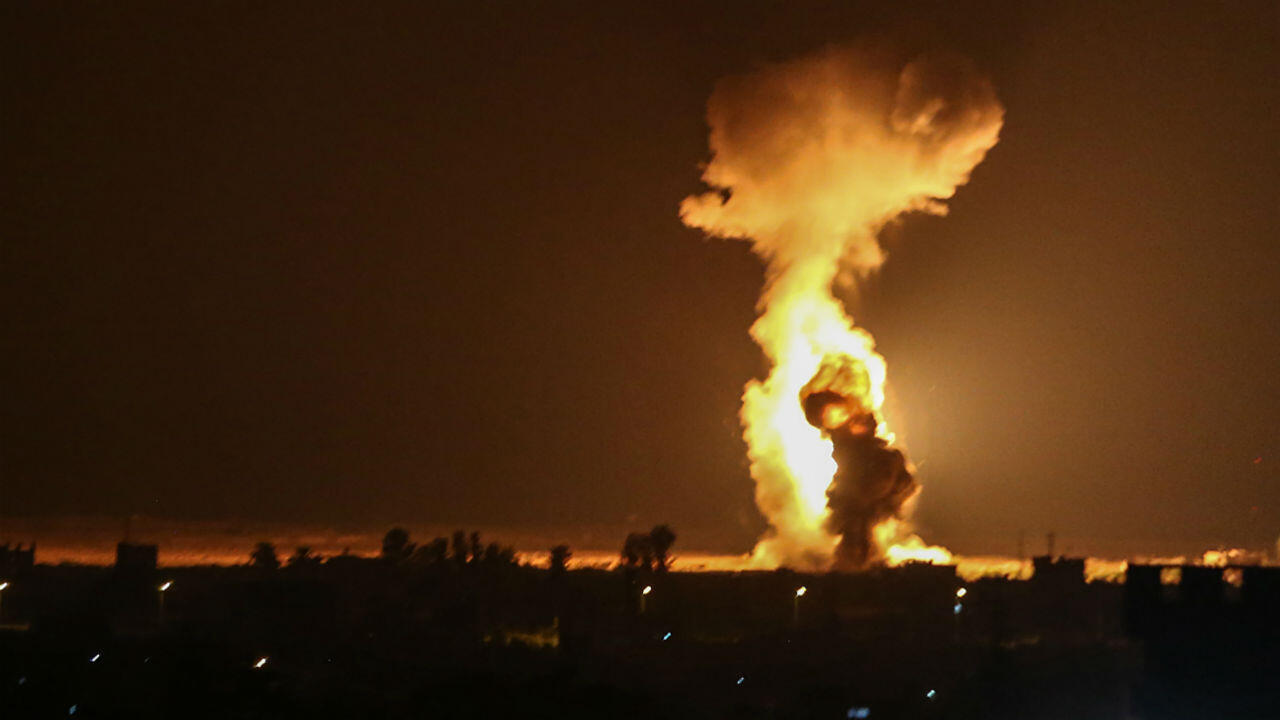
Image source: Smoke and flames rise after war planes belonging to the Israeli army carried out airstrikes over the southern Gaza Strip city of Rafah on August 12, 2020. © Said Khatib, AFP
 iDigress
With you on this. I am opposed to the brutal behaviour both of Hamas and Israel in this conflict. But I long to see the people of both territories reach a point where they can all live in peace.