
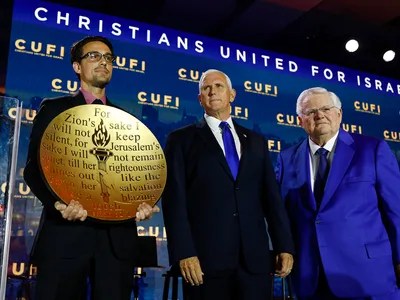
Christian Zionism is a religious movement that offers theological and political support for the modern State of Israel based on particular interpretations of the Bible. It is especially influential in parts of evangelical and Pentecostal Protestantism shaped at least in part by dispensationalist theology.
Its central claims typically include:
1. That God’s biblical promises concerning the land of Israel remain permanently and literally binding for the Jewish people.
2. That the establishment and preservation of the State of Israel fulfill biblical prophecy.
3. That Christians therefore have a religious obligation to support Israel politically and materially.
4. That events involving Israel play a key role in end-times expectations surrounding the return of Christ.
The movement is internally diverse, ranging from general pro-Israel sentiment among Christians to highly developed prophetic systems linking current Middle Eastern events to biblical end-times scenarios.
Christian Zionism and biblical theology
Christian Zionist theology rests on several contested biblical assumptions. First, it often reads land promises to Abraham and Israel in the Hebrew Scriptures as eternally binding in a modern political sense. Many theologians argue, however, that the New Testament reframes these promises through Christ, expanding God’s covenant purposes beyond one territory to encompass all nations (e.g., Gal 3:28–29; Eph 2:11–22). The land promise becomes part of a wider vision of reconciliation rather than a perpetual territorial mandate.
Second, dispensationalist interpretations sharply separate God’s plans for Israel and the Church, claiming modern Israel fulfills prophecy. Yet this system emerged only in the mid-19th century through theologians such as John Nelson Darby, and lacks grounding in earlier Christian tradition. By contrast, many biblical scholars and theologians instead see continuity in God’s redemptive purposes rather than parallel programs.
Third, apocalyptic readings of Scripture by Christian Zionists frequently assume that contemporary political events directly fulfill biblical prophecy. Often this leads to embarrassment as history moves on and their predictions and other claims are shown to be misguided. Critics note that biblical apocalyptic literature addressed first-century historical and social realities and speaks symbolically about God’s ultimate victory rather than the latest geopolitical alignments highlighted by news organisations.
Finally, Scripture consistently links possession of land with justice, mercy, and obedience to God, warning that injustice undermines any claim to divine favour. Thus, many theologians conclude that faithfulness to the biblical text cannot justify uncritical political support for any modern state but must instead prioritise the hard work of establishing peace, justice, and the reconciliation of all peoples.
Christian Zionism and antisemitism
Many adherents of Christian Zionism see their stance as an expression of solidarity with Jewish people after centuries of persecution, culminating in the Holocaust. Yet some forms of Christian Zionism arguably reproduce patterns of antisemitism even while claiming to support Jews and Israel. Understanding this critique is essential if Christian theology is to support both Jewish dignity and a just peace for Israelis and Palestinians alike.
One concern is that Christian Zionism often instrumentalises Jewish people within an eschatological narrative not of their own making. In some popular dispensationalist interpretations, Jewish restoration to the land is seen primarily as a necessary step toward end-times events culminating in Christ’s return, mass Jewish conversion, or catastrophic conflict. In this scheme, Jewish people are not valued for their own religious identity and ongoing covenantal life but for the role they play in fulfilling Christian prophecy.
Critics argue that this reduces Jewish communities to actors in a Christian drama, echoing older supersessionist patterns in which Judaism ultimately serves Christianity’s theological purposes.
A second issue concerns the effective erasure of Jewish diversity. Christian Zionist rhetoric often treats “the Jews” as a single political and theological entity uniformly committed to Zionist political goals as defined by evangelical Christians. In reality, Jewish opinion about Zionism and Israeli policy is diverse, both within Israel and across the diaspora.
When Christians assume that unquestioning support for current Israeli government policy is synonymous with support for Jewish people, they risk silencing Jewish critics and reinforcing simplistic ethnic or religious stereotypes—an indirect form of antisemitic thinking. Further, they risk being identified as complicit with morally questionable policies and actions of the Israeli state, and the unjust consequences of such policies and actions.
Third, some forms of Christian Zionism perpetuate what I regard as harmful theological assumptions about Jewish people and Judaism. Christian apocalyptic frameworks sometimes imply that Jewish suffering is divinely ordained or necessary within God’s redemptive economy. Such thinking can lead to the normalisation of violence affecting Jewish communities, excusing suffering as part of inevitable prophetic fulfilment.
Historically, Christian theology that spiritualises Jewish suffering has contributed to Christian indifference toward antisemitic persecution. Critics of such theology expressed concern that certain modern prophetic frameworks risk repeating these patterns.
Fourth, uncritical political alignment with Israeli state actions may unintentionally foster resentment against Jewish communities in other parts of the world, as political grievances are conflated with Jewish identity. When political conflict is framed in terms of religious absolutes, hostility toward state policy may spill over into hatred and violence toward Jewish people. Responsible Christian theology must therefore carefully distinguish between reasonable political critique and the potential erosion of religious and ethnic identity.
Theological alternatives
I have suggested that Christian Zionism is problematic on several fronts. What theological alternatives are there that better respect both Jewish dignity and the rights of Israeli citizens while faithfully interpreting Scripture?
The elephant in the room in all these discussions is the ongoing conflict between Israel and Palestine, and the following points recognise the conflict and the multiple issues it raises, while focusing on theology rather than political solutions.
One alternative is covenantal pluralism. Many Christian theologians affirm that God’s covenantal relationship with the Jewish people remains valid and should not be subordinated to Christian expectations of conversion or eschatological drama. This approach resists supersessionism while also affirming that modern political arrangements must be judged according to justice, human rights, and international law rather than biblical literalism.
A second approach is Christ-centred peacemaking theology. Instead of reading Scripture primarily through geopolitical prophecy, Christians may interpret biblical promises through the New Testament’s emphasis on reconciliation, justice, and peace. Jesus’s teaching on selflessly loving one’s neighbour and one’s enemy encourages Christians to protect the security and dignity of both Israelis and Palestinians. Scripture, in this view, guides ethical engagement rather than promoting territorial claims.
Third, many theologians advocate a theology of shared land and mutual belonging. Biblical narratives often stress hospitality to the stranger and justice for the vulnerable. Applied today, this suggests the possibility of support for political solutions that safeguard Israeli security while ensuring Palestinian rights and dignity. Such theology refuses zero-sum narratives and instead seeks coexistence.
Fourth, public theology offers an alternative framework. Rather than grounding political positions in apocalyptic expectations, Christians engage shared civic principles (such as human rights, democracy, and peace-building) to support policies benefiting all people in the region. This approach respects the integrity of plural societies in which Jews, Christians, Muslims, and others share contested political space.
In practice, a robust theological alternative to Christian Zionism includes several commitments: unequivocal opposition to antisemitism in all forms; recognition of Jewish historical trauma and legitimate Israeli security concerns; equal concern for Palestinian suffering and rights; and careful, humble interpretation of Scripture that prioritises justice and reconciliation over fanciful prophetic speculation.
The challenge for Christian theology is to express concerns about the state of Israel and support for Jewish communities in ways that avoid manipulating Jewish identity and denying the dignity of others. Faithful engagement requires Christians to honour the biblical call to justice, to affirm the ongoing relationship of God with the Jewish people, and to pursue peace for all who call the land of Israel home.
Rev Dr Rod Benson is General Secretary of the NSW Ecumenical Council and a minister of the Uniting Church in Australia serving at North Rocks Community Church in Sydney.
Image source: John Hagee (right), founder of Christians United for Israel, giving the Defender of Israel award to former U.S. Vice President Mike Pence (centre) in Arlington, Virginia, July 17, 2023. Britannica
 iDigress