
Public discussion about the history and politics of Israel often demands moral clarity expressed in simple declarations. One is expected either to “stand with Israel” or to oppose it. One affirms as historical fact the notion that “a people with no land came to a land with no people,” or chants “From the river to the sea, Palestine will be free.”
Yet the realities of history, suffering, and moral responsibility resist such categories. I would describe my own considered position as compassionate ambivalence toward the modern State of Israel. This reflects my unwillingness to offer unqualified political support for Israel, combined with deep respect and concern for the people who live within and around it: Jewish Israelis, Palestinians, and the many other national, religious, and ethnic communities whose lives are bound together in this ancient land.
Let me be clear: Israel’s existence cannot be fully understood apart from Jewish historical experience. Jewish attachment to the land stretches back thousands of years through Scripture, memory, and ritual longing, a complex tapestry of language, culture and everyday life sustained across exile and diaspora. Modern political Zionism (and here I am not referring to Christian Zionism) emerged in nineteenth-century Europe amid violent antisemitism and exclusion from civic life. Thinkers such as Theodor Herzl concluded that Jewish survival required state sovereignty rather than dependence on the goodwill of others.
The horrors of the Holocaust gave further moral justification and profound urgency to this aspiration. For many Jews, the establishment of Israel in 1948 represented not colonial ambition but geopolitical refuge after centuries of persecution and immense suffering culminating in genocide. Recognition of this history demands humility. Any ethical reflection that ignores the cold hard facts of Jewish history risks repeating patterns of indifference and suppression that proved catastrophic in the twentieth century.
Yet the establishment of Israel as a political state also involved profound losses for Palestinian people. There were, of course, many people living in the region prior to the migration of Jewish people in the late 19th and early 20th centuries.
Under British administration after World War I, competing national aspirations intensified as Jewish immigration increased, particularly during the Nazi era. The United Nations’ 1947 partition proposal sought compromise but satisfied neither community. When Israel declared independence and regional war followed, approximately 700,000 Palestinians fled or were expelled from their homes — the Nakba (Arabic for “catastrophe”) which remains central to Palestinian memory and identity.
Subsequent wars deepened mutual fears. Israel faced invasion attempts and existential hostility from neighboring states. The 1967 Six-Day War resulted in Israeli control over the West Bank, East Jerusalem, Gaza, Sinai, and the Golan Heights. Although peace agreements later returned Sinai to Egypt, Israeli administration of Palestinian Territories continued. Settlement expansion, fragmented governance structures, and recurring violence hardened distrust and complicated prospects for lasting political resolution.
My compassionate ambivalence toward the Israeli state arises largely from the moral tension between legitimate security needs and the human consequences of prolonged occupation. Human rights organisations, including Israeli voices, have documented settlement expansion, restrictions on movement, land confiscations, administrative detention, and military operations producing significant civilian harm. Gaza, governed by Hamas since 2007, has endured repeated wars leaving deep economic and humanitarian scars.
I have been directly involved in some of this documentation of alleged human rights abuse through my association with the Ecumenical Accompaniment Programme in Palestine and Israel, now administered in Australia by Act for Peace. At the same time, Israeli fears are neither imaginary nor trivial. The trauma of the Holocaust continues to shape national consciousness and inform public policy. Israel has experienced terrorism, suicide bombings, rocket attacks, and explicit threats from armed groups and regional actors hostile to its existence. For many Israelis, security policies and defensive actions are understood not as ideological choices but as safeguards against annihilation.
Holding these realities together is, naturally, a moral discomforting task. Such is life in the 21st century. Policies pursued in the name of security have inflicted suffering on Palestinians and risk entrenching permanent inequality. Yet the deadly violence of militant groups targeting Israeli civilians also destroys trust and undermines prospects for coexistence. Compassion requires thoughtful acknowledgment that existential fear exists on both sides — the fear by Jewish people of disappearance from the earth, and Palestinian fear of dispossession from the land. On both sides, where many people simply want to live with family in peace and tranquillity, there is constant fear of suffering and potential death through state violence and terrorism.
Christian responses to the creation and expansion of the Israeli state reflect similar divisions. Some Christians strongly support Israel, interpreting biblical promises as continuing political mandates or prophetic fulfillment. Others emphasise biblical commitments to justice, reconciliation, and solidarity with the vulnerable, leading them to critique occupation and inequality. Palestinian Christian communities often speak from lived experience, urging global churches to recognise how their theology intersects with and informs the realities of daily life.
Christian Zionism, particularly in some evangelical traditions, remains controversial. I have written about this elsewhere. Its critics argue that it risks reading contemporary geopolitics directly into biblical prophecy and can unintentionally sanctify political power. When theology becomes a justification for any state’s policies, ethical accountability may be diminished. At the same time, Christian critique must never ignore Jewish historical suffering or contribute to antisemitism. Responsible theology resists both romantic nationalism and moral indifference.
For me, compassionate ambivalence means refusing slogans that erase complexity in a highly contested ideological space. I cannot offer uncritical political endorsement of policies that perpetuate suffering or foreclose Palestinian dignity. Yet neither can I deny Israel’s legitimacy, Jewish historical connection to the land, or the genuine fears that shape Israeli society. To honour Israelis and Palestinians alike is to recognise that both peoples carry trauma, memory, fear, and hope.
Encounters with voices from across the region make this clear. Israeli parents fear rockets, kidnappings, and regional hostility. Palestinian families fear checkpoints, displacement, and recurring military incursions. Minority communities — Druze, Bedouin, migrant workers, Armenian Christians, African asylum seekers, and others — navigate identities often overlooked in polarized narratives. Each story complicates easy and simplistic judgment.
At its best, the Christian imagination must always seek to resist selective compassion. Scripture repeatedly calls followers of the way of Jesus to pursue justice with mercy, truth tempered by humility, and peace even when it appears unattainable. The prophetic vision of swords beaten into ploughshares in the Hebrew Scriptures does not belong exclusively to one nation or ideology. It belongs to our shared universal longing for reconciliation, peace and tranquility.
My position, therefore, is not neutrality born of indifference but restraint born of Christian conscience. I honour the resilience and cultural vitality of Israel’s Jewish communities. I likewise honour Palestinian endurance and longing for freedom and dignity. I honour all who seek peaceful coexistence in the face of fear and uncertainty
My deepest hope is not that one people prevail over another but that both flourish together. Compassionate ambivalence leaves room for diplomacy, repentance, and imagination: the difficult work required for lasting peace. Justice and security cannot ultimately be separated.
Only when Israelis and Palestinians alike are able to live without fear, and with dignity and mutual recognition, will the promise of peace begin to take root in this wounded and beloved land soaked in history, grace, and blood.
Rev Dr Rod Benson is General Secretary of the NSW Ecumenical Council and a minister of the Uniting Church in Australia serving at North Rocks Community Church in Sydney.
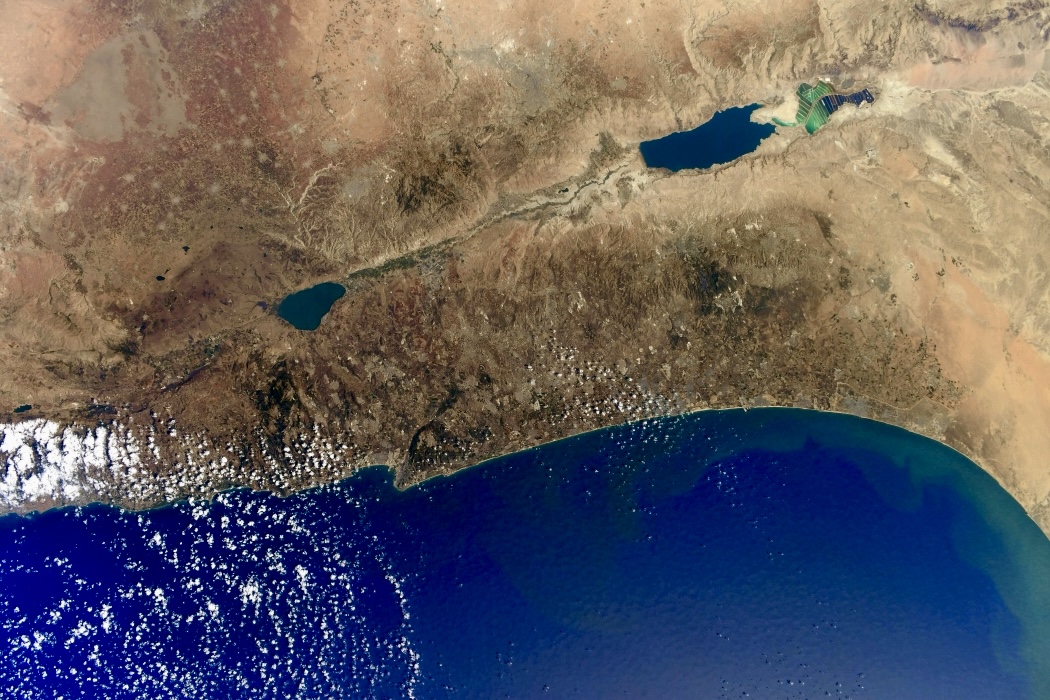
Image source: NASA
 iDigress