
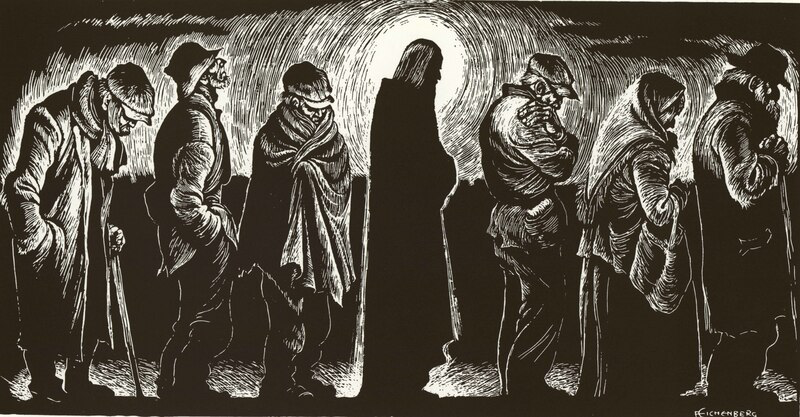
Our Gospel reading today tells the story of the “triumphal entry” of Jesus into Jerusalem (cf Zec 9:9), riding a donkey, welcomed by cheering crowds, just one week before his violent death. It’s the first of three symbolic acts in Matthew 21. It’s the beginning of Passover Week: Jesus enters Jerusalem, the holy City of David (vv. 8-11), cleanses the temple (vv. 12f), and curses a fig tree (vv. 18-22).
Everything about this man is disturbing. He presents not as proud but meek; he wears plain clothes, not the grand robes of royalty or the military elite; he arrives on a donkey, not a warhorse; and he is solitary among the crowds, not accompanied by columns of soldiers marching in his train.
There is a large crowd of visitors pressing in on him, but they are here to witness a spectacle. They expect some entertainment. What is Jesus doing here?
He’s not here to entertain. He is here to subvert cultural expectations about kingship, modelling humble service and a flattened hierarchy, symbolically announcing a new and radical way of thinking of and managing political power.
Later the same day, when he flips the tables of the merchants in the temple courts, he identifies with the temple and its holy authority, demanding religious purity in place of commercial expediency.
The next morning, his cursing of the fig tree declares that divine judgment is coming for the leaders of the nation and the temple, because they lack the righteous fruit required in the pursuit of their solemn responsibilities.
This is no sweet children’s tale. This is heavy stuff! But I want to focus on five words in Matthew 21:10-11:
When he entered Jerusalem, the whole city was in an uproar, saying, ‘Who is this? ’ The crowds were saying, ‘This is the prophet Jesus from Nazareth in Galilee.’
“The prophet Jesus from Galilee.” Those five words say so much.
I want to highlight four points.
1. Public interest does not equal deep faith
There are two different groups in this narrative. The “crowds” (vv. 8f) are people from the north, from Galilee, who have come to Jerusalem for Passover, and who know a little about this strange man Jesus. The “whole city” that is “in an uproar” (v. 10) are the locals, including the urban elite, the political and religious establishment, the captains of industry. They have no idea who Jesus is.
The Galilean crowd, pilgrims from the north, from Jesus’s hometown and region, greet him as the royal “Son of David” (v. 9; cf Ps 118:2, 5f). By contrast, in verse 10, the urban elite dismiss Jesus as a nobody, and a potential menace to public order. But the crowd speaks the truth: “This is the prophet Jesus from Nazareth in Galilee” (v. 11).
Jerusalem is accustomed to these seasonal crowds. They’re good for business, and rural piety has its place. But Jesus is making waves. He is becoming a threat to public order and to religious authority. A prophet who attracts popular acclaim, critiques the temple system, and disrupts its economic functions poses political and theological danger to those in power. They are well aware of what a prophet can do.
But don’t be too quick to join the crowd. In less than a week, this same crowd that welcomes Jesus as king in Matthew 21 will turn on him. So much emotionally-driven “faith” turns out to be no faith at all when it matters most, when it is challenged by power or public opinion.
What that community needed, and what we need today, is deep and durable faith in Jesus Christ, grounded in conviction, strengthened by confession, sustained by spiritual formation, and tempered by radical obedience as apprentices to Jesus, the prophet from Nazareth.
2. Cultural expectations domesticate the Gospel
In his commentary on this text, biblical scholar David Turner observes that the crowd
correctly describe Jesus with messianic language, but they incorrectly understand this language. They rightly quote messianic texts, but they wrongly model their Messiah after a conquering military hero.[1]
When the crowd identifies Jesus as “the prophet from Nazareth,” they are drawing on a rich tradition of Jewish prophetic vocation. For many, a prophet was not merely a predictor of future events but a divinely commissioned voice clarifying and interpreting the purposes of God for Israel in the present generation.
The crowds, and the urban elite, remembered classic prophets such as Isaiah, Jeremiah, Ezekiel and Malachi as those who spoke the word of the Lord into concrete historical situations, calling Israel back from apostasy to covenant faithfulness. Israel’s prophets exposed idolatry, challenged injustice, and warned of divine judgement while holding out hope of national restoration. But many thought the age of the great prophets had passed. Their influence had waned, their function eclipsed by law and custom. Calling Jesus a prophet from Nazareth domesticated him, placing him within familiar religious frameworks and dismissing his authority.
It’s so easy for us to fall into the same trap. Our culture reshapes Jesus in its own image. Think of the “Christian nationalist” Jesus, the therapeutic Jesus, the Jesus of John Laws and Scott Morrison and Donald Trump. Faithfulness requires us to allow Jesus to speak to us afresh, to confront and correct our false cultural projections, calling us to radical faith and radical obedience in the service of his kingdom.
3. Partial truth misses the full reality
The crowd was right: Jesus was from Nazareth, and he was a prophet. Earlier, in chapter 13:54-57, Jesus had begun to develop a reputation, teaching in the Nazareth synagogue and gathering a motley band of apprentices as was the practice of every would-be Jewish rabbi. And the locals said, “Where did this man get this wisdom and miraculous powers? Isn’t this the carpenter’s son?”
In response, Jesus rebukes them with an aphorism, saying, “A prophet is not without honour except in his hometown” (v. 57). And Matthew adds, “He did not do many miracles there because of their unbelief” (v. 58). What a tragic legacy.
Here in chapter 21, the crowd rightly identifies Jesus as a prophet, but not yet as Israel’s Messiah, not as the Son of God, and not as Lord. It is the same today. Many in our community recognise Jesus as a holy man, a person of wisdom, a guide to emulate. But they strongly resist talk of him as a saviour from sin, or as an absolute master.
What do you and I really believe about Jesus of Nazareth? Who is this man? Who is this now ancient prophet? All the clues are there in the words of Scripture, and in the record of Christian history. Jesus calls us to reach beyond partial truth and embrace full reality.
4. Confession is just the start of a life of apprenticeship
The confession by the crowd in verse 11 is a fine starting point, but if Jesus is merely a prophet, his mission has failed and they are missing out on so much that is within reach. We gain a full appreciation of who Jesus is, and why he entered our world, only through enlightened reflection on the events of Easter: his death on the cross, and his resurrection from the grave.
Yes, partial insight is admirable. Yes, to recognise Jesus as a prophet is to recognise that the eternal God speaks through him. Yet the events of Easter reveal Jesus to be far more than a prophet. He not only speaks the word of God; he enacts and embodies it. His authority is not derivative but intrinsic. His mission is not enlightenment but salvation.
For the crowd and the urban elite, and for us today, the question is not only “Who is Jesus?” but “What does paying attention to him and following him demand?”
At the end of the day, we are not saved by admiring a spectacle, appreciating great wisdom, or matching his teaching to our felt needs. We are saved by allegiance to Jesus, and we are called to serve as his apprentices in a confused and resistant world.
I close with a poem by the American Presbyterian poet Ann Weems (1934-2016) titled, “Come Unto Me”:
When the journey gets too hard
when we feel depleted,
when our compassion
turns to complaining,
when our efforts toward
justice and mercy
seem to get us nowhere,
it’s time to remember
the humility part –
that it is God who has made us
and not we ourselves;
that the saving of the world
or even one part of it
is not on our shoulders.
It is then we can come unto him,
and he will give us rest.
With rest we’ll remember
what it is we are about.[2]
Sermon 847 copyright © 2026 Rod Benson. Preached at North Rocks Community Church, Sydney, Australia, on Sunday 29 March 2026. Unless otherwise noted, Scripture quotations are from The Christian Standard Bible (Nashville: Holman Bible Publishers, 2020).
References
[1] David L. Turner, Matthew (Grand Rapids: Baker Academic, 2008), 497.
[2] Ann Weems, Kneeling in Jerusalem (Louisville, KY: Westminster John Knox Press, 1993).
Rev Dr Rod Benson is General Secretary of the NSW Ecumenical Council and a minister of the Uniting Church in Australia serving at North Rocks Community Church in Sydney.
Image source: “Christ of the Breadlines,” wood engraving by Quaker artist Fritz Eichenberg for the Catholic Worker (1950s).
 iDigress