
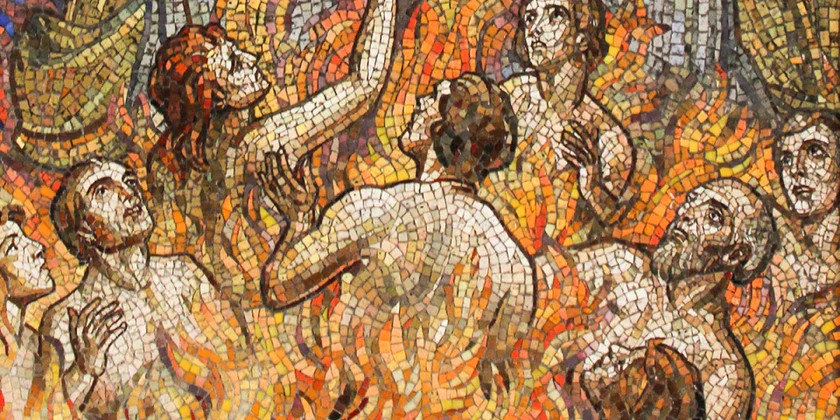
A Protestant appreciation of what has traditionally been called “purgatory” requires careful theological framing. It must proceed with biblical reasoning, doctrinal clarity, and appropriate restraint. Properly understood, it need not entail an uncritical adoption of late medieval developments, nor compromise the Reformation’s central convictions regarding justification by grace alone through faith alone. Rather, it may be rearticulated as a biblically grounded account of the final completion of sanctification: the consummation of God’s transforming work in the believer, brought to fulfilment in Christ through the Spirit.
The term “purgatory” carries substantial historical baggage. It is commonly associated with ideas of merit, punishment, and uncertainty about salvation—features rightly rejected by the Reformers. Yet beneath these accretions lies a more basic theological question: how are believers, who at death remain morally incomplete, made fit for the immediate presence of a holy God? This question is not foreign to Protestant theology but arises naturally from the tension between justification as a definitive declaration and sanctification as an ongoing transformation.
Scripture affirms both the necessity and the completion of holiness. Philippians 1:6 declares that “he who began a good work in you will carry it on to completion until the day of Christ Jesus.” Hebrews 12:14 insists that “without holiness no one will see the Lord.” At the same time, believers plainly do not attain moral perfection in this life. Protestant theology has often addressed this by appealing to union with Christ and definitive sanctification. Yet the biblical witness also gestures toward a transformation that reaches its telos in the eschaton, suggesting that the work of sanctification may be completed in a way not fully realised before death.
A constructive Protestant account, therefore, reframes “purgatory” not as a place or state of penal suffering, but as the final completion of sanctification. This reframing must be carefully qualified. The concerns of theologians such as Michael Horton, J. I. Packer, and Michael F. Bird are decisive in maintaining doctrinal boundaries.
First, justification must remain distinct and complete. Romans 8:1 affirms, “There is now no condemnation for those who are in Christ Jesus.” Horton in particular would insist that any notion of post-mortem purification must not imply that justification is incomplete or requires supplementation. The believer’s righteous status before God is final, grounded entirely in Christ’s atoning work. Any account of final sanctification must therefore exclude notions of merit, punishment, or uncertainty.
Second, there is no biblical warrant for imagining a post-mortem economy in which the living can affect the purification of the dead. As Bird observes, Scripture does not present the intermediate state as a realm of cleansing mediated by human action. This reinforces the need to avoid importing speculative or devotional practices that lack canonical grounding.
With these cautions in place, the concept may be positively restated. What has been called “purgatory” can be understood as the final moment, or process, in which God fully liberates the believer from the residual power of sin. It is not a “third place” between heaven and hell, but the consummation of the sanctifying process already underway through union with Christ. Revelation 21:27 affirms that “nothing unclean will ever enter” the New Jerusalem. The question is not whether believers will be made holy, but how and when this holiness is completed.
Some Protestant thinkers have gestured in this direction. John Wesley allowed for the possibility of continued growth in holiness after death, while C. S. Lewis spoke of purgatory as a necessary cleansing. More recently, Dallas Willard has offered a framework that, while not explicitly advocating purgatory, proves suggestive. In works such as Renovation of the Heart and The Divine Conspiracy, Willard presents salvation as the transformation of the whole person into Christlikeness. Salvation is not merely a change of status but a renovation of the self.
If this transformation remains incomplete at death, it follows that God will complete it. Willard occasionally gestures toward the idea of a final, purifying post-mortem encounter with God that prepares the believer for full participation in divine life. Importantly, however, his emphasis falls on present formation through grace and spiritual discipline. The future completion of sanctification is not a substitute for discipleship but its fulfilment.
At first glance, such an account might appear to threaten the doctrine of assurance. If further transformation is required after death, does this not introduce uncertainty? Properly understood, the opposite is the case. Assurance rests not on the believer’s degree of sanctification but on God’s faithfulness. Romans 8:30 declares that those whom God justifies, he also glorifies. The movement from justification to glorification is guaranteed. Final sanctification, therefore, is not a burden placed upon the believer but a promise secured by divine grace.
The doctrine of union with Christ is decisive here. As Horton and Packer emphasise, all aspects of salvation are grounded in participation in Christ. Final purification cannot be conceived as a separate process alongside this union; it is the full realisation of it. 1 John 3:2 expresses this succinctly: “When he appears, we shall be like him, for we shall see him as he is.” The vision of Christ is transformative. To behold him fully is to be conformed fully to his likeness.
A further methodological caution is necessary. Texts sometimes cited in support of purgatory, such as 1 Corinthians 3:12–15 or Matthew 12:32, do not clearly teach such a doctrine in their immediate contexts. As Bird notes, a responsible Protestant account should not depend on isolated proof-texts. Instead, it should arise from the broader canonical pattern. Scripture consistently affirms three converging themes: the necessity of holiness, the incompleteness of present sanctification, and the absolute purity required for communion with God. Together, these imply that God will bring believers to complete holiness, even if the precise manner remains unspecified.
Biblical imagery reinforces this pattern. God is repeatedly depicted as one who refines and purifies. Fire, in particular, functions not only as a symbol of judgment but also of transformation. What is impure is removed; what is true and good and beautiful is perfected. This imagery provides a theological grammar for speaking of final purification without constructing speculative mechanisms.
At the same time, the language of “process” should be used cautiously. It may suggest temporal stages or measurable progression after death, which Scripture does not clearly describe. A more restrained formulation would speak of a decisive divine act associated with entering Christ’s presence. Whether this act is experienced as instantaneous or in some extended manner is not revealed. What matters is its theological meaning: the completion of sanctification by God’s grace.
In this light, the language of purgatory may be cautiously reappropriated by Protestant Christians. When stripped of associations with merit, punishment and uncertainty, it functions as a way of articulating Protestant hope. It affirms that the God who justifies sinners also brings them to perfect holiness. It safeguards the finality of justification, grounds assurance in divine faithfulness, and remains anchored in union with Christ. Properly understood, it is not a concession to another tradition, but a clarification of the promise that God will complete what he has begun through the saving work of Christ.
Come what may, we shall be like him.
Rev Dr Rod Benson is General Secretary of the NSW Ecumenical Council and a minister of the Uniting Church in Australia serving at North Rocks Community Church in Sydney.
Image source: Laudate-Mariam.com
 iDigress
