
Australia has never been a monoculture. Long before European settlement, the continent was home to many Aboriginal and Torres Strait Islander peoples, cultures and languages. At the time of colonisation, about 250 distinct Indigenous languages were spoken, many with multiple dialects. Since 1788, successive migrations have added further layers of ethnic, cultural and religious diversity. The idea that Australia might recover a lost monocultural past arises from blatant political expediency and a questionable reading of our history.
This is the central insight of an important contribution to the current debate by Kanishka Raffel, Anglican Archbishop of Sydney, and Rabbi Dr Benjamin Elton, Chief Minister of Sydney’s Great Synagogue. Their article, “A plea to keep faith in our cultural diversity,” published in The Australian on 18 August 2026, responds to Senator Pauline Hanson’s advocacy of a more monocultural Australia.
Raffel and Elton acknowledge genuine problems associated with multiculturalism, including failures of integration and the isolation of communities. But cultural uniformity, they argue, is neither historically plausible nor socially desirable. Their alternative is “collaborative multiculturalism”: distinctive communities retaining their identities while participating in a shared Australian civic life.
Pauline Hanson’s monoculture
In her June 2026 National Press Club address, One Nation leader Pauline Hanson declared multiculturalism a failed policy, arguing that although Australia is a multiracial society, it should be “monocultural,” united beneath a common Australian cultural identity. She linked high immigration and inadequate assimilation with declining social cohesion, criticised the use of languages other than English, and particularly targeted what she described as the threat of “radical Islam.”
Within this argument, Hanson objected to migrants disregarding Australian “values,” language, traditions and customs, adding that Australia is “predominantly a Judaeo-Christian society.” The phrase thus formed part of a broader political argument about immigration, assimilation and national identity, in which Australia’s supposed Judeo-Christian inheritance was presented as an established cultural norm to which newcomers should accommodate themselves.
The proposal by the Sydney Archbishop and Chief Rabbi deserves serious consideration. It shifts the debate beyond a false choice between assimilation and fragmentation. From a Christian theological and ethical perspective, it also points toward a richer vision of Australian society shaped by unity without uniformity and diversity without fragmentation.
A common civic life
There is an important intuition behind contemporary concerns about multiculturalism that should not simply be dismissed. A successful society requires things held in common. Citizenship cannot mean that every community inhabits a separate moral and political world. Australians need shared institutions, the rule of law, democratic habits, sufficient linguistic competence for public participation, mutual obligations and commitment to the common good. These requirements, however, do not amount to a monoculture. It is important to distinguish culture from civic order.
Australians eat different foods, worship differently, inherit different traditions and profoundly disagree about sport, religion and morality while sharing allegiance to democratic institutions and (for the most part) accepting their common responsibilities as citizens. Parliamentary democracy, equality before the law and peaceful political participation do not require common ancestry or religion. We have inherited a plural culture that requires a common civic ethic.
Every functioning democracy expects newcomers to obey its laws, participate constructively in civic life and acquire the practical means of communicating with others. Integration is reciprocal participation in a common society. Coercive assimilation goes further by expecting minorities to abandon cultural or religious characteristics merely because they differ from those of the majority.
Nor should multiculturalism become an excuse for fragmentation. Communities that rarely encounter one another can become mutually suspicious, while social-media echo chambers intensify the problem by surrounding us with people who confirm our assumptions. Raffel and Elton rightly argue that the answer is greater engagement across differences, not confected cultural sameness. Social cohesion requires common commitments, but common commitments are not the same as common culture.
The limits of multiculturalism
On the other hand, a credible defence of multiculturalism must acknowledge that diversity is not an absolute good. Not every practice deserves protection simply because it is culturally inherited or religiously defended. Multiculturalism becomes ethically problematic when communal loyalty is used to legitimise coercion, violence, misogyny, sectarianism, racism, religious hatred or withdrawal from basic civic responsibilities. A just society must protect minority communities against prejudice and unjust majoritarian power while also protecting vulnerable individuals within those communities.
Collaborative multiculturalism therefore requires reciprocal obligations. Australians should be able to welcome cultural and religious difference while affirming that our common life places responsibilities upon us all. Respect for difference cannot mean indifference to injustice, just as commitment to common values should not become a pretext for suppressing legitimate difference.
Raffel and Elton locate this common life in mutual respect, democratic freedom and the rule of law. The constitutional position concerning religious freedom should nevertheless be stated carefully. Section 116 of the Australian Constitution prevents the Commonwealth from establishing a religion, imposing religious observance or prohibiting the free exercise of religion, and prohibits religious tests for Commonwealth office. It does not create a comprehensive individual constitutional right to religious freedom and does not generally constrain state governments. Broader protections arise from legislation, common law and Australia’s international human-rights commitments. Cultural diversity flourishes best within a civic framework protecting both freedom and equality.
Indigenous Australia
There is an important qualification to the language of multiculturalism. Aboriginal and Torres Strait Islander peoples are not simply cultural communities among other Australian cultural communities. Their presence precedes the Australian state, and their identities arise from enduring relationships to Country, kinship, law and culture, as well as from the history of colonisation and dispossession.
Indigenous Australia therefore does more than demonstrate that this continent was never monocultural. It reminds us that mature Australian pluralism must encompass reconciliation, truth-telling and justice for First Peoples rather than absorbing Indigenous identity into a general story about immigration and diversity. Australia’s cultural diversity has several histories, and they should not be collapsed into one another.
Multiculturalism and migration
Multiculturalism should likewise be distinguished from immigration policy. Three questions are frequently blended together: How many migrants should Australia accept? Who should be admitted? How should Australians of different backgrounds live together once they are here? They are related, but they are not identical.
Australians may reasonably disagree about immigration levels, population growth, housing, infrastructure and the capacity of institutions to accommodate rapid change. Supporting multiculturalism does not require supporting any particular immigration rate. Conversely, supporting high immigration does not absolve governments from attending seriously to integration, infrastructure and social cohesion.
Disagreements about future migration, however, should not determine whether Australians already here are treated as full members of the national community. Belonging cannot perpetually be conditional upon ancestry. Whatever our disagreements on immigration policy, people who belong to the national community should be treated with equal dignity and afforded genuine opportunities to participate in its common life.
A Christian social ethic
Christian theology offers important resources for thinking about such a common life. Raffel invokes the biblical command to practise hospitality to strangers, a theme running deeply through Scripture. Israel is commanded to love the stranger, remembering its own alienation in Egypt (Lev. 19:33–34; Deut. 10:17–19). Jesus identifies himself with the stranger who is welcomed (Matt. 25:35), while the Good Samaritan crosses entrenched religious and ethnic boundaries to become neighbour to a wounded man (Luke 10:25–37).
Tolerance may mean little more than leaving other people alone, whereas hospitality requires making room for them. Yet a commitment to hospitality is not enough to ensure a flourishing community. The language of host and guest may imply that some Australians permanently own the house while others remain visitors. Christian social needs to encourage a sometimes difficult move from tolerance to hospitality, from hospitality to recognition, from recognition to solidarity, and ultimately toward fully shared responsibility for the common good.
Christian anthropology provides a foundation for that movement. If every human being bears the image of God (Gen. 1:26–27), human dignity precedes nationality, ethnicity, culture and religion. Christians encounter people of other faiths, people of no faith, migrants and Indigenous Australians first as fellow human beings whose dignity is not conferred by the state, the majority culture or the church. This does not erase differences or require Christians to regard all beliefs as equally true. It provides a moral basis for treating those with whom we disagree as neighbours rather than threats.
Pentecost offers a suggestive theological image of unity amid difference. Acts 2 is not a political theory of multiculturalism, but its symbolism is striking. The Spirit does not create unity by making everyone culturally identical; one message is heard through many languages. Similarly, Revelation imagines redeemed humanity drawn from “every nation, tribe, people and language” (Rev. 7:9). These texts are not blueprints for Australian public policy, but they nourish a Christian imagination in which communion does not require the erasure of difference.
Living well with difference
Perhaps the most important feature of Raffel and Elton’s intervention is the identity of its authors. I understand that one is an Anglican Christian of Sri Lankan heritage; the other an Australian Jew of English origin. They represent traditions sharing important historical connections while differing over fundamental theological questions. Their cooperation for the common good is itself a practical demonstration of the pluralism they advocate.
A mature democracy does not require agreement about everything. Christians, Jews, Muslims, Hindus, Buddhists, atheists and others will continue to disagree about God, human nature, morality and the good life. The test of social cohesion is not whether those disagreements disappear, but whether we can conduct them without denying one another’s dignity or membership in the political community. Democratic pluralism requires neither theological relativism nor moral indifference. It requires the discipline of living constructively with people whose deepest convictions differ from our own.
Religious communities can make an important contribution here. Australia does not need religion to retreat entirely into private life, nor does it need religious communities seeking political or cultural domination. It needs communities sufficiently confident in their convictions to engage generously with those who do not share them. For Christians, that means bringing the resources of creation, neighbour-love, hospitality, justice, reconciliation and peacemaking into public life—not to secure privilege for Christianity, but to serve our neighbours and contribute to the common good.
The Australian common good
There are genuine reasons why some Australians worry about social cohesion. Rapid social change can generate uncertainty, economic pressures can sharpen resentment, and communities can become isolated. Online environments can further reward outrage and suspicion. These concerns deserve serious discussion rather than easy dismissal. Acknowledging them does not concede the case for monoculturalism; it recognises that successful pluralism requires sustained social and political work.
The better response to fragmentation is to strengthen civic belonging. That work happens through institutions and relationships: schools, sporting clubs, workplaces, universities, neighbourhood organisations, local councils, churches, synagogues, mosques and temples. Social cohesion is not manufactured by slogans. It is learned through repeated encounters in which people discover that those who appear different are also neighbours, colleagues, friends and fellow citizens.
This is where Raffel and Elton’s idea of collaborative multiculturalism is especially attractive. It asks Australians to move beyond merely occupying the same territory towards building a common home together. Such a society does not emerge automatically from diversity. It must be cultivated through institutions that encourage encounter, political practices that respect disagreement, laws that protect freedom and equality, and citizens willing to assume responsibility for one another.
Christian hope adds something distinctive to that vision. It is not optimism that human beings will naturally overcome prejudice and conflict. Christianity takes human fear, selfishness and hostility seriously. Yet reconciliation is heart of the gospel of Jesus. Estrangement need not have the final word, and inherited divisions need not determine the future. Christian hope encourages engagement with social difference not because reconciliation is easy, but because relationships and communities can be transformed.
I believe that together we can build a society in this ancient land that is confident enough to welcome difference without fearing disintegration, strong enough to uphold common responsibilities without demanding cultural conformity, and generous enough to recognise that people may belong wholeheartedly to Australia while cherishing different histories, traditions and faiths. This is not a retreat from national identity but a mature understanding of it, articulating a genuine sense of belonging grounded in shared citizenship and responsibility rather than cultural sameness.
What dreams may come
The Australian future I want to see will not be a future in which our differences have disappeared but one in which our differences no longer prevent us from recognising and celebrating one another as valued neighbours. Our future is not a confected monoculture pandering to a politics of fear. Nor is it a disconnected multiculturalism imposed on a reluctant nation.
The future I want to see is a shared Australian life, diverse in its cultures, secure in its democratic commitments, just in its treatment of difference, and united in responsibility for the common good. There are political and corporate interests intent on closing that window of opportunity, but it currently remains open. It’s our task as Australians to open it wide and let in a breath of hopeful, harmonious, joyful fresh air.
Rev Dr Rod Benson is General Secretary of the NSW Ecumenical Council and a minister of the Uniting Church in Australia serving at North Rocks Community Church in Sydney.
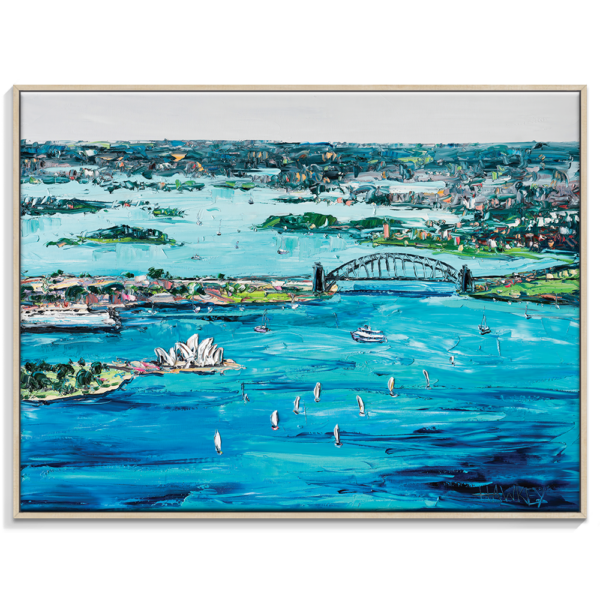
Image source: Angela Hawkey, ‘Sydney Harbour,’ Artist Lane (2025).

