
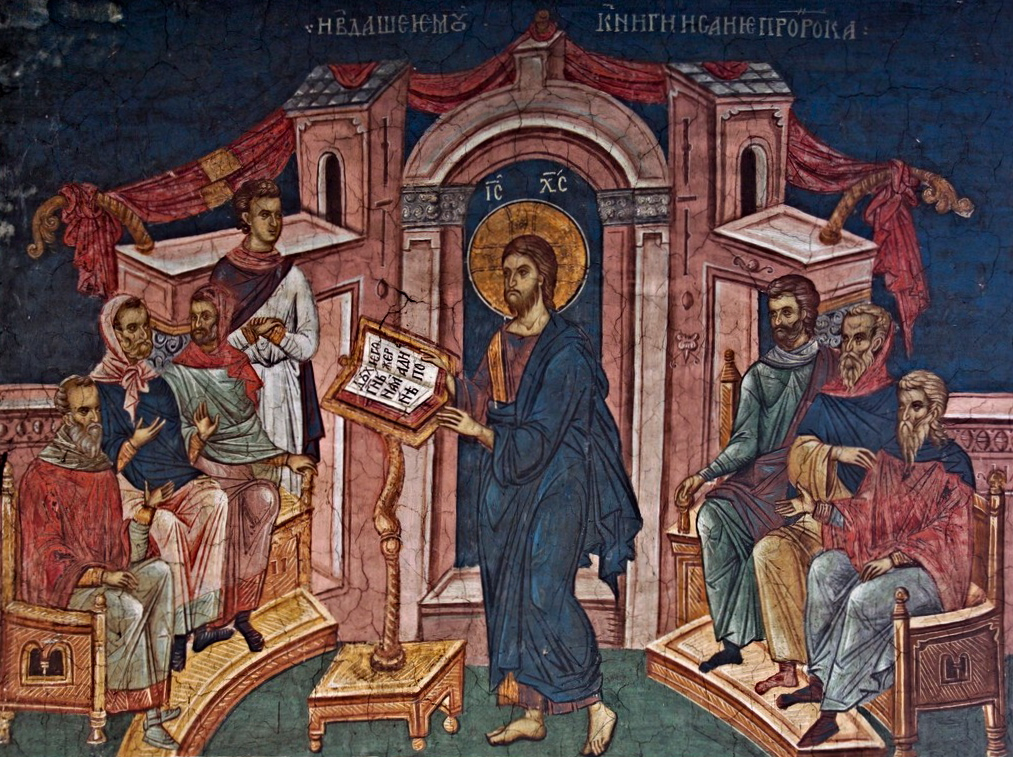
Visoki Decani Monastery, Kosovo
Working in the Sydney CBD, I have often walked past “rough sleepers” on the streets outside the Queen Victoria Building, railway station entrances, and the steps of churches. You’ve probably seen them too.
Occasionally, a passer-by will place some spare change in a cup or box at their feet. More occasionally, someone engages the rough sleeper in conversation, and buys a burger or a coffee and brings it back to them.
Kindness like that is a precious gift. May God inspire more of us to live open-handed in support of those less fortunate than ourselves. When you’re actually hungry, and you don’t know where your next meal is coming from, the generosity of a stranger means a lot. Learning the name of the person in need, and asking how you can help them, might just change both of your lives.
But what if you returned next week and there are ten rough sleepers? Compassion asks, “How can I help this person?”
Justice adds a deeper question: “Why do people repeatedly find themselves in circumstances requiring emergency assistance?” Or a wider question still: “With all our technology and wealth, and knowing what we know about food scarcity and malnutrition and starvation, why are we unable to end world hunger?”
In a synagogue at Nazareth, a young man named Jesus reads from the scroll of Isaiah. The Spirit has anointed him “to bring good news to the poor.” He announces release for those in chains, sight for the blind, freedom for the oppressed, and he announces the year of the Lord’s favour. Then he takes his seat and says that the Scripture has now been fulfilled, in their hearing (Lk 4:16-21).
In the arrival of Jesus, God’s promise of an end to all forms of oppression comes within reach of people whose lives are constrained by powers they cannot overcome on their own. But how is that good news to someone who cannot afford a place to live, or who has no money to buy tomorrow’s dinner, or their child’s medication?
The year Jesus proclaims echoes the Jewish tradition of Jubilee, when Israel was called to put release into practice. The weekly Sabbath gave servants and resident foreigners a claim to rest alongside the household that depended on their labour. The law of gleaning required landholders to leave the edges of their fields for poor people and foreigners to harvest. Jubilee called for liberty and the return of ancestral holdings, setting a limit to how permanently a family could lose its land. When Amos denounces merchants who used false scales, he exposes how ordinary transactions can be arranged to exploit people.
Underneath those commands lies a conviction about creation. “The earth is the Lord’s,” says the psalmist (Ps 24:1). The land and its fruits were gifts from God before they became property or produce. There is room in that conviction for owning a home, building a business and making decisions about what we purchase and possess.
Catholic social tradition calls this the universal destination of goods. The earth’s goods are intended for the benefit of all humanity, not just a few and not just my tribe. What we own, we hold lightly and contingently within that larger purpose. Our freedom to use what we own carries a responsibility to do good to others, including strangers, foreigners and rough sleepers.
In Luke 16, Jesus gives the “other” a name. The man Lazarus lies hungry at the gate of another man who has more than enough food and wine every day, a fine roof over his head, and a soft bed at night. An offer of a meal would have meant so much to Lazarus. An open gate and a place at the rich man’s table might well have changed his life.
Both men die, and come face to face with ultimate reality, and the tables are turned. Now they are equals, and there are consequences. Abraham tells the rich man that his brothers have Moses and the prophets to tell them how to live. They have enough Scripture to show them what to do about the destitute man at their gate.
But the time to do good has come to an end for this rich man.
After the resurrection and ascension of Jesus, the first believers quickly learned what to do with their resources. In the Book of Acts, they sell their possessions and share the proceeds to help those in need. The Letter of James takes us to the other side of the transaction. The wages withheld from the harvesters cry out to God. A worker waiting to be paid needs what is owed.
There are personal and social dimensions to the economic ethics of the Bible. So let me ask a question: What does the teaching of Jesus have to say about Australian economic policy?
The New Testament offers moral criteria for judging the economic responsibilities of the modern nation state while leaving specific policies open to democratic deliberation. The New Testament writers lived in a world of Roman taxation, agrarian inequality, patronage and slavery.
Applying the economic principles evident in their writings in a plural democracy requires interpretation and application to our context. We read passages in their original context, identify their moral claims, express those claims in publicly defensible terms, and test which policies best articulate those principles in Australia today. It sounds like a logical process, but there are multiple hidden complexities. That is why we have political theology, and public theology, and theological ethics.
Jesus’ proclamation of God’s reign places poor and vulnerable people at the centre of economic judgment. Growth, employment and price stability matter for what they make possible, including material security and participation. Jesus’ warnings about wealth challenge the equation of prosperity with accumulation and consumption. Health, education, leisure and caring relationships also have a place in any account of flourishing.
Property also carries responsibilities. The rich man’s neglect of Lazarus, and Zacchaeus’s restitution of what he has stolen from those he taxed (Lk 19:1-10) expose the obligations that accompany wealth. The voluntary sharing in Acts, and Paul’s collection for Jerusalem (1 Cor 16:1-4; 2 Cor 8:1-9:15) show how one community’s abundance can meet another’s need.
These examples give moral weight to principles of sufficiency and fair distribution. Modern governments can pursue these ends through wages, housing, education, public services and income support, with attention to how each measure works.
The teaching of Jesus on tribute to Caesar (Mt 22:21), and Paul’s account of governing authority in Romans 13, recognise taxation as a legitimate civic obligation. Public revenue funds our justice system and social safety net as well as roads and hospitals and schools. Its collection and use require transparency, proportionality and accountability, including scrutiny of who ultimately pays and what public spending achieves.
The portrayal of Babylon in the Book of Revelation also invites scrutiny of concentrated economic power, exploitation and corruption in government and business. The affirmation that workers deserve fair payment, and condemnation of withheld wages, make labour conditions a matter of justice. Their implications include fair pay, safety, bargaining power and recognition of unpaid care.
New Testament teaching on practical care for people in need supports social protection that relieves hardship and enables participation. The parable of the Good Samaritan extends neighbour-love across boundaries, challenging governments to consider how trade, migration and aid decisions affect people beyond their borders.
The New Testament’s vision of the renewal of creation also give ecological stewardship and intergenerational justice a place in national economic policy. Governments must consider who bears the costs of pollution, resource depletion and biodiversity loss, including future generations. Both science and economics help determine which responses are effective and fair.
We can also link this economic framework to the Uniting Church’s Basis of Union and its vision of an economy centred on human wellbeing and creation. Christian ethics helps identify and prioritise the question of why public and private institutions should serve the community. Choosing how to serve them requires evidence about outcomes and trade-offs, sound legal reasoning, and (where possible) respect for citizens who hold different beliefs.
Ultimately, though, government and business cannot do everything. It all comes back to our individual choices and motivations. In Luke 4, Jesus acknowledged his responsibility and role in bringing justice and mercy to his world. In Luke 16, the rich man failed to see the need at his front gate, and failed to act with justice and mercy in his world.
What is God calling us to be and to do today, as we seek to follow Jesus, for the sake of justice and mercy?
Sermon 877 copyright © 2026 Rod Benson. Preached at North Rocks Community Church, Sydney, Australia, on Sunday 8 November 2026. Unless otherwise noted, Scripture quotations are from The Christian Standard Bible (Nashville: Holman Bible Publishers, 2020).
Rev Dr Rod Benson is a minister of the Uniting Church in Australia serving at North Rocks Community Church in Sydney.
Image source: Mind Journeys
Taking it further…
Reflection questions
- How does Rod distinguish compassion from justice in his opening account of rough sleeping in Sydney? Why does he see a need for both?
- How do the sharing of possessions in Acts and the condemnation of withheld wages in James illuminate two different responsibilities towards people in need?
- What criteria does the sermon draw from the New Testament for evaluating Australian economic policy? Why does Benson also emphasise evidence about outcomes and trade-offs?
Application questions
- What is one way you could use your money, possessions or time differently this month in light of the sermon’s claim that ownership carries responsibilities?
- Where could you check whether workers are being paid fairly in a workplace, church or organisation you belong to? What could you do if you discovered a problem?
- Choose one Australian policy proposal on housing, wages or income support. How would you assess its likely effect on people facing the greatest hardship, and what evidence would you look

