
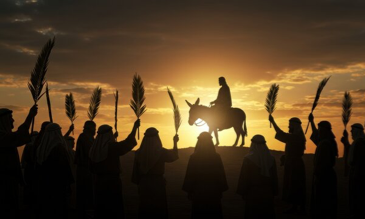
The portrayal of the entry of Jesus to Jerusalem (Lk 19:28-40) draws deeply on the theology and symbolism of Luke’s earlier reference to Mary’s song, known to us as the “Magnificat” (Lk 1:46-55). Of the four Gospels, Luke’s account of the life and teachings of Jesus most clearly demonstrates an emphasis on radical social justice informed by the teaching of the Hebrew prophets and the rest of the Hebrew Scriptures. These two Lucan texts are prime examples of this emphasis.
The Magnificat functions as an overture to Luke’s Gospel. Placed on Mary’s lips before Jesus is born, it announces in poetic form the radical social, political, and theological reversal embodied by the arrival of the kingdom of God in the ministry of Jesus. The language of the song is saturated with revolutionary imagery: the proud are scattered, the mighty cast down from their thrones, the lowly lifted, the hungry filled, and the rich sent away empty. A divinely inspired reordering is on its way. A long-awaited judgment on arrogance and injustice is coming, and a restoration of universal mercy and peace.
Luke shows that the mission of Jesus is to proclaim – in word and deed – good news to the poor, release to captives, sight to the blind, and freedom for the oppressed (Lk 4:18-19). The Magnificat anticipates this new order marked by justice and mercy, where power is redefined by humble service. It is a theological revolution grounded in divine faithfulness to Abraham and all his descendants. The movement of history is bent toward reconciliation because it is directed and empowered by divine promise and the imperative of flattening harmful hierarchies and rejecting power, corruption, and greed.
Palm Sunday intensifies this paradox between power and service, authority and humility. As Jesus enters Jerusalem, hailed with what amounts to royal acclamation, the crowd invokes a messianic hope: “Blessed is the king who comes in the name of the Lord” (Lk 19:38a). Yet the king chooses to arrive on a colt or donkey, not a warhorse. And the song of chapter one bears the voice and passion of Mary, not of Joseph. The kingdom of this King is an upside-down one, and its nature guarantees its enduring relevance to all human communities.
In particular, at a time when wars and other conflicts are on the rise, Luke confronts us with the fact that the revolution embodied by the humble presence of King Jesus intentionally opposes coercion and militarism. The peace we proclaim on Palm Sunday, “peace in heaven and glory in the highest” (Lk 19:38b), echoes the angelic song at his birth and fulfils the trajectory set by the Magnificat. Jesus rejects the standard script of domination, where greatness is defined by force and wealth, replacing it with a radical narrative of self-giving love.
Both texts proclaim Jesus as Israel’s promised Messiah. The Magnificat announces his impending birth, and the crowd in Luke 19 shouts, “Blessed is the King who comes in the name of the Lord.” Mary’s song assures us that God will “scatter the proud” and “exalt the humble” (Lk 1:51f). The triumphal entry symbolically fulfils this by having the king enter on a humble donkey. The Magnificat declares that God has “filled the hungry with good things” and “sent the rich away empty” (Lk 1:53). Similarly, Jesus welcomes and enables ordinary people rather than the religious elite. Luke wants all who follow Jesus to take note and act likewise.
Our annual celebration of Palm Sunday, a week before Easter, is more than an opportunity to wave palm branches and sing enthusiastic songs of hope. It recalls the subversive, generative and dangerous example of Jesus, the servant-king. It reminds the people of God, those who affirm Jesus as their sovereign, to embody justice without vengeance, revolution without violence, and genuine reconciliation grounded in God’s faithful mercy. It invites all people everywhere to speak up, and march, and work for lasting peace in our world.
Rev Dr Rod Benson is General Secretary of the NSW Ecumenical Council and a minister of the Uniting Church in Australia serving at North Rocks Community Church in Sydney.
Image source: Adobe stock
 iDigress