
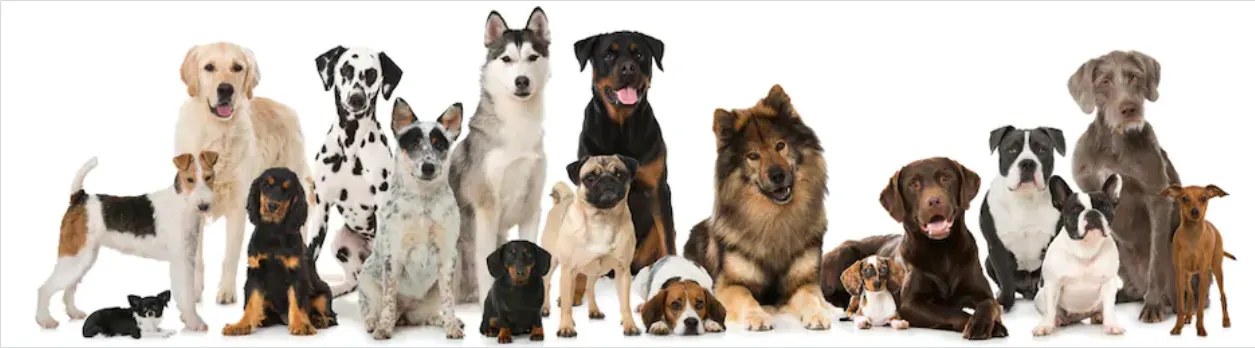
The extraordinary diversity of dog breeds in the modern world, from the towering Irish Wolfhound to the compact Chihuahua, is the result of a long and intricate partnership between humans and animals.
Unlike most domesticated species, dogs exhibit an extraordinary level of variation. This diversity reflects not only biological potential but also human culture and labour. Moreover, dogs feature distinctively in imaginative literature and religious texts, reminding us of their long cohabitation with humans.
Evolutionary origins
All dogs as we know them today descend from the gray wolf (Canis lupus), domesticated between 15,000 and 30,000 years ago. The domestic dog (Canis lupus familiaris) is one of the most familiar animals in human life, yet its origins lie deep in the evolutionary history of carnivorous mammals.
Dogs belong to the biological family Canidae, which includes wolves, foxes, and jackals. This family emerged from earlier carnivorous mammals over 40 million years ago. Among these early ancestors were small, weasel-like creatures that gradually evolved into more specialised hunters.
Over millions of years, evolutionary pressures such as climate change, prey availability, and competition favoured animals that could run efficiently, hunt cooperatively, and adapt to diverse environments. This process eventually produced what humans have labelled the genus Canis, which includes wolves, coyotes, and domestic dogs.
Domestication of the species
Wild wolves developed complex social structures, cooperative hunting strategies, and high intelligence. These traits would later make domestication possible.
The transition from wolf to dog occurred through a gradual process of domestication, although dogs and wolves may still successfully interbreed. A widely accepted theory proposes that certain wolves began to associate with human camps. These animals were likely less aggressive and more tolerant of human presence. They scavenged food scraps and benefited from the relative safety of living near humans. In turn, humans may have benefited from their alertness, which could warn of danger, and their ability to assist in hunting.
Over time, humans began to favour and intentionally breed the more docile and cooperative wolves. This led to a process known as self-domestication, followed by increasingly deliberate selection. As wolves adapted to life alongside humans, their behaviour and physical form began to change.
Genetic plasticity
Genetically, as dogs diverged from wolves, changes appeared in coat colour, ear shape, tail carriage, and skull structure. These traits are part of what scientists sometimes call the “domestication syndrome,” a suite of characteristics that commonly appear in domesticated animals. Importantly, dogs retained and even enhanced their social intelligence. Their ability to read human cues, such as pointing or eye gaze, is more advanced than that of wolves, suggesting that domestication selected for communication as much as for temperament.
Genetic studies suggest that domestication could have happened in multiple regions, including parts of Eurasia. Different populations of wolves may have independently begun the domestication process, later mixing as human populations moved and interacted. Early dog remains have been found in Europe, Siberia, and East Asia, indicating that the human-dog relationship was widespread and possibly arose more than once.
Once domesticated, dogs spread rapidly alongside human populations. As humans migrated, settled, and developed new ways of life, dogs adapted with them. Different environments and tasks led to the emergence of distinct types of dogs such as hunters, herders, guardians, and (especially in the twenty-first century) companion animals.
What distinguishes dogs from many other domesticated animals is their genetic plasticity. Of all animal species, they are unusually responsiveness to selective breeding. Humans quickly discovered that by choosing which animals to breed, they could accentuate particular traits: docility, alertness, strength, or sociability.
Over generations, these traits became embedded in distinct populations. Importantly, this process occurred rapidly in evolutionary terms. The dog’s genome allows for significant morphological change without compromising viability, which explains how radically different breeds can emerge within relatively short periods.
Functional specialisation and the rise of types
As human societies developed, dogs were shaped for specific tasks. Herding, hunting, guarding, and companionship all required different capabilities. This led to the emergence of functional “types” of dogs, many of which later became formal breeds.
The Border Collie exemplifies precision and intelligence in managing livestock, while the Bloodhound demonstrates extraordinary olfactory tracking ability. In colder regions, the Siberian Husky evolved for endurance and resilience, while guarding breeds such as the Rottweiler were selected for strength and protective instinct.
A fine example of functional design is the Dachshund, originating in Germany several centuries ago as a specialised hunting dog shaped by functional breeding. Its name, meaning “badger dog,” reflects its primary role of tracking scent, flushing prey, and entering burrows to confront animals such as badgers, foxes, and rabbits. Breeders selected for an elongated body, short but muscular legs, strong claws, and a deep chest for lung capacity, enabling sustained underground work.
Over time, distinct varieties emerged. Standard Dachshunds were used for larger prey like badgers, while smaller miniature forms were developed for hunting rabbits. Coat variations (smooth, long-haired, and wire-haired) reflect crossbreeding with spaniels and terriers, enhancing protection and adaptability in different terrains and climates.
By the nineteenth century, the breed’s role expanded beyond hunting. Their intelligence, alertness, and distinctive appearance made them popular companion animals across Europe, while still retaining strong natural instincts rooted in their working origins as hunting dogs.
Geographic isolation and local variation
Before modern transport, dog populations were geographically isolated. This allowed distinct traits to develop within specific regions. Environmental pressures such as climate, terrain, available prey or livestock further shaped these dogs.
For example, the Shiba Inu reflects its adaptation to the mountainous terrain and hunting culture of Japan, while the Australian Cattle Dog embodies the demands of managing livestock across vast and often harsh Australian landscapes. These regional adaptations gradually solidified into recognisable breeds.
The modern invention of “breed”
The contemporary notion of fixed dog breeds is relatively recent. In the nineteenth century, organisations such as The Kennel Club (established in 1873) formalised breed standards. These standards defined the “ideal” appearance and temperament of each breed.
While this system helped preserve distinct traits, it also narrowed genetic diversity. Breeding increasingly prioritised aesthetic conformity over functional health, sometimes leading to inherited disorders. Thus, the very process that produced the rich diversity of breeds also introduced new vulnerabilities.
Not all breeds are the result of practical necessity. Many reflect cultural taste. Companion breeds such as the Pomeranian or the French Bulldog owe their existence largely to human preference for particular appearances and temperaments.
Dogs have also functioned as symbols of status, identity, and belonging. In different societies, certain breeds signal refinement, strength, or loyalty. Thus, the proliferation of breeds mirrors not only human needs but also human desires.
Dogs in sacred texts
Dogs are not only biological companions; they also occupy a complex place in the sacred texts and traditions of major world religions.
In the Bible, dogs are often portrayed ambivalently. In some passages, they are associated with impurity or scavenging (e.g., Proverbs 26:11), yet they also appear as part of everyday life. The story of the Syrophoenician woman (Mark 7:24–30) uses the image of dogs metaphorically, reflecting social boundaries while simultaneously challenging them.
In the Qur’an, dogs are similarly complex. While certain Islamic traditions regard dogs as ritually impure, the Qur’an itself includes a more positive portrayal in the story of the “Companions of the Cave” (Surah 18), where a faithful dog keeps watch over the sleepers. This image suggests loyalty and guardianship.
In Hindu traditions, dogs appear in association with deities such as Bhairava, often depicted with a dog as his companion or vehicle. Dogs are also linked to Yama, the god of death, whose hounds guard the path to the afterlife. Here, the dog is a liminal figure, standing at the boundary between life and death.
In Buddhism, dogs occasionally symbolise ignorance or attachment, yet stories also emphasise compassion toward all sentient beings, including animals. In many traditions, feeding stray dogs is considered a meritorious act.
Across these religious traditions, dogs are often situated at the margins between purity and impurity, domesticity and wildness, life and death. Yet they are also consistently associated with loyalty, vigilance, and companionship.
Dogs in English literary tradition
Dogs have also played a notable role in imaginative literature. For example, in the English literary tradition dogs often serving as symbols of loyalty, instinct, and the boundary between civilisation and nature. In medieval literature, dogs frequently appear as hunting companions, reflecting aristocratic culture and the close relationship between humans and animals.
In the works of William Shakespeare, dogs are used metaphorically to express both affection and contempt. Characters may be described as “dogs” to signify loyalty or, conversely, degradation. This dual usage reflects the ambivalent cultural status of dogs in early modern England.
In the eighteenth century, writers such as Alexander Pope famously commemorated his dog Bounce in verse, elevating the animal as an object of affection and reflection. By the nineteenth century, dogs had become central figures in narrative fiction. Charles Dickens includes memorable canine characters, such as Bull’s-eye in Oliver Twist, who mirrors the moral ambiguity of his owner.
Perhaps the most iconic literary dog is Sherlock Holmes’s spectral adversary in The Hound of the Baskervilles, where the dog becomes a symbol of fear, superstition, and the unknown. Here, the dog occupies a liminal space between the natural and the supernatural.
Across English literature, dogs function not merely as background figures but as symbolic mediators, linking instinct and reason, nature and culture, loyalty and threat.
The long-term future of dogs
What is the future of this remarkably adaptable species? In the near term, dogs will likely continue to diversify, especially through hybridisation and advances in genetic science. There is growing awareness, however, of the health consequences of extreme selective breeding. This may lead to a shift toward more sustainable practices that prioritise genetic diversity and wellbeing over rigid aesthetic standards.
More broadly, the future of dogs is tied to the future of human society. As urbanisation increases, demand for smaller, adaptable companion animals may grow. At the same time, working roles for dogs, from detection to therapy and assistance, are expanding in new directions.
Dogs have thrived because of their capacity to live alongside humans. Speculatively, however, one might ask whether dogs could outlast or even supersede humans. This idea is explored in the science fiction novel City by Clifford D. Simak, where dogs evolve into intelligent, articulate beings who inherit the Earth long after the decline and disappearance of the human race. The stories, framed as canine legends about humans, invert the familiar hierarchy and suggest that the qualities we have cultivated in dogs, such as cooperation, loyalty, and social cohesion, might form the basis of a different and superior kind of civilisation.
Conclusion
The vast number of dog breeds in our world today is the cumulative result of millennia of human selection, shaped by work, environment, culture, and imagination. Dogs are, in a real sense, living artefacts of human history.
Yet they are more than that. Their presence in sacred texts suggests that dogs also occupy a symbolic and moral space within human thought. Their future as companions, workers or successors remains deeply intertwined with our own. The story of the dog, at least for now, is a shared narrative of adaptation and companionship.
Rev Dr Rod Benson is General Secretary of the NSW Ecumenical Council and a minister of the Uniting Church in Australia serving at North Rocks Community Church in Sydney. He also writes personal essays, poetry, and short stories.
Image source: Medium

