
The Uniting Church in Australia (UCA) is distinctive among Australian Christian denominations because of a particular way of being church: it is intentionally ecumenical in origin, conciliar in structure, dialogical in decision-making, and diverse in practice. Formed in 1977 through the union of Methodist, Presbyterian, and Congregational traditions, it represents a culmination of ecumenical aspiration and an ongoing experiment in Christian unity.
The Basis of Union: a theological charter for a pilgrim church
At the heart of the UCA lies the Basis of Union, a foundational document that operates as a theological charter articulating core Christian affirmations while orienting the Church toward an open, future-directed life.
Like other Church confessions, it affirms classical Christian beliefs such as the doctrine of the Trinity, the unique revelation of Holy Scripture, and the ancient ecumenical creeds. But the Basis of Union places equal emphasis on the living activity of the Holy Spirit guiding the Church in changing contexts. Thus it is not a static confession nor a rigid doctrinal standard. This is the supreme distinctive genius of the Uniting Church.
What does this mean in practice? It articulates a basic self-understanding of the Church as a pilgrim people: always reforming, always listening, always open to correction. The Basis of Union frames the Church as part of the one holy catholic and apostolic Church, resisting sectarian closure while intentionally encouraging theological engagement with progressive contemporary thought.
We can say, then, that the Uniting Church intentionally defines its identity as a Church through a dynamic process of discernment shaped by Scripture, tradition, and the present experience of all of its members. The Basis of Union guarantees the fidelity, liberty, and agility of the Church in changing times, whatever challenges and opportunities may come. No other Australian Church does this so well.
Continuing features of the founding denominations
Although the UCA is a united Church, it has not erased the theological and ecclesial DNA of its three founding traditions. Instead, it preserves and integrates a range of key features. From Methodism, the UCA draws an emphasis on vital personal faith, personal evangelism, and Christian social justice. From Presbyterianism, it retains a system of ordered governance through councils and a strong theological tradition. From Congregationalism, it inherits the central place of the local congregation and a tradition of participatory decision-making.
This inheritance is visible in the UCA’s polity, described as a blend of Presbyterian, connexional, and congregational elements. The Church is organised through a network of councils (congregation, presbytery, synod, and assembly) rather than a strict hierarchy. The result is a layered identity that seeks to resist the stifling and corrupting tendencies of institutional hierarchies. The UCA continues to carry multiple theological accents, often held in creative tension. This helps explain both its breadth and its internal debates.
Consensus decision-making
Another distinctive feature of the UCA is its commitment to consensus decision-making. Rather than relying primarily on adversarial debate and majority vote, councils seek to discern the will of God together through prayer, listening, and dialogue. This model reflects the theological conviction that Christ governs the Church through the Holy Spirit, and that this guidance is best discerned in community. Meetings are structured to prioritise attentive listening, to Scripture and one another, before decisions are reached.
Consensus does not eliminate disagreement, but reframes it. The goal is not victory but convergence, not efficiency but faithfulness, not the weaponisation of power but grace and service. This approach has enabled the UCA to make significant and sometimes controversial decisions (for example, in relation to Indigenous recognition and marriage) while maintaining a commitment to unity-in-diversity.
Diversity of congregational life
Perhaps the most visible distinctiveness of the UCA is the extraordinary diversity of its congregations. This diversity is theological, cultural, liturgical, and social. The Church formally declared itself a multicultural Church in 1985, and continues to celebrate diversity of language, ethnicity, and cultural expression as a gift of God. Congregations worship in multiple languages and using liturgies from diverse traditions. Indigenous expressions of faith are recognised and affirmed through bodies such as the Uniting Aboriginal and Islander Christian Congress.
Liturgically, UCA congregations express many streams and styles of worship within the Christian tradition, from traditional Reformed services to highly contemporary worship, from formal sacramental practice to experimental and contextual forms. Theologically, congregations may lean toward evangelical, liberal, or progressive praxis, and a congregation’s preferred theological emphasis is respected and preserved within the guardrails of the Basis of Union. The UCA is also a community of faith where religious liberty and freedom of conscience are able to flourish.
This diversity is intrinsic to the UCA’s identity. The Church understands itself as a community in which different expressions of Christian faith can coexist, provided they remain oriented toward the shared confession of Christ and participation in the mission of God.
A distinctive ecclesial experiment
Taken together, these features suggest that the Uniting Church in Australia is less a fixed denominational system and more a structured experiment in Christian unity. Its Basis of Union provides theological grounding without rigidity; its inherited traditions offer depth without uniformity; its consensus model fosters discernment rather than division; and its congregational diversity embodies a wide, inclusive vision of the Church. The UCA represents a distinctive attempt to hold together unity, freedom, and diversity within a single ecclesial life. It is a place I am honoured to call my spiritual home.
Rev Dr Rod Benson is General Secretary of the NSW Ecumenical Council and a minister of the Uniting Church in Australia serving at North Rocks Community Church in Sydney.
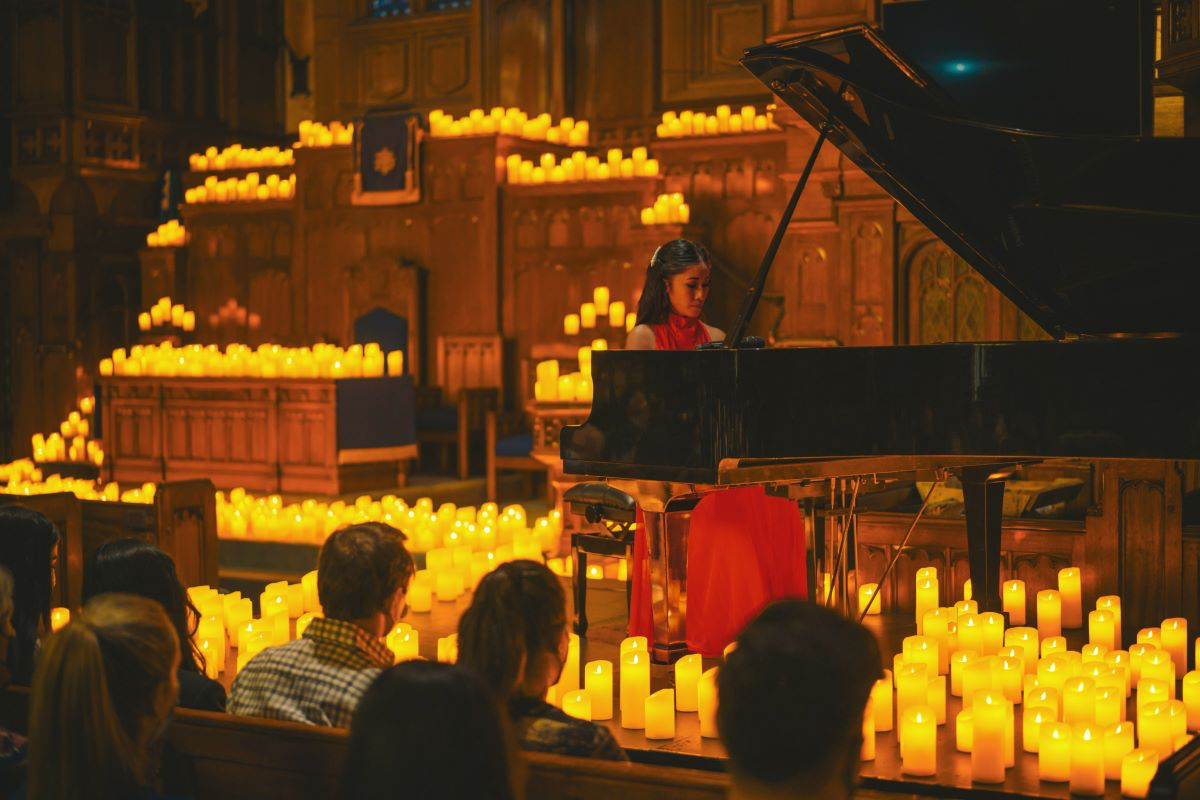
Image source: Candlelight at the historic St Stephen’s Uniting Church, Macquarie St, Sydney.
 iDigress