
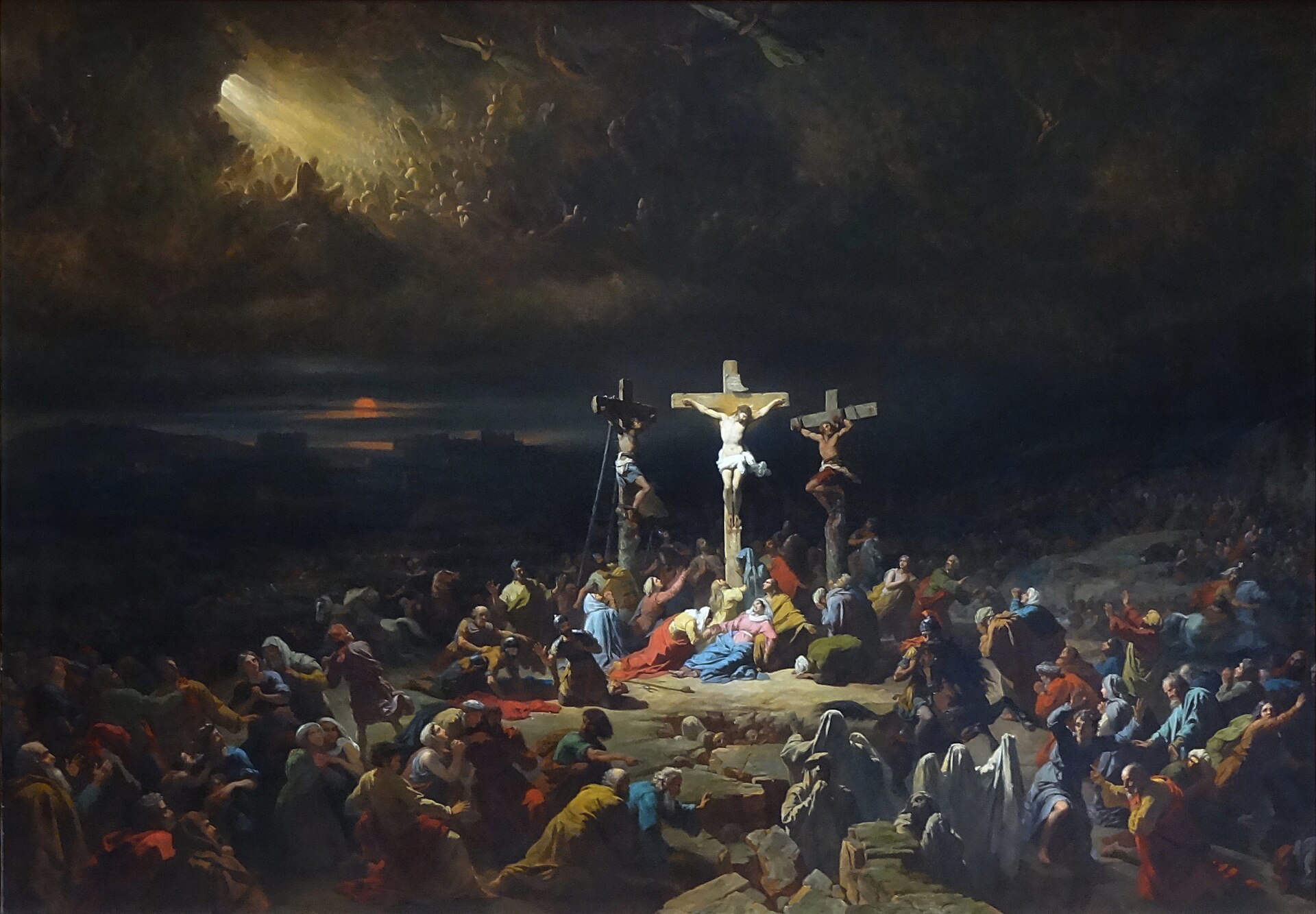
A sermon for Good Friday
Can reading a book change your life? Harvard University Professor David Damrosch tells this story from his young adulthood:
Early in the fall semester, I saw a sign for an audition that night for a production of Gilbert and Sullivan’s operetta Trial by Jury, and I wanted to try out for the chorus, even though I hadn’t yet done the reading for my class the next day on Plato’s Republic. But I had read The Republic a couple of years before, and I decided that my limited recollections would do, so I went ahead with Trial by Jury. This proved to be a non-Platonic choice in more ways than one, since in the chorus I met an alto with a lovely smile.
When I teach a great books course today, I tell my students that I have visual proof that reading Plato can change your life, and I show a photo of my wife, Lori, and myself, three and a half decades after that memorable autumn, with our three kids at our older daughter’s college graduation. Our life’s journey began thanks to reading Plato, or more precisely thanks to having read Plato; we never know when a book may prove to be a life-changing experience.[1]
Clearly, reading Plato changed his life! I love that last line: “we never know when a book may prove to be a life-changing experience.”
Reading the Bible can change your life too. The Bible speaks to our deepest needs and desires; shows us how to find peace, redemption, freedom, meaning and hope.
Philosophy can do all that too. But the Bible does more: it offers relational connection with God, and the opportunity to connect your story with the story of God. Through that connection, so much that is otherwise a locked door becomes open to possibility.
Today is Good Friday. As weary or unwitting pilgrims, we arrive at the end of the Lenten journey and stand before the cross of Christ. We are confronted with the end of the brief life of Jesus of Nazareth, and with the scandalous, unbearable mystery of the death of God. This holy moment invites us to reflect and respond.
The text of Hebrews 10:19–25 offers a carefully structured and deeply pastoral account of how the suffering and death of Jesus addresses some of the most fundamental needs of the human condition. Yet it is possible to remain unmoved. You may say, “It has not changed me.” You may ask, “Why should the death of a man two thousand years ago matter now?” Such questions are not dismissed by the text; they are the very questions into which its brilliant logic speaks.
If Jesus is God, and God is the Creator of the universe, I would expect God to understand our deepest needs better than we understand ourselves, and I’d expect God to do something to meet those needs. And I believe God has done just that.
At its heart, I want to suggest that Hebrews 10:19-25 presents four interwoven claims about how the death of Jesus changes us.
First, the death of Jesus ends our estrangement from God.
The original readers of the Letter to the Hebrews, largely Jewish Christians, understood estrangement in theological and liturgical terms. Access to God was mediated, restricted, and carefully regulated. The Most Holy Place in the Temple stood as both a symbol of divine presence and a boundary of human exclusion.
Yet the text declares that through Jesus we now have “confidence to enter the sanctuary by the blood of Jesus” and that he has opened “a new and living way through the curtain” (Heb 10:19–20). This is not only a shift in religious practice but a fundamental reconfiguration of the human relationship with God.
The disturbing sense of distance, whether born of suffering, unanswered prayer, or moral failure, is addressed not by human effort but by divine initiative. In the obedient self-offering of Jesus, God makes himself accessible. The Christian claim is not simply that God exists, but that God is near, relational, and inviting.
The cross of Jesus is the decisive sign that we are neither abandoned nor excluded. We are summoned to draw near to God. As biblical scholar Sigurd Grindheim puts it, “Jesus’s covenant-inaugurating sacrifice was … the means by which he tore through the curtain and blazed a trail straight into the presence of God.”[2]
Second, the death of Jesus removes our guilt and shame.
The exhortation to “draw near with a true heart in full assurance of faith” rests on a prior reality: that hearts are “sprinkled clean from an evil conscience” and bodies “washed with pure water” (Heb 10:22). These images, drawn from Israel’s sacrificial and purification practices, point beyond themselves to an inward transformation.
Guilt and shame are not superficial burdens. They shape our identity, burden and scar us psychologically, distort relationships, and erode the brief glimpses of hope we might be granted. The text does not deny the reality of these titans; it announces their removal.
In the death of Jesus, the conscience is addressed at its deepest level. The anxiety of moral failure gives way to assurance; alienation gives way to reconciliation. God is here, and he is not inactive. The cleansing described in verse 22 initiates a process by which our lives are gradually reshaped – relationally, ethically, and spiritually. Faith in Christ does not simply transform our status before God; it begins to transform our character into the likeness of Christ.
Third, the death of Jesus overcomes fear about the future.
Human life is marked by contingency. Stability can quickly give way to uncertainty; confidence can dissolve into anxiety. We see this in the current fuel crisis; we saw it writ large in the Covid-19 pandemic. Health crisis, marriage crisis, loss of employment… the list is long. Truth be told, we all harbour fears about the future.
Yet through his death, Jesus overcomes our fears and apprehensions, our uncertainty and insecurity. The exhortation to “hold fast to the confession of our hope without wavering” is grounded not in human resilience but in divine faithfulness: “for he who has promised is faithful” (Heb 10:23).
The cross of Jesus reframes the future by anchoring hope in the unwavering character of God. The same God who has acted decisively in Christ will remain faithful in all that lies ahead. This does not eliminate uncertainty, but it redefines its significance. The future is no longer an open threat but a domain held within the purposes of a faithful and all-powerful God.
The imagery of the Temple curtain reinforces this. The curtain once marked both separation from God and contact with God, shielding the people from the divine presence while signifying its reality. In Christ, that barrier is gloriously and permanently transformed. The union of divinity and humanity in the person of Jesus becomes the basis for a new and confident hope that depends not on circumstances but on the enduring and unwavering faithfulness of God.
Fourth, the death of Jesus inspires faith and perseverance.
The tearing of the Temple curtain at the moment of Jesus’s death (Mt 27:51) symbolises the end of restricted access to God and the inauguration of a new covenant of heart-religion guaranteed by Jesus and empowered by the Holy Spirit.
This act signals not only theological change but communal possibility. The exhortations that follow (“Let us draw near,” “Let us hold fast,” “Let us consider how to provoke one another to love and good works” (Heb 10:22–24)—are deliberately plural. It’s “let us!”Genuine perseverance is not about solitary endurance but shared participation in a new community shaped by grace.
Our text today implies the reality of weariness, distraction, and drift. Its response is not condemnation but encouragement: to remain, to continue, to support one another in love and action.
Christian hope is not abstract optimism. It’s not some hazy utopian vision. It is real, and it is sustained through intentional practices: we actively draw near to God, hold fast to confession, and foster servant-hearted love and compassion in the context of a healthy and wholesome community. The cross of Jesus generates not only personal transformation but communal resilience and the promise of new life for all that leads to our glorification.
The death of Jesus confronts us with suffering, sacrifice, and the unsettling claim that God’s decisive act of love takes place through apparent defeat. Yet the text of Hebrews 10 insists that this event is not a mere historical reality but is transformative for every generation.
Like a seed sown in fertile soil, the death of Jesus bears fruit, restoring relationship with God, cleansing the conscience, securing hope, and sustaining a community of love, resilience and perseverance.
The question for us today is not whether the death of Jesus has changed the world, but whether we will allow it to change us.
Sermon 848 copyright © 2026 Rod Benson. Preached at North Rocks Community Church, Sydney, Australia, on Good Friday 3 April 2026. Unless otherwise noted, Scripture quotations are from The Christian Standard Bible (Nashville: Holman Bible Publishers, 2020).
Rev Dr Rod Benson is General Secretary of the NSW Ecumenical Council and a minister of the Uniting Church in Australia serving at North Rocks Community Church in Sydney.
References
[1] David Damrosch, Around the World in 80 Books (New York: Penguin Press, 2021), xxi-xiii.
[2] Sigurd Grindheim, The Letter to the Hebrews (Grand Rapids: Eerdmans, 2023), 495.
Image source: Julien Michel Gué, “The last sigh of Christ” (1840). Wikimedia Commons.
 iDigress