
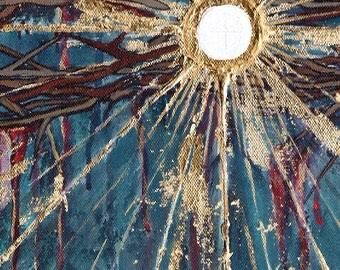
A sermon for Easter Sunday
Christ is risen. He is risen indeed!
I have great good news to share with you: The resurrection of Jesus is confirmation that God loves us; that God is for us, and not against us. The resurrection of Jesus is the crux of history. It is the most profound truth the universe has yet disclosed to us.
But as we celebrate, let us not forget the cost of this amazing grace. As today’s lectionary reading declares: “Christ our Passover Lamb has been sacrificed” (1 Cor 5:7b).
As we saw on Good Friday, where the author of the Letter to the Hebrews invokes the Temple curtain as a symbol of our access to God through the person of Christ (Heb 10:20), so now Paul the Apostle vividly applies Israel’s Passover tradition, and all it represents in terms of sacrifice, redemption and liberty, to the death of Jesus and our participation in his death (1 Cor 5:7b).
As we identify with Jesus in his death, we participate in his resurrection, and the resurrection of Jesus changes everything. The resurrection changes our understanding of God, the world, history, human anthropology, and life after death. It is not a metaphor for hope or renewal. It is a unique event that happened within history, redefining history. Through the resurrection of Jesus, a “new creation” has begun.
I want to share with you four amazing truths about the resurrection of Jesus that inspire joy, confidence and hope, and challenge us to take seriously our privilege of serving as apprentices of the risen Jesus.
1. The resurrection spells the defeat of death
By his resurrection, Jesus has vanquished death. He has changed the meaning of death. Death, that powerful foe, has been defeated.
Physical death remains for us, and its effects are neither trivial nor easily explained away. But death no longer has the final word. Because Jesus lives in the power of endless life, and we are united to him, we are raised with him to share in his immortal life. Eternal life begins now as we live in the presence and power of God’s kingdom (see, e.g., John 5:24). Resurrection is not only about what happens at the end of history; it is also about the new life available to us here and now.
We do continue to experience loss, grief and mortality, but the resurrection reframes these burdens within a larger horizon. Because Jesus lives, we are empowered to live beyond fear. We endure suffering without despair. We face death without surrender. Death is just the next step, the real beginning, of the fullness of life with God.
This is why Christ our Passover Lamb was sacrificed.
2. The resurrection announces the renewal of creation
The Christian hope is not escape from this world to an ephemeral paradise in the clouds. The Christian hope is the radical transformation of this world, this universe, into the glorious kingdom of God. Popular imagination often reduces the Christian hope to “going to heaven when we die.” The resurrection of Jesus points not to the abandonment of creation but its transformation.
The risen Jesus is not a disembodied spirit. To his followers, he is recognisably Jesus of Nazareth, yet he has been transformed. He eats with them, and invites Thomas to touch his wounds, but his appearance transcends ordinary physical limitations. This is the beginning of a new kind of life: what Paul calls a “spiritual body” (1 Cor 15:44): material, yes, but animated by the life of God.
The resurrection of Jesus is a divine declaration that creation matters, that the environment matters, that our bodies matter, that history matters, that justice matters. The world is not disposable but redeemed. And if that is true, then Christian faith cannot be reduced to private spirituality. It must involve participation in the renewal of creation through acts of justice, reconciliation, healing, and hope.
The resurrection reorients our understanding of what God is doing. It does not promise rescue from the world, but renewal of the world.
This too is why Christ our Passover Lamb was sacrificed.
3. The resurrection clarifies the meaning of history
History is not an endlessly repeating cycle, nor is it an eternal “now.” The resurrection of Jesus clarifies the nature and meaning of history. It introduces a “before” and “after.” What has begun in Jesus will be completed in the renewal of all things. The future is not an abstraction but has already entered the present in a decisive way.
This gives Christian hope its distinctive character. Our hope is not optimism – the belief that things will somehow naturally get better. Nor is it escapism – the desire to withdraw from the world. It is real hope grounded in the faithfulness of God, who has acted decisively in raising Jesus from the dead.
And this hope has ethical implications. If history is moving in a process of cosmic renewal toward its consummation, then the actions we take either participate in its trajectory or work against what God is doing. Our small acts of justice, mercy, compassion and truth are beautiful anticipations of the new creation. What is done for the sake of Jesus is not wasted. It belongs to the future that God is shaping for his glory.
This too is why Christ our Passover Lamb was sacrificed.
4. The resurrection informs the shape of Christian living
What difference does this make to how we actually live today? The New Testament writings suggest that the resurrection of Jesus transformed the perception of those first disciples. They moved moved from confusion to recognition, from fear to courage. The risen Jesus reoriented their understanding of God, themselves, and their mission. And Jesus wants to do the same for us today.
To live in the light of the resurrection is to be apprenticed to Jesus: to enter into a process of formation shaped by his life and teaching, and to participate with Jesus in fulfilling the mission of God.
This involves concrete practices such as prayer, forgiveness, generosity, speaking the truth, community, Sabbath, and more. These are not moral add-ons to commend us to God, but the means by which the resurrection life of Jesus is embodied in our world. At its best, the church is a community of love and compassion reaching out to the world, empowered by the Spirit of God, anticipating the future God has in store for us.
This too is why Christ our Passover Lamb was sacrificed.
And it is why Paul, when he speaks here of Christ and his death for us, immediately follows with an exhortation to live within the reality of the new creation through the resurrection of Jesus:
Therefore, let us observe the feast, not with old leaven or with the leaven of malice and evil, but with the unleavened bread of sincerity and truth (1 Cor 5:8).
Conclusion
The resurrection tells us that God has not given up on the world. It spells the defeat of death; announces the renewal of creation; clarifies the meaning of history; and informs the shape of Christian living.
Because Jesus rose, death is not the final word; new life really is possible; history has a divinely imagined future; and we are called to model God’s new creation in the world as we anticipate its arrival in fullness when Jesus returns.
So Easter is not simply a retelling of what happened to Jesus long ago. Nor is it merely a celebration of the idea of new seasons or new life. It is not a metaphor or a figure of speech. It is an invitation to participate in something big, something new, something eternal. As Paul reminds us, Christ our Passover Lamb has been sacrificed. But that is not the end of the story; it is just the beginning.
The cross is bare. The tomb is empty. Christ is risen. The resurrection of Jesus is the crux of history, the pivot on which history turns. Death has been defeated; creation is being renewed; the meaning of history is clear; and there is a new way to live in the world. Because he lives, everything has changed:
No guilt in life, no fear in death:
this is the power of Christ in me.
From life’s first cry to final breath,
Jesus commands my destiny.
No power of hell, no scheme of man
Can ever pluck me from his hand;
Till he returns or calls me home,
Here in the power of Christ I’ll stand.[1]
Sermon 849 copyright © 2026 Rod Benson. Preached at North Rocks Community Church, Sydney, Australia, on Easter Sunday 5 April 2026. Unless otherwise noted, Scripture quotations are from The Christian Standard Bible (Nashville: Holman Bible Publishers, 2020).
Rev Dr Rod Benson is General Secretary of the NSW Ecumenical Council and a minister of the Uniting Church in Australia serving at North Rocks Community Church in Sydney.
Reference
[1] “In Christ alone,” by Keith Getty & Stuart Townend (Thankyou Music, 2001).
Image source: Detail from a commercial print by unknown artist.
 iDigress