
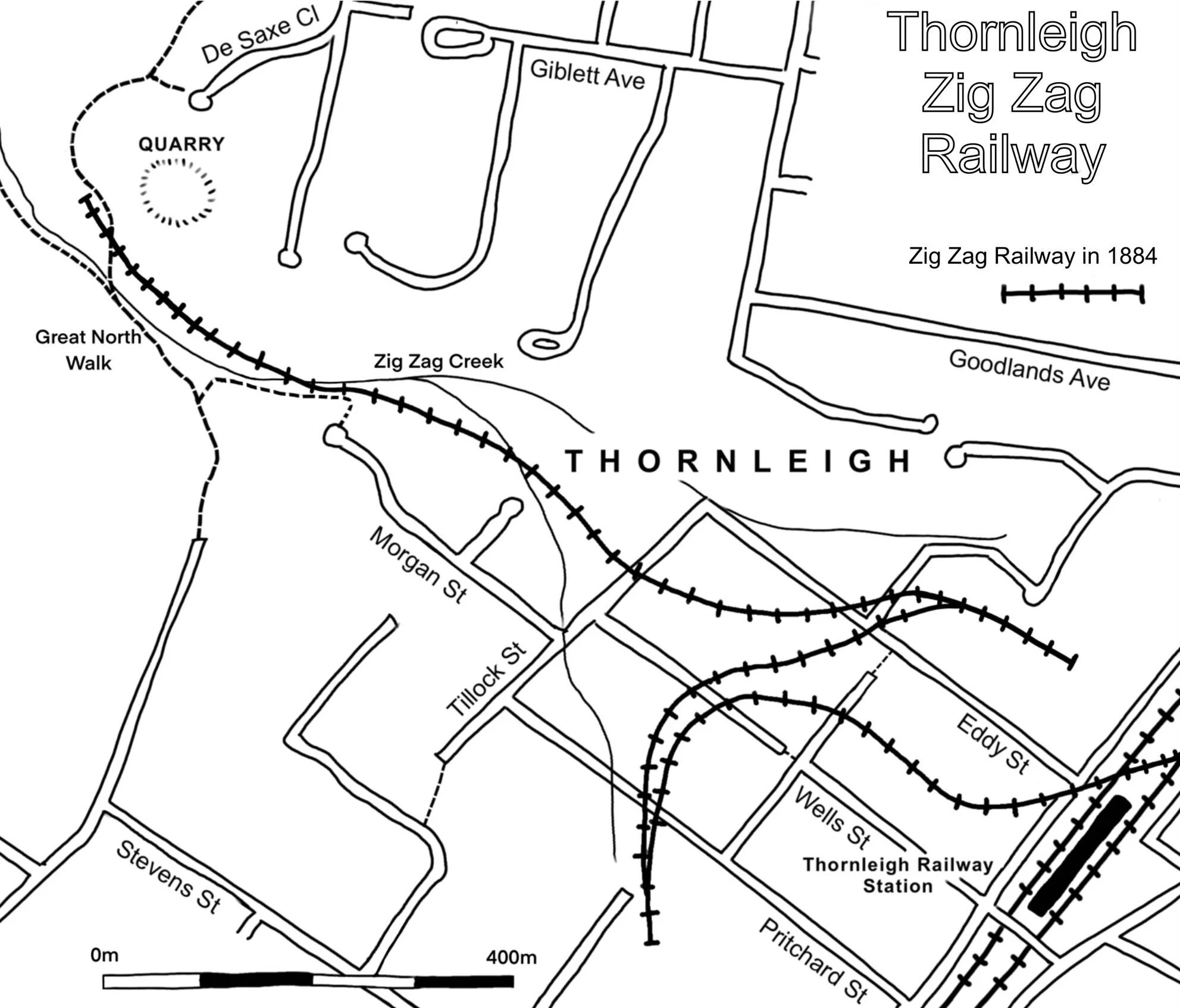
The historic Thornleigh zig zag railway, in Sydney’s north, was the third and apparently final such transportation infrastructure built in New South Wales. It is also the least known of the three tracks.
A zig zag railway, also called a switchback railway, is a method for climbing or descending steep terrain where a direct railway gradient would be too steep for trains. The track advances forward to a dead-end siding, where the train stops and points are changed. The train then reverses direction onto another section of track climbing at a gentler gradient. This forward-and-reverse process may repeat several times in a zig zag pattern up a mountain or escarpment. Zig zag railways were especially useful in the nineteenth century before powerful locomotives and extensive tunnelling technology made steeper direct routes more practical and economically viable.
The first zig zag railway in New South Wales was the Lapstone Zig Zag, opened in 1867 on the eastern side of the Blue Mountains near Glenbrook. Designed to help trains climb the steep escarpment from Emu Plains, it consisted of a series of reversing points that allowed locomotives to gain height gradually. Although a remarkable engineering achievement for its time, the line proved difficult to operate and maintain, and it was replaced in 1892 by the Glenbrook Tunnel deviation. The remains of the original Lapstone Zig Zag are now a popular heritage walking track.
The second and best known was the Lithgow or Great Zig Zag, opened in 1869 on the western descent of the Blue Mountains between Clarence and Lithgow. This impressive construction, featuring massive sandstone viaducts and retaining walls, enabled trains to safely descend the western escarpment and connected Sydney with the interior of New South Wales. The Great Zig Zag was used until 1910, when the more efficient Ten Tunnels Deviation replaced it. Today, a section of the route has been restored as the Zig Zag Heritage Railway, a popular tourist attraction.
The third and final example was the Thornleigh or Halls Camp Zig Zag, built around 1883 to connect the Great Northern Railway at Thornleigh with a nearby quarry and construction camp. The line used a short zig zag formation to negotiate the steep terrain between the station and the quarry floor about 30 metres below. Though it was used for less than a decade and later dismantled, its remnants are still traceable through local bushland and are recognised by Engineers Australia as part of New South Wales’ railway heritage.
My friend, local historian Tim Sowden, leads occasional tours of the track and provides expert commentary along the way. He has also published a book on the history of the Thornleigh zig-zag railway.
As far as I know, these three railway tracks are the only zig zag railways ever built in New South Wales.
Rev Dr Rod Benson is General Secretary of the NSW Ecumenical Council and a minister of the Uniting Church in Australia serving at North Rocks Community Church in Sydney. He lives just 2 kilometres from the site of the historic Thornleigh zig-zag railway.
More information:
https://www.visitsydneyaustralia.com.au/lost-rail-thornleigh.html
https://www.thornleighzigzag.com.au (click for tour information)

