
Growing up in the same fundamental religious denomination as novelist Ken Follett and poet Patricia Beer, I was taught from earliest days that nothing good could come from the Catholic Church. My paternal grandmother, for example, a superb mimic, would occasionally regale us at the Christmas dinner table at Wahroonga with humorous anti-papist rhetoric.
On one occasion, in a broad Irish accent channelling Frank Knox, a leading itinerant evangelist who moved as the Spirit led among “the Assemblies of the Lord’s people,” as our branch of the Plymouth Brethren was known, my grandmother advised that “candles speak of Catholics, Catholics of the Pope, and the Pope of the Devil.”[1] On the other hand, as I came to discover, my paternal grandfather was clandestinely referred to by his detractors as “the Pope of Goulburn Street [Assembly].”
It was a lot for a young boy to absorb while eating his grandmother’s excellent apple pie and custard. Beneath the humour lay the theological conviction that the papacy represented usurped spiritual authority and potential spiritual corruption.
Times have changed, and many sectarian certainties have evaporated since the 1970s. Recently, an online acquaintance cautioned against referring to Pope Leo XIV as “the Vicar of Christ,” reviving memories of those earlier polemics of my childhood. No man, it was argued, may assume the place of Christ; to do so was blasphemy. I realised that although I had long heard the title used, I had never seriously investigated its meaning. And so I began digging.
Here’s what I found. For Roman Catholics, the title “Vicar of Christ” is not intended to suggest that the Pope replaces Christ. Rather, it expresses the belief that the Bishop of Rome exercises a representative and pastoral ministry on behalf of Christ within the visible Church. The phrase derives from the Latin vicarius Christi, meaning “representative” or “delegate” of Christ. In Catholic theology, Christ remains the true and living head of the Church.
As I understand Catholic teaching, the Pope’s authority is derivative, ministerial, and accountable to objective standards. It is derivative because the pope is regarded as the successor of St Peter and exercises authority received from Christ rather than invented by himself. It is ministerial because he is supposed to serve the unity, doctrine, worship, and pastoral care of the church rather than rule as an unchecked monarch. It is accountable because Catholic theology insists that the pope is bound by divine revelation, apostolic tradition, ecumenical creeds, and the deposit of faith.
However, on the notion of accountability to divine revelation, Catholics would want to add an important qualification. They do not hold to Scripture alone as the sole infallible authority for faith and conduct. Instead, they argue that Scripture and apostolic tradition together constitute the deposit of faith, interpreted authentically through the church’s teaching office (the magisterium). In this framework, the pope is not above Scripture, but neither is Scripture interpreted independently of the Church.
Historically, the title “Vicar of Christ” was not originally exclusive to the Pope. In the early Church, bishops more generally could be described as vicars or representatives of Christ within their own communities. Over time, particularly during the medieval consolidation of papal authority under figures such as Pope Innocent III, the designation became increasingly associated with the Bishop of Rome alone. This reflected the gradual centralisation of authority in Western Christianity. Eastern Christian traditions developed their own patriarchal structures and forms of ecclesial primacy, but generally resisted the idea of universal papal jurisdiction.
The following points clarify my understanding of the Roman Catholic Church’s use of the term “Vicar of Christ” as applied to the papacy.
First, the Pope acts in the name of Christ, not in the place of Christ. Catholic theology insists that Christ continues to govern the Church through the Holy Spirit. The Pope does not originate revelation or replace divine authority. His role is to guard, interpret, and transmit the apostolic faith. This distinction is important because critics often assume that the title implies an almost divine status for the Pope, whereas Catholic theology officially rejects such an interpretation.
Second, the title is closely connected to the Catholic understanding of Saint Peter. Catholics interpret Matthew 16:18–19 (“You are Peter, and on this rock I will build my church”) as granting Peter a distinctive pastoral responsibility among the apostles. The Pope, as Bishop of Rome, is regarded as Peter’s successor. Yet Catholic theology distinguishes between succession to Peter and the title “Vicar of Christ.” The former concerns apostolic continuity; the latter concerns universal pastoral oversight. Historically, many Christians acknowledged Rome’s special honour without accepting the stronger claims later attached to papal supremacy.
Third, the title has an ecclesiological function. The Pope is understood as a visible sign of unity within a global communion of cultures, languages, and liturgical traditions. The Catholic argument is fundamentally practical as well as theological: visible unity ordinarily requires some visible centre of communion. Critics, however, contend that excessive concentration of authority risks undermining the collegial and communal character of the Church. Modern Catholicism continues to wrestle with this tension between central authority and local autonomy.
Fourth, the title relates to papal teaching authority. Catholic doctrine holds that, under carefully defined conditions, the Pope may teach infallibly on matters of faith and morals when speaking ex cathedra. This doctrine does not imply that every papal statement is free from error, nor that popes possess exceptional personal holiness or intelligence. Rather, it reflects confidence that Christ will preserve the Church from definitive doctrinal collapse. Nevertheless, this teaching has generated substantial controversy since the Reformation.
Protestant Reformers such as Martin Luther and John Calvin argued that the papacy risked obscuring the unique mediatorial role of Christ described in 1 Timothy 2:5, where Paul says there is “one mediator between God and humankind, the man Christ Jesus.” Their objection was not mere emotional hostility toward Rome; the dispute reflected competing understandings of revelation, authority, salvation, and the relationship between Scripture and ecclesiastical tradition.
Fifth, Eastern Orthodox Christianity developed a different critique from that of Protestantism. Orthodoxy has generally recognised the Bishop of Rome as “first among equals” within the ancient patriarchal order, while rejecting later doctrines of universal jurisdiction and papal infallibility. From the Orthodox perspective, the problem is not that the Pope symbolises Christian unity, but that the Roman office evolved into a juridically supreme institution inconsistent with the collegial structure of the early Church.
Sixth, Catholic tradition tempers the grandeur of “Vicar of Christ” with another papal title, Servus servorum Dei (“Servant of the servants of God”). In recent decades, the papacy has increasingly been interpreted less as a triumphal monarchy and more as a ministry of pastoral service, diplomacy, moral witness, and global encouragement. Figures such as Pope John XXIII, Pope John Paul II, Pope Francis and Pope Leo XIV have significantly reshaped public perceptions of the office in this direction.
When informed Catholics refer to the Pope as “the Vicar of Christ,” they are therefore affirming a derivative and representative ministry intended to express Christ’s care, teaching, and unity within the Church. Christ remains the true head of the Church; the Pope functions as a visible and historical sign of that invisible reality. I can imagine old Frank Knox turning in his grave as I type this, but such is life.
The enduring theological question beneath the title is whether the global Christian Church requires such a universal visible office at all. That debate remains central for the Church today.
Rod Benson lives in Sydney and writes about a range of topics from books and local history to food, faith, philosophy, ethics, research skills, and everyday life. Away from the keyboard, he enjoys cooking for friends, walking in the Australian bush, exploring a beach, discovering new restaurants, and reading philosophy, fiction and poetry. He is married to Emma Goodsir.
Reference:
[1] You can hear Frank Knox telling his own story here: https://gospelhallaudio.org/sermons/frank-knoxs-testimony-57-min/
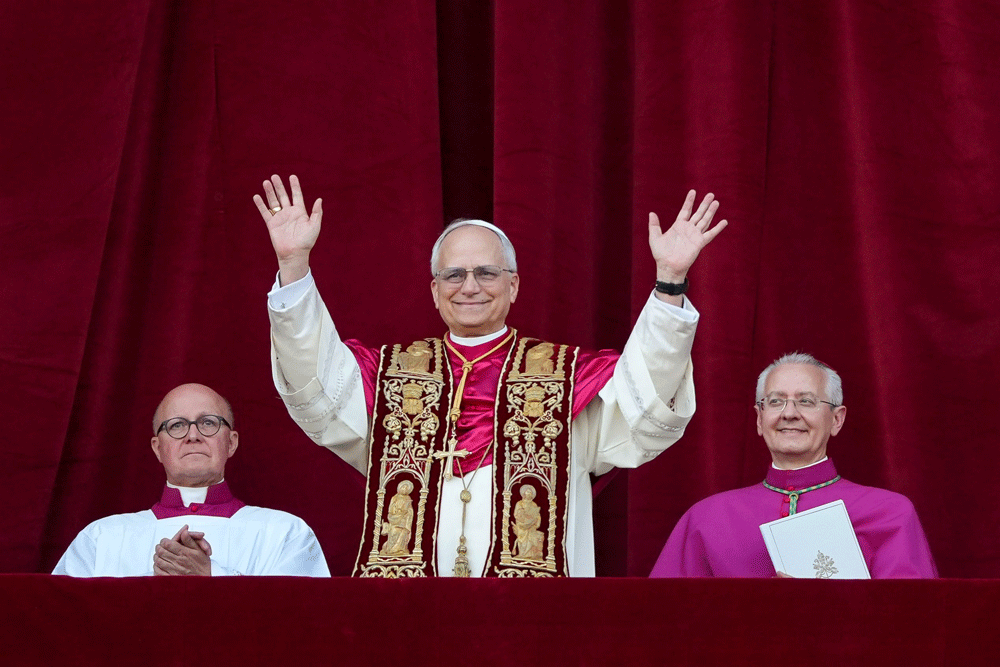
Image source: Pope Leo XIV, the former Cardinal Robert F. Prevost, waves to the crowds in St. Peter’s Square at the Vatican after his election as pope on 8 May, 2025. (CNS photo/Vatican Media)

