
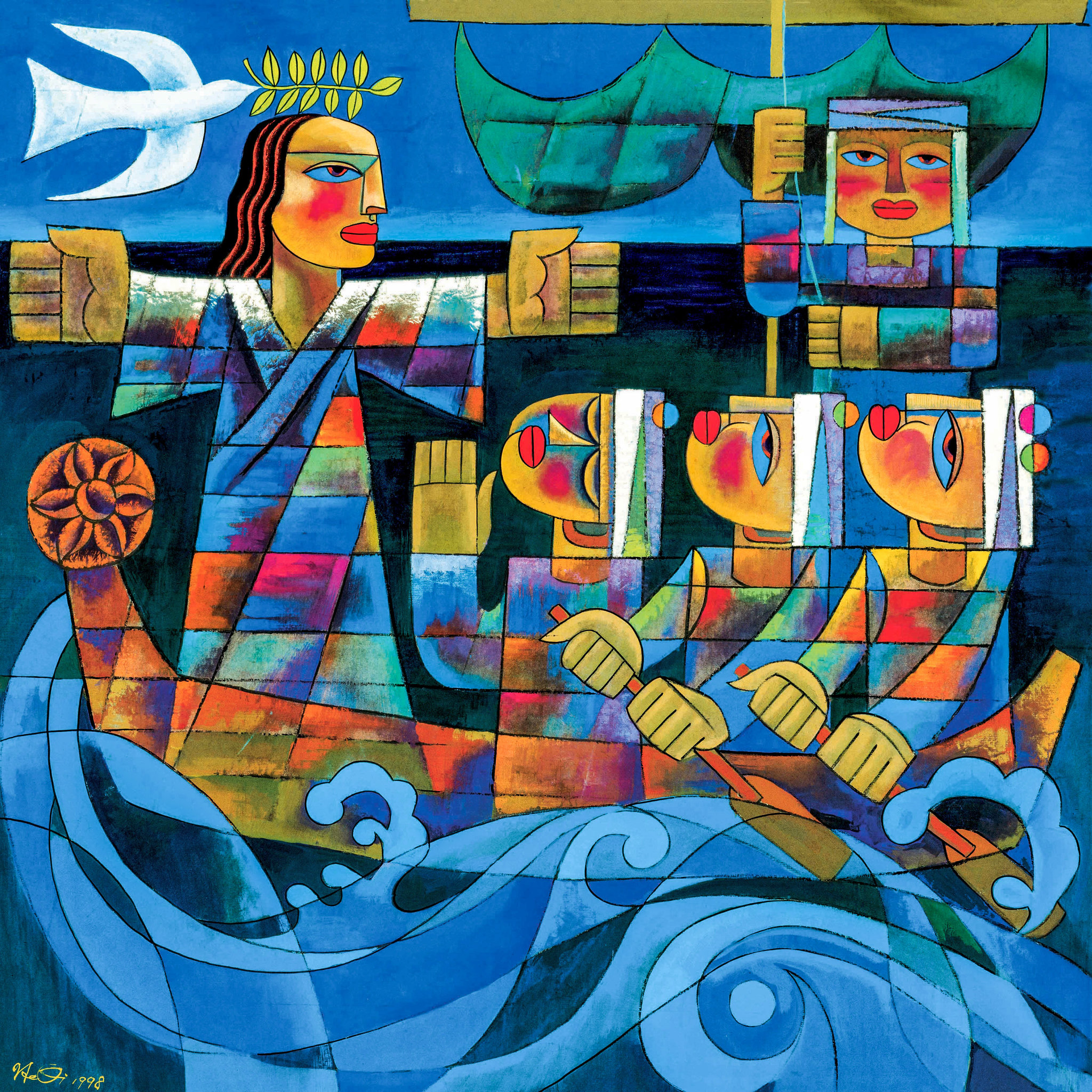
I can imagine it now: Australian Prime Minister Anthony Albanese steps up to his despatch box in the federal parliament to claim Jesus as the hero of progressive politics:
- “Render unto Caesar the things that are Caesar’s” (Mt 22:21) – a tacit endorsement of big government as an instrument of social responsibility and distributive justice.
- “Sell your possessions and give to the poor” (Lk 12:33) – an argument against wealth accumulation in solidarity with low-income earners.
I can also imagine Opposition Leader Angus Taylor rising to his feet to defend Jesus Christ as the hero of conservative politics:
- “Whoever can be trusted with very little can also be trusted with much” (Lk 16:10, NIV) – which can be construed as an argument for tax breaks for high income earners.
- “The poor you will always have with you” (Mt 26:11) – famously associated with British Prime Minister Margaret Thatcher’s 1978 argument, reiterated in 1988, against state wealth redistribution.
I really can’t imagine what Senator Pauline Hanson would have to say on the matter.
Those caricatures, humorous as they may seem, do beg a serious question: What does it mean to speak of “the politics of Jesus”? Jesus was not a politician. He established no political party, contested no election, and issued no how to vote card. Nor can he simply be recruited to the political left, right or centre. Any attempt to make Jesus the chaplain of our preferred political ideology diminishes him.
The politics of Jesus
Yet Jesus was not apolitical. He proclaimed the kingdom of God. He spoke about rulers and servants, rich and poor, neighbours and enemies, insiders and outsiders. He challenged prevailing assumptions about status, exclusion and power, and was finally executed by the Roman state beneath the politically charged title “King of the Jews.” The gospel of Jesus Christ as revealed to us in Holy Scripture is not politically partisan; nor is it politically neutral.
Thousands of books and articles have been written on the politics of Jesus. One of the most influential is the Mennonite scholar John Howard Yoder’s 1972 book, explicitly titled The Politics of Jesus.[1] Yoder challenged the assumption that Jesus promoted a private morality while effectively ignoring broader political issues. He argued that the life and teaching of Jesus discloses a distinctive way of approaching power, confronting evil and ordering human relationships.
In our Scripture reading today, Mark begins his account of the ministry of Jesus not with a manifesto but a baptism. Jesus comes to the Jordan River, receives the Spirit and hears a voice from heaven, “You are my beloved Son; with you I am well pleased” (Mk 1:11).
The Spirit of God then drives Jesus into the desert, where he is “tempted by Satan” (v. 13). Mark establishes Jesus’ identity, and shows him being tested on a range of moral issues. Jesus then returns to the habitable world, his home country of Galilee, and proclaims: “The time is fulfilled, and the kingdom of God has come near. Repent and believe in the good news” (v. 15).
In a world governed by emperors, governors, kings and religious authorities, Jesus announces a new and rival rule of God, raising questions of ultimate authority and allegiance. Governments are necessary and political participation important, but no political authority possesses an absolute claim upon us.
How would Jesus vote?
For Christians, every political loyalty, and every party platform, is subordinate to allegiance to God revealed in Jesus. If we miss that, we miss everything about Jesus and the good news he announced.
How, then, would Jesus vote?[2] It is an interesting question, but it is not the first question we should ask. Above all, we should ask what kind of people Jesus calls us to be. If we don’t start there, we risk beginning with our political preferences and recruiting Jesus to endorse them.
Politics is much more than parliaments, politicians and periodic elections. Political cultures shape our fears, loyalties, resentments and desires. Political cultures influence whom we trust and fear, whom we regard as belonging, and whose suffering we address or ignore. Political formation begins long before we enter a polling booth.
We are constantly being formed and reformed by what we like to call “the news,” by social media, advertising, economic pressures, political rhetoric, corporate narratives, and the opinions of others. These influences cultivate compassion or resentment, courage or fear, generosity or possessiveness. None of us approaches public life as a detached observer.
In Romans 12:1-2, Paul urges us not to conform to the patterns of the present age, but to be transformed through the renewing of our minds. It’s just the kind of thing Jesus might have said; in fact, it’s a good summary of his moral teaching on Christian discipleship.
But Jesus is not in the business of forming isolated individuals. Walking beside the Sea of Galilee, he calls Simon and Andrew, then James and John. A faith community begins to take shape. They learn to be with Jesus, become like him, and do as he did. That’s the essence of Christian discipleship. It’s nothing less than experimentally following Jesus, in community, and learning another way of being human.
Church and kingdom
The church is not precisely the same as the kingdom of God. The kingdom is vastly larger than the church, which in its present forms is too compromised and fallible to own such a claim. Yet the church is called to be a sign and foretaste of the kingdom of God, a community in which God’s promised future becomes visible in the present.
A church that preaches love and inclusion must practise love and inclusion. A church that preaches reconciliation must practise reconciliation. A church that advocates justice must live according to just principles. A church that commends hospitality must welcome strangers. A church concerned about abuse of power must make its own leaders accountable to moral and legal authority. Otherwise the church’s public witness contradicts the gospel it announces, and its reputation is harmed. We have seen in recent years how that plays out, tragically, and to our collective shame.
This understanding of the church as a sign and foretaste of the kingdom of God avoids two opposite temptations. The first is political withdrawal: the assumption that Christianity concerns private spirituality while politics belongs to somebody else. The second is political conquest: the attempt to capture political power and impose supposedly Christian outcomes upon others. The alternative is faithful public presence.
Luke describes the character of this presence when Jesus enters the synagogue at Nazareth and reads from Isaiah, announcing good news to the poor, release to captives, sight to the blind and freedom to the oppressed (Lk 4:16-20).
This vision of the kingdom of God is a radical vision. It’s a vision calibrated to comfort the disturbed and disturb the comfortable. It is a vision that has real consequences for bodies, communities and institutions. It concerns dignity, freedom, justice and restored relationships. This is the politics of Jesus.
Personal transformation
But it is also a vision of personal transformation through the power of God at work in ordinary people who recognise that they are not right with God, that they need to repent of their bent thoughts and actions, and believe the good news of salvation that Jesus announces (Mk 1:14-15). It is a vision of hearing the call of Jesus, who is the embodiment of objective truth, the one who offers the kind of enriching and meaningful life that every one of us deeply desires, the one whose way leads to freedom and forgiveness, justice and peace, hope and joy. This too is the politics of Jesus.
Christians have good reason to actively participate in democratic life: to vote, advocate, serve, protest, contribute to civil society, care for neighbours, and hold governments accountable to a higher authority. But Christian citizenship cannot be reduced to voting, nor can a commitment to party politics take the place of authentic discipleship. Every political system is provisional, every government fallible, and every ideology incomplete without Jesus at its centre.
The political dimension of Christian hope is necessarily both serious and modest. We work for peace, justice, human rights and good government without imagining that any single election victory, legislative reform, or social movement will establish the kingdom of God among us.
At the centre of this vision stand the cross, the resurrection, and the ascension of Jesus Christ. These great gospel events provide the controlling pattern for Christian engagement with power. Power ought to be judged by service, justice by attention to the vulnerable, and resistance to evil by the command to love our enemies. We do right when we place every political allegiance beneath a greater allegiance we confess when we say that Jesus Christ is Lord. This too is the politics of Jesus.
“Follow me”
This is the kingdom of God in action. This is the transformation of which Paul speaks. This is another way of being human. Jesus does not merely give his followers different political opinions. Through the power of the Holy Spirit, Jesus is forming us as people capable of exercising authority without domination, pursuing justice without self-righteousness, resisting evil without becoming evil, holding strong convictions without dehumanising our opponents, and seeking peace without denying the reality of conflict.
What does Jesus say to those humble fishermen beside the Sea of Galilee? He says, “Follow me” (Mk 1:16-20). And they left their nets and changed the world.
The politics of Jesus begins with the astonishing announcement that “the kingdom of God has come near,” and the invitation upon which everything else depends: “Follow me.”
Sermon 867 copyright © 2026 Rod Benson. Preached at North Rocks Community Church, Sydney, Australia, on Sunday 23 August 2026. Unless otherwise noted, Scripture quotations are from The Christian Standard Bible (Nashville: Holman Bible Publishers, 2020).
Rev Dr Rod Benson is General Secretary of the NSW Ecumenical Council and a minister of the Uniting Church in Australia serving at North Rocks Community Church in Sydney.
References
[1] John Howard Yoder, The Politics of Jesus: Vicit Agnus Noster (second edition; Grand Rapids: Eerdmans, 1994). While Yoder has since been disgraced for a sustained pattern of alleged sexual abuse of women, his 1972 book was both insightful and radical, reflecting on the ways in which the life and teachings of Jesus influenced the social behaviour of his first followers and endorsed “a specific kind of Christian pacifism.” He was never criminally prosecuted or convicted in a civil or criminal court.
[2] See, for example, D. James Kennedy and Jerry Newcombe, How Would Jesus Vote? A Christian Perspective on the Issues (Colorado Springs, CO: Waterbrook Press, 2008), and Darrell Bock, How Would Jesus Vote? Politics, the Bible, and Loving Your Neighbor (New York: Howard Books Publishing, 2016).
Image source: The New York Times
Taking it further….
Reflection questions
- Why does the sermon resist identifying Jesus with either progressive or conservative politics? What is lost when Christians recruit Jesus to endorse an existing political ideology?
- What does it mean to describe the church as a “sign and foretaste of the kingdom of God”? How does this understanding avoid both political withdrawal and political conquest?
- According to the sermon, how do the cross, resurrection and ascension of Jesus provide a pattern for Christian engagement with power? In particular, how do they reshape our understanding of authority, justice, resistance and relationships with opponents?
Application questions
- Examine your own political convictions. Which of them arise most clearly from following Jesus, and which may owe more to family background, social class, media consumption, political party loyalty or cultural assumptions?
- Consider your sources of political formation. What news, social media, commentators, friendships or organisations most influence the way you perceive public issues? Are they forming you as a person of compassion, courage and generosity—or fear, resentment and hostility?
- Choose one current political or social issue and ask: What would it mean to approach this issue through the values of the kingdom of God rather than simply through the categories of left and right?

