
Vocational education and nation-building in Papua New Guinea
By Rod Benson
Lae is a city shaped by its geography. It lies at the head of the Huon Gulf, close to the mouth of the Markham River, where a broad valley opens between formidable mountain systems and the sea. Behind the coastal plain rise the Atzera and other ranges; inland, the Markham Valley provides one of the great natural corridors of eastern New Guinea. The setting is tropical, hot and exceptionally wet. An Australian National University study based on long-term meteorological records calculated an average temperature of about 26°C and annual rainfall of approximately 4.5 metres, with high humidity throughout much of the year. The surrounding mountains intercept moisture brought from the Huon Gulf, giving Lae substantially heavier rainfall than places farther inland along the Markham Valley.
Long before Europeans imagined a town at Lae, the coastal plain, river systems and nearby valleys were inhabited and used by Indigenous communities with established systems of land tenure, gardening, fishing, hunting, exchange and settlement. Later accounts identify Labu, Lae and Ahi communities among the peoples whose lands became incorporated into the expanding city, while Wampar communities occupied areas farther inland in the Markham Valley. James Sinclair’s history of Morobe describes the modern city as developing from a landscape of small villages whose inhabitants had lived there for generations before the dramatic economic changes of the twentieth century. Customary relationships to land did not disappear when an urban settlement was imposed upon them; indeed, Lae’s later expansion repeatedly brought the formal city into contact with land that remained under customary ownership.
The local economy before colonial urbanisation was not static or isolated. Communities cultivated gardens, exploited riverine and coastal resources, exchanged goods and maintained social connections extending along the coast and through the Markham and adjacent valleys. The region’s topography encouraged both local diversity and movement. Rivers were sources of food and transport as well as boundaries and hazards, while fertile valleys supported cultivation. The modern distinction between “city” and “village” therefore obscures an older landscape already organised through human occupation, mobility and economic use. The later colonial town did not arise on empty unsettled land.
Lae’s transformation accelerated during the Morobe gold rush of the 1920s and 1930s. Gold discoveries around Wau, Bulolo and Edie Creek drew prospectors, companies, machinery and labour into mountainous country that was extraordinarily difficult to supply overland. Salamaua initially served as the principal coastal entry point, but the arduous route into the goldfields made air transport increasingly attractive. In 1927 Cecil Levien organised construction of a landing ground at Lae, opening an aviation route to Wau. The resulting airlift became one of the remarkable logistical enterprises of the interwar Pacific. Aircraft carried passengers, food, fuel and machinery into the interior, including components of enormous gold dredges that were reassembled in the Bulolo Valley. By the early 1930s Lae had become a town built substantially around an airfield and the servicing of the gold economy.
This development gave Lae a distinctive technological character before any formal technical college existed there. Aircraft had to be serviced, loaded and refuelled; motor vehicles repaired; buildings erected; workshops operated; roads and airstrips maintained; freight handled and machinery assembled. Much of the formally recognised engineering expertise remained in expatriate hands, but Papua New Guinean employees learned practical skills within aviation companies, government departments, garages, construction work and commercial enterprises. Technical formation occurred principally through employment: observation, repetition, supervised practice and increasing responsibility.
The Second World War transformed Lae again. After the Japanese capture of Rabaul, the Australian administration had begun preparing Lae as the new capital of the Mandated Territory, but Japanese forces occupied the town on 8 March 1942 before that transfer could be completed. Lae became a major Japanese base and was subjected to sustained Allied bombing. In September 1943 Australian forces advanced on the town in a coordinated operation involving amphibious landings east of Lae and an airborne landing at Nadzab. Lae was recaptured on 16 September 1943. The campaign devastated the area and imposed severe costs on local Papua New Guinean communities as well as the combatant forces.
War also enlarged the region’s technological and logistical infrastructure. Military workshops, airfields, transport systems, engineering units, communications and supply depots operated on a scale unknown before 1942. This was not technical education in the later institutional sense, but it intensified local exposure to machinery, construction and maintenance. Postwar Lae inherited both damaged infrastructure and a greatly enlarged expectation of what modern transport and engineering systems could accomplish. The creation of Lae Technical College less than a decade later belonged to this wider transition from a gold-rush and wartime transport centre to a permanent industrial city.
From workplace learning to formal technical education
Technical education in Papua and New Guinea did not begin at Lae in the 1950s. For decades, Papua New Guineans had acquired trades and occupational skills through missions, government departments and employers. In Papua, Christian missions developed some of the earliest organised technical training. Mission institutions taught carpentry, boat-building, blacksmithing, plumbing, motor mechanics and related skills, sometimes with government financial assistance. At centres such as Kwato and Yule Island, practical training could produce artisans capable of considerable independence. The purposes varied: missions needed skilled workers for their own enterprises, hoped to strengthen Christian communities, and sometimes sought to provide alternatives to unskilled colonial employment.
In the Territory of New Guinea, Rabaul became the strongest prewar centre of formal government technical training. By 1940 a government school there offered an unusually broad range of instruction, including clerical work, printing, blacksmithing, engine maintenance, telegraph-line work, carpentry, plumbing, painting and cement work. Malaguna, near Rabaul, combined general and vocational education. Some courses clearly reflected the racial and occupational hierarchy of colonial society, preparing Papua New Guineans for subordinate domestic or manual employment; others imparted skills of lasting industrial value.
Lae developed differently. Before the war it possessed no government technical school comparable with Rabaul. Its technical training occurred primarily through work. Aviation, transport, Public Works, shipping, plantation workshops and commercial employers acted in effect as informal schools. An employee might begin with elementary duties, learn the use of tools and machinery beside an experienced worker and gradually assume more complicated responsibilities. Government departments followed much the same pattern. Posts and Telegraphs, Public Works, mechanical services, shipping and transport trained workers for their immediate departmental requirements.
The strength of this arrangement was its practicality. People learned using actual machinery and confronting real problems. Its weaknesses were equally obvious. Training varied sharply between workplaces; theoretical instruction could be slight; employees might become proficient in a narrow range of tasks without acquiring a recognised trade; and competence gained with one employer did not necessarily produce a qualification recognised by another. Advancement was also constrained by the racial hierarchy of colonial administration.
The postwar technical-school system sought to overcome these limitations. Port Moresby’s Iduabada Technical High School, opened in 1947, was an early example. Malaguna resumed an important role near Rabaul, and Lae followed in the 1950s. The formal apprenticeship system introduced during that decade added further structure. Workplace training was not abandoned; rather, employment was increasingly combined with prescribed instruction, recognised occupational categories and common standards. Lae Technical College should therefore be understood not as the beginning of technical training in Papua New Guinea but as an important stage in its institutionalisation.
Foundation and expansion, 1953–68
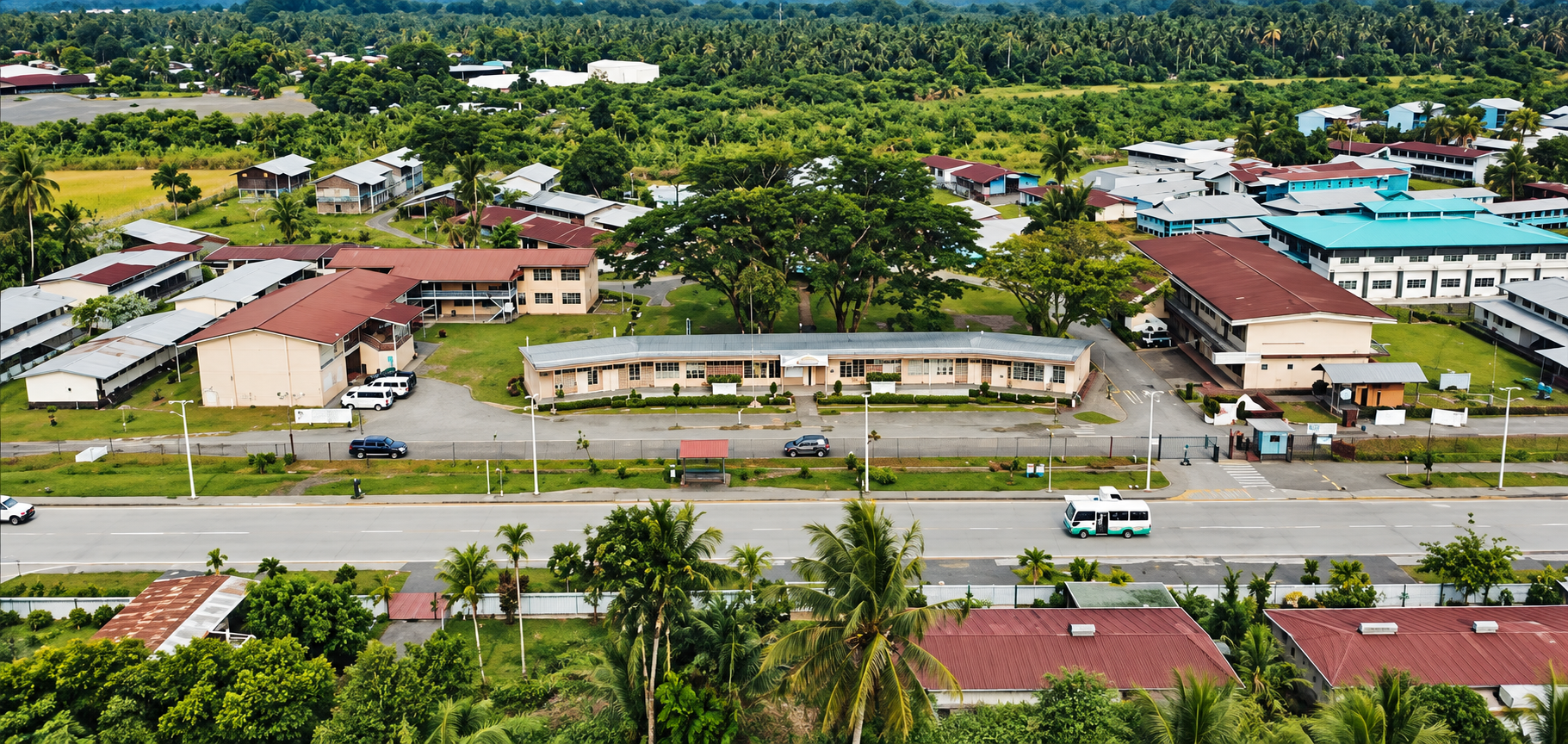
Lae Technical College generally dates its foundation to 1953, although contemporary evidence suggests that establishment occurred over several years. Later institutional accounts identify 1953 as the formal beginning and record the move shortly afterwards from the area subsequently occupied by Busu Secondary School to the permanent site on Milford Haven Road. A 1957 Pacific Islands Monthly report, however, described a relatively new Lae Technical Training Centre, suggesting that substantial teaching at the developed campus had begun only in the mid-1950s. The simplest reconciliation is to regard 1953 as the administrative foundation and 1954–56 as the period in which the institution was physically established and its principal programs commenced.
The formative figure was Walter Rea Oberg, usually known as Rea Oberg. Oberg had attended Wollongong Technical College and trained as a patternmaker at what a later biographical account describes simply as the Wollongong steelworks. His exact employer has not been established, but his formation belonged to the heavy-industrial culture of Wollongong and Port Kembla, where apprenticeship, skilled manufacturing and technical education were closely related.
Oberg was asked to do much more than teach. He helped develop the campus, organise programs, supervise students and serve as principal. Under his leadership the institution offered subjects including carpentry and joinery, fitting and machining, sheet-metal work, automotive engineering, clerical and secretarial studies and general education. His work illustrates the character of institution-building in postwar Papua New Guinea: buildings, workshops, curricula, student welfare and staffing all had to be developed together.
The technical school initially combined functions that would later be distributed across secondary schools, vocational institutions and tertiary colleges. Students could continue general education while undertaking increasing amounts of practical and technical instruction. This arrangement made sense in a Territory where conventional secondary schooling remained scarce. Technical education could extend a student’s general schooling while simultaneously preparing him for apprenticeship and employment.
Physical development accompanied the broadening curriculum. Between 1965 and 1969, the Hungarian-born civil engineer Andrew Redei served as project officer for the development and construction of Lae Technical College. His appointment coincided with the institution’s transition from Technical School to Technical College, generally dated to 1965. New workshops and teaching facilities reflected a more ambitious conception of technical education. The change in title therefore signified more than institutional status: Lae was beginning to educate not only tradesmen but technicians who required a higher level of theoretical and applied knowledge.
This evolution also reflected the changing economy of Lae. After the war, the city developed as a port, manufacturing centre and transport hub. The later opening and improvement of the Highlands Highway strengthened its role as the principal commercial gateway to the populous interior. Industrial expansion required people capable of repairing vehicles, maintaining plant, installing electrical systems, preparing drawings and supervising technical work. A major technical college made particular sense in a city whose daily economy depended upon such skills.
The college’s development also exposed an enduring ambiguity in colonial education. Technical training gave Papua New Guineans access to valued skills and new occupations, yet it was initially organised largely around the labour requirements of government and expatriate-controlled industry. Administrators increasingly spoke of “manpower needs”: how many fitters, mechanics, electricians, clerks and technicians the economy required. Such planning responded to genuine shortages, but it could narrow educational purpose to the supply of labour.
By the later 1960s, however, this occupational framework was changing. Papua New Guinea needed not only tradespeople but middle-level technicians capable of working between skilled labour and professional engineering. These technical officers, draftsmen, laboratory workers and supervisors required more mathematics, technical drawing, systems knowledge and diagnostic ability than traditional apprenticeship alone normally provided. Lae Technical College increasingly occupied this intermediate educational space.
National planning and independence, 1969–78
The Technical Education and Industrial Training Seminar held in Lae from 9 to 11 October 1969 marked an important turning point. Its substantial proceedings survive in the Ian Hossack papers at the Australian National University. The seminar addressed a problem created by the rapid expansion of vocational training across government departments, employers and educational institutions: programs were fragmented, standards varied and responsibilities overlapped.
The importance of the meeting lay in the transition from institution-building to system-building. The question was no longer simply how an individual technical school should operate. Policymakers were attempting to determine how apprenticeships, technical colleges, employer training and higher technological education should fit together across Papua New Guinea. That the seminar was held in Lae itself indicates the growing importance of the city as both an industrial centre and a place where national technical-education policy could be debated.
Sir John Gunther, one of the major figures in the development of higher education in Papua New Guinea, addressed the seminar. His participation connected technical education with the broader project of preparing Papua New Guineans for professional and administrative responsibility. The surviving Gunther and Hossack collections together reveal policymakers attempting to construct a more differentiated educational structure: vocational training and apprenticeship at one level, technician education at another, and professional technological education above them.
During the following years this discussion became increasingly systematic. The Hossack papers include K. R. McKinnon’s Technical Education and Manpower Needs of 1970, studies of localisation, projected enrolments to 1980, apprenticeship statistics, recurrent-cost calculations and institutional staffing records. UNDP and the International Labour Organization contributed to assessments of workforce and training requirements. International development agencies increasingly regarded technical education as infrastructure necessary for economic development.
Employer sponsorship illustrates how closely LTC was becoming integrated with industry. In 1972, Bougainville Copper—the company that mined the enormous open-cut Panguna copper mine based on a 1967 agreement—supported thirty-eight scholarship students at Lae Technical College, more than it supported at either the Institute of Technology or the University of Papua New Guinea. Commercial production commenced at Panguna in April 1972. The comparison reveals the occupational pyramid of a major industrial enterprise. Professional engineers were essential, but mines and other large operations required even greater numbers of technicians and tradespeople to maintain plant, supervise workshops and implement engineering decisions.
Government employers used technical education similarly. Some trainees attended Lae for blocks of formal instruction and spent the remainder of the year in supervised employment. This block-release model preserved the strongest feature of older workplace learning—its direct connection with practical experience—while adding systematic theoretical instruction and recognised certification. Specialised national industries also drew upon the college. By the later 1970s, technical training associated with Lae contributed to the formation of Air Niugini aircraft and airframe personnel. The college was therefore no longer concerned only with conventional mechanical and building trades. Its graduates were becoming part of the technical infrastructure of aviation, mining, public utilities and government.
Papua New Guinea’s independence from Australian colonial rule on 16 September 1975 transformed the political meaning of these developments. Technical education had previously supplied workers to an Australian-administered economy. It now became one means by which Papua New Guineans could assume responsibility for their own industries and public institutions. Localisation—the progressive replacement of expatriate personnel by appropriately qualified Papua New Guineans—became a central policy objective.
World Bank documentation makes this purpose unusually clear. In 1975 LTC had a nominal capacity of approximately 585 students and was producing about 135 technicians annually. Plans sought to increase capacity to about 900 students and technician output to approximately 210 a year. Additional workshops, teaching facilities, equipment, staff housing and library resources were provided, while some higher technical courses were concentrated at Lae. The object was not simply institutional growth but an increased supply of Papua New Guinean technicians capable of filling positions otherwise occupied by expatriates.
Expansion nevertheless revealed the limitations of manpower planning. Creating additional places did not automatically produce additional students. Enrolments in the early 1980s remained well below the enlarged capacity even though employers continued to seek qualified technicians. Sponsorship arrangements imposed costs upon employers, who might have to continue paying trainees, hire replacements and risk losing qualified staff afterwards to competitors. Technical education depended upon incentives and social circumstances that could not be captured simply in workforce projections.
The physical realities of the college posed similar difficulties. Technical education is expensive because machinery has to withstand intensive use and be continually maintained. Some lathes supplied through development assistance proved too light for workshop conditions and broke down repeatedly. Such mundane problems matter historically. They illustrate the distance between planning an institution and making one work.
Independence, staff and campus life
The late 1970s and 1980s brought further changes in the educational structure of LTC. The older technical high-school stream was phased out around 1979–80 as secondary education expanded elsewhere. It was replaced by the forty-week Pre-Employment Technical Training Certificate, generally known as PETT, while the college continued apprenticeship instruction and higher technical certificate courses. LTC was becoming more clearly a post-secondary institution.
One of its continuing strengths was the recruitment of educators with substantial industrial experience. Oberg had represented this tradition in the 1950s. A generation later, Martin Benson joined the college in May 1978 to teach mechanical engineering after approximately twenty years as an engineer with John Lysaght in the Wollongong–Port Kembla industrial district. He later held senior teaching and departmental responsibilities before moving to the Papua New Guinea University of Technology around the mid-1980s.
The parallel is revealing. Oberg had been formed as a skilled tradesman and institution-builder during the colonial era; Benson arrived as an experienced professional engineer in an independent Papua New Guinea. Both brought knowledge acquired in demanding industrial environments into technical education. Students learned more than correct procedures. Experienced lecturers could convey habits of diagnosis, precision, safety, maintenance and judgement—the practical reasoning required when a machine or system did not behave as a textbook suggested.
Recollections from the period identify Bob Potts as principal during part of the 1970s and Roger Dingle, Rex Drage and Norm Chambers among the teaching staff. Chambers taught electrical engineering. Dingle may have been recruited through Australian Volunteers Abroad, although that connection remains to be documented. These names are important to the social history of the institution, but they also draw attention to a larger archival problem: Australian lecturers are more readily identified in surviving Australian records than their Papua New Guinean colleagues.
The greatest unfinished task in LTC’s institutional history is therefore the reconstruction of its Papua New Guinean teaching staff during the 1970s and 1980s. Localisation was not achieved merely when Papua New Guinean graduates entered industry. A genuinely national technical college also required Papua New Guinean lecturers, workshop instructors, department heads and administrators. Detailed Technical Division staffing records survive, but many remain undigitized. Until those sources and college records are examined systematically, an expatriate-centred narrative risks reflecting the bias of the surviving archive rather than the actual life of the institution.
Students themselves came from across Papua New Guinea. A young person from the Highlands, Islands, Momase or Southern region could arrive in Lae and encounter fellow students whose languages and customary backgrounds differed markedly from his or her own. In the years immediately surrounding independence, the college therefore functioned as a small laboratory of national life. Technical education brought people together not only in workshops but in dormitories, churches, sporting activities, student organisations and the wider city.
A small item in the Tok Pisin newspaper Wantok in 1975 gives an unusual glimpse of this student world. A “studen Lae Tek” spoke about visiting the Lae Youth Centre to get away from school, meet other young people and talk. The comment is unremarkable in itself, but precisely for that reason it is valuable. Administrative histories describe enrolments and courses; such fragments reveal students as young adults negotiating friendship, leisure and urban life.
The Lae Tech Catering School provided another memorable point of contact between the college and the city. On Fridays students served three-course, restaurant-style lunches to members of the public at very modest prices. These occasions were both popular and educational. Students learned preparation, timing, presentation, service and hospitality by working in circumstances closer to an operating restaurant than to a classroom exercise. The public, in turn, encountered the college not simply as a closed technical institution but as part of Lae’s social life. The Friday lunches expressed in an unusually pleasant form the basic philosophy of technical education: competence developed by performing real work for real people.
Religious life also formed part of the campus culture. A Tertiary Students Christian Fellowship (TSCF) operated at LTC for many years, sometimes supported by Christian members of the lecturing staff. The movement had begun in Papua New Guinea in 1967 after contacts with the Australian Fellowship of Evangelical Students and became affiliated with the International Fellowship of Evangelical Students in 1979. TSCF was principally student-led and combined fellowship, Bible study, evangelism and leadership development.
Recollections from the LTC community also record a visit by the British Anglican theologian and evangelical leader John Stott during the 1980s. I have not located documentary confirmation of that particular visit, so it is best treated as oral testimony at this stage. It is nevertheless consistent with Stott’s strong international connections with IFES and evangelical student movements. Its significance, if confirmed, would lie less in celebrity than in what it reveals about the college’s participation in networks extending far beyond Lae.
The gender composition of the college was more complex than might be expected. Advanced technical certificate programs remained overwhelmingly male around 1980, with women sometimes numbering only two or three among well over a hundred male students. PETT presented a very different picture. In several semesters between 1979 and 1982, women comprised approximately half the intake and sometimes a majority. In one available 1982 semester, PETT enrolled 104 men and 115 women.
These figures require care. They do not reveal which individual PETT courses women entered, and it would be unsafe to assume either that most were confined to traditionally female occupations or that large numbers were already entering mechanical and electrical trades. They nevertheless demonstrate that women were much more visible within the college than a simple image of an all-male technical institution suggests.
A glimpse of individual careers reinforce this point. Barbara Takai studied business with an accounting major at LTC during the 1980s and later pursued a long career in finance and aviation administration. Delilah Gore, later a member of parliament and cabinet minister, also studied finance at the college before entering administration and auditing. Their experience illustrates the breadth of the institution: technical education at Lae included commerce and business as well as engineering and trades. Other graduates moved into public administration, business and political leadership. James Gau, later Governor of Madang Province, studied at LTC and worked as a civil-engineering technical officer with the Department of Works. Benny Allan, another future parliamentarian and minister, attended the college before entering teacher education. Such careers demonstrate that a technical qualification did not determine a graduate’s entire working life. It could provide a platform for further learning, management and leadership.
This was one dimension of technical education as social mobility. For many students, coming to Lae meant moving from a village or provincial community into an urban institution and eventually into salaried employment. Qualifications could reshape family expectations, income, status and identity. Yet the process also contributed to urban migration and sometimes loosened daily connections with customary communities. The college participated in the broader transformation of Papua New Guinea from a society organised overwhelmingly through local and rural relationships into one increasingly shaped by movement among villages, towns, institutions and formal employment.
From national technical college to Polytechnic
By the 1980s Lae Technical College had become a national institution in a fuller sense. It offered mechanical, electrical and civil engineering, building and architectural studies, commerce, laboratory work, hospitality and trade education. It supplied personnel to government agencies and major industries and participated in the regulation of technical standards. A 1975 National Gazette, for example, identified the college as an examination centre for electricians’ licensing. LTC therefore contributed not only to education but to the machinery through which technical competence was assessed and recognised.
The college also became increasingly involved in regional networks. In March 1979 it hosted Papua New Guinea’s first in-country program associated with the Colombo Plan Staff College for Technician Education, concentrating on measurement and evaluation. A further staff-development program followed later that year. These initiatives placed Lae within an Asia-Pacific discussion about technical curricula, assessment and lecturer development.
The relationship with the Papua New Guinea University of Technology gave the city an especially important place in national technological education. The two institutions performed complementary functions. Unitech prepared graduate engineers, architects, surveyors, scientists and technologists, while LTC concentrated principally on technicians, tradespeople and later diploma students. Staff could move between the two institutions, as Martin Benson did in the mid-1980s. Together they gave Lae an unusual concentration of technical and technological expertise.
The distinction between university and technical education should not be interpreted as a hierarchy of valuable and less valuable knowledge. Modern engineering depends on both. Professional engineers may design systems and assume high-level responsibility, but the operation of those systems depends upon technicians capable of interpreting drawings, diagnosing problems, maintaining equipment and supervising work. LTC’s contribution lay especially in educating this indispensable middle layer.
Institutional development was not uniformly smooth. Evidence of administrative intervention around 1989 suggests that LTC experienced periods of governance and operational difficulty. Such episodes belong within the history rather than outside it. Technical institutions are expensive, vulnerable to shortages of specialist staff and equipment, and exposed to rapid changes in government finance and labour-market expectations. Their success requires continual renewal.
Even so, the college continued to move towards higher-level tertiary education. From 1993, two-year diploma courses began replacing older Certificates in Higher Technical Education. By the early twenty-first century UNESCO described LTC as one of Papua New Guinea’s leading technical institutions, with programs in building, civil, electrical and mechanical engineering, business, tourism and hospitality, pre-employment education and trade extension. Its designation as a UNESCO-UNEVOC Centre linked it formally to an international network for technical and vocational education.
In 2009, Lae Technical College formally became the National Polytechnic Institute of Papua New Guinea. The new title represented both change and continuity. The modest technical training centre of the 1950s had become a tertiary institution offering increasingly advanced qualifications, but the fundamental task remained recognisable: connecting education with practical competence and the technological requirements of society.
Interpreting the history
The development of Lae Technical College can now be understood in several broad phases. Before its foundation, technical skills were transmitted through mission workshops, government departments, commercial employment and informal workplace learning. From 1953 to the mid-1960s, Lae developed a formal technical school combining general education, trade preparation and apprenticeship. From 1965 to 1968, expanded facilities and the transition to college status reflected a growing emphasis on technician education. Between 1969 and independence, national manpower planning increasingly placed LTC within a coordinated system of vocational, technical and higher technological education. After 1975, localisation and national technical capacity became explicit objectives. During the 1980s and 1990s, LTC matured as a post-secondary institution and moved progressively toward diploma education, culminating in the Polytechnic era after 2009.
This chronology also reveals changing ideas about the purpose of education. Under colonial administration, technical training was strongly shaped by the labour requirements of government and industry. During the approach to independence it became part of planned economic development. After independence it acquired a national political purpose: the transfer of technical responsibility to Papua New Guineans. Yet the college was always more than an instrument of workforce planning. Students formed friendships and religious communities, learned to negotiate life in a culturally diverse city, served the public through ventures such as the Catering School lunches, and used their qualifications in ways no employment forecast could predict. Some remained technicians; others became managers, business owners, educators or politicians.
The history also cautions against treating “vocational” education as intellectually inferior to academic education. Technical work demands knowledge and judgement. A technician must interpret evidence, diagnose failure, decide what matters and apply general principles to particular circumstances. The strongest lecturers at LTC brought this kind of practical reasoning from industry into the classroom. The educational goal was not simply to teach students how to follow procedures, but to equip them to respond intelligently when procedures alone were insufficient.
The greatest remaining gap in the history is the contribution of Papua New Guinean teaching staff. Existing online sources preserve Australian educators more readily than national lecturers, workshop instructors and department heads. That is an archival imbalance, not an adequate representation of the mature college. The next stage of historical work should therefore recover these names and careers through staffing lists, graduation programs, Education Department files, college publications and oral history.
Conclusion
Lae Technical College emerged from a place already marked by extraordinary economic and technological change. Before the college existed, the Lae region had moved from customary village landscapes to gold-rush aviation hub, wartime base and postwar industrial centre within a remarkably short period. Technical knowledge had long been acquired through missions, government departments, aircraft operations, workshops and commercial employment. The achievement of the 1950s was to bring such learning increasingly within an organised educational framework.
Under Rea Oberg and his colleagues, the new technical institution combined general education, trade preparation and apprenticeship. During the 1960s it developed into a college increasingly concerned with middle-level technicians. The 1969 Lae Seminar placed the city near the centre of national discussion about manpower, apprenticeship and industrial training. Independence in 1975 gave that work a new purpose: technical education became one of the practical means by which Papua New Guineans could assume responsibility for their own industries and institutions.
The contribution of the college cannot be measured only in enrolment tables or certificates. It also lay in the lives of students who travelled to Lae from across the country, lived and worked alongside people from different communities, participated in organisations such as TSCF, learned hospitality through the Catering School, and carried their qualifications into occupations ranging from engineering and aviation to administration, business and public life.
Papua New Guinea required constitutions, political institutions, universities and national leaders to become an independent nation. It also required people capable of maintaining generators, repairing vehicles, wiring buildings, preparing drawings, managing accounts, servicing machinery, supervising workshops and keeping complex systems operating.
Lae Technical College educated such people. Its history is, in a practical sense, a history of Papua New Guineans learning how to make things work. The phrase applies to engines, electrical systems, buildings, restaurants and businesses, but also to the material infrastructure of an independent country. When Lae Technical College became the National Polytechnic in 2009, its institutional form changed. Its deeper vocation did not: to join knowledge with practical skill, disciplined judgement and service to the common life of Papua New Guinea.
Rev Dr Rod Benson is General Secretary of the NSW Ecumenical Council and a minister of the Uniting Church in Australia serving at North Rocks Community Church in Sydney. He lived in Lae as a child from 1978 to 1983.
Image source: Morobe Tokout-Tokstret Forum

