
By Rod Benson
The controversy surrounding Macklemore’s recent removal from the remaining U.S. dates of Ed Sheeran’s 2026 Loop tour raises a question extending far beyond one rapper, one pop star or one geopolitical conflict. Should musicians use concert stages to address controversial political questions, or does accepting a place on another artist’s tour entail an obligation to leave political advocacy elsewhere? The dispute is especially charged because it concerns Israel and Palestine, where questions of war, civilian suffering, antisemitism, Palestinian rights and competing historical narratives intersect. Yet the underlying issue is broader. It concerns the relationship between artistic freedom, moral conscience, commercial power and public responsibility.
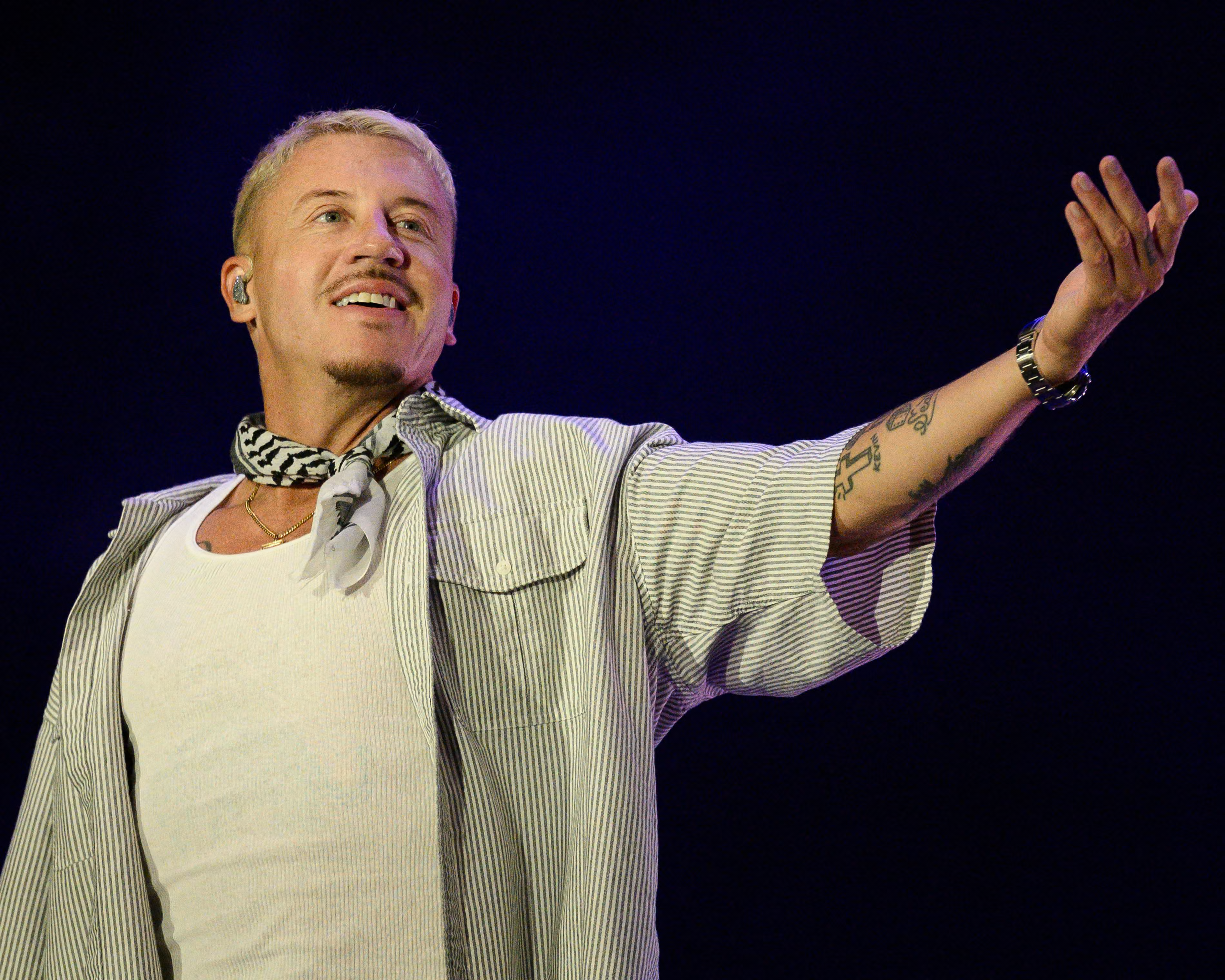
Macklemore had been scheduled to support Sheeran at eight subsequent American concerts. At MetLife Stadium on 4 September, he told the audience that an important reason for joining the tour was the opportunity to say “Free Palestine” before large audiences and assure Palestinians in Gaza and the occupied West Bank that they had not been forgotten. He also performed Hind’s Hall accompanied by images of destruction in Gaza. The Israeli American Council subsequently called for his removal, while StopAntisemitism accused him of using the concert to advance an anti-Israel political message.
The immediate cause of Macklemore’s removal, however, was more complicated than a personal disagreement between him and Sheeran. Messina Touring Group said forthcoming venues would not stage concerts if Macklemore remained on the bill. Robert Kraft, whose organisation controls Gillette Stadium in Massachusetts, confirmed his opposition to Macklemore performing there, citing what he regarded as offensive rhetoric and imagery concerning Jewish people. Sheeran later stated that he had attempted to broker discussions but that the promoter and venues ultimately made the decision.
Sheeran was not acting in a vacuum, and Macklemore himself described a friend of thirteen years placed in a difficult position. The ethical question is consequently not whether one celebrity simply “cancelled” another. Responsibility was distributed among artists, promoters, stadium owners, advocacy organisations and audiences. That does not eliminate Sheeran’s moral agency, but it makes simplistic accounts of the episode inadequate.
There is also an important contractual uncertainty. A support artist does not necessarily possess unrestricted freedom to redefine the character of another performer’s concert. Contracts, promoter agreements, advance understandings and audience expectations may all establish legitimate limits. The publicly available reporting does not disclose the complete contractual framework governing Macklemore’s appearances. That absence matters. Any serious ethical assessment should therefore distinguish what is known about the controversy from what remains unclear about the parties’ formal obligations.
Art has never been apolitical
The suggestion that musicians should simply “stick to music” rests on an implausibly narrow understanding of art. Songs have long interpreted war, race, poverty, sexuality, nationalism, religion, labour and injustice. Gospel, folk, blues, punk and hip-hop have often emerged from communities trying to make moral sense of their world. Even apparently apolitical popular music can embody assumptions about relationships, consumption, success, gender and social belonging.
Nor does celebrity deprive an artist of ordinary citizenship. A singer does not surrender freedom of conscience because an audience has purchased a ticket. Artists are entitled to political opinions, and audiences are entitled to disagree with them. The harder question is whether particular venues, stages and contractual relationships create additional responsibilities. A support artist is not operating entirely independently: the principal performer, promoter, venue and audience all possess legitimate interests.
Artistic freedom is therefore real but not unlimited. Artists can properly be criticised for factual errors, inflammatory language, careless generalisation or rhetoric that contributes to hatred. Jewish people have compelling reasons to remain alert to antisemitism given its long history and continuing contemporary manifestations. Palestinians possess the same inherent human dignity and universal human rights as everyone else. Advocacy for Palestinian freedom cannot simply be equated with hostility toward Jews, just as concern about antisemitism cannot reasonably be dismissed as political propaganda.
Macklemore attempted to make precisely this distinction during his second MetLife appearance. Addressing Jewish members of the audience, he argued that criticism of Israel and allegations concerning apartheid or genocide were not criticisms of Jewish people, and described his message as one of peace, dignity, equality and respect. Whether listeners considered the clarification adequate is a separate question, but an accurate account should acknowledge that he explicitly distinguished Jewish identity from Israeli government policy.
The strongest case against Macklemore
The most serious criticism of Macklemore is not merely that he was “political.” It is that he used a platform embedded within another artist’s tour to deliver a message that some audience members experienced as unilateral, confrontational or hostile. A support act occupies a particular relational position: invited by another artist, appearing before an audience assembled primarily for someone else, and operating within a commercial and contractual structure not entirely of its own making.
Freedom of conscience does not erase obligations of context, proportion and hospitality toward audiences. Yet neither should alleged “audience discomfort” become a sufficient reason to suppress controversial moral speech. The relevant question is whether Macklemore’s intervention crossed a defensible line between legitimate advocacy and speech that rendered the shared event intolerable or unsafe. His effort to distinguish criticism of Israeli policy from hostility toward Jewish people is relevant precisely because it bears upon that distinction.
The high cost of conscience
The morally significant feature of Macklemore’s intervention is his stated willingness to accept consequences. At MetLife he argued that if preserving personal or audience comfort required him to remain silent, he would no longer deserve the stage. After his removal he maintained that losing access to the tour was worthwhile if it redirected attention toward Palestinian suffering. Sincerity does not establish the truth of every political claim, but willingness to bear a cost distinguishes conviction from cost-free signalling.
This is where the controversy becomes uncomfortable for the entertainment industry. Popular musicians routinely sing about love, empathy, peace, solidarity and changing the world. Such themes create moral expectations because audiences do not always experience them as merely aesthetic sentiments. When artists build public identities around compassion, people may reasonably ask how those values function when compassion becomes professionally or commercially costly.
That does not require identical political interventions from every performer. Artists differ in knowledge, vocation, temperament and judgement. Silence may represent prudence rather than indifference. Yet repeated appeals to neutrality become morally significant when institutions are already exercising power. Once access to major stages is conditioned by what may or may not be said about a disputed public question, neutrality itself requires examination.
The more precise question is not whether public figures must adopt the same political conclusions, but whether the principles they invoke—human dignity, compassion, freedom and opposition to hatred—remain operative when applying them becomes costly, contested or institutionally inconvenient.
P!NK and precision
After amplifying criticism of Macklemore, the music artist P!NK explained that she did not object to the words “Free Palestine,” did not want another artist silenced and had not asked for him to be removed. Her stated concern was that aspects of the presentation frightened her and people she loved. It would therefore be inaccurate to say that P!NK demanded Macklemore’s dismissal. One may ask whether amplifying criticism contributed indirectly to a climate of pressure, but that is analytically different from seeking his removal.
This distinction illustrates why public argument over Israel and Palestine so readily deteriorates. People can move too quickly from acknowledging Jewish fear to disregarding Palestinian suffering, or from defending Palestinians to minimising Jewish experiences of antisemitism. Universal human rights resist both temptations. Palestinian civilians and Jewish communities alike possess rights that do not depend upon nationality, ethnicity, religion or political expediency.
Who controls the stage?
U.S. Representative Alexandria Ocasio-Cortez shifted attention from celebrity personalities toward institutional power. She argued that the deeper question concerned the ability of a relatively small number of stadium owners to restrict which political messages could be heard on major cultural platforms, describing the episode as an “abuse of power” and warning that similar mechanisms could affect speech on other controversial subjects. That is her political interpretation rather than an uncontested statement of fact, but it identifies a serious structural issue.
Claims that Kraft personally coordinated a broader campaign among stadium owners should likewise be presented as allegations unless independently demonstrated. What is established is narrower but still significant: Kraft opposed Macklemore appearing at Gillette Stadium, and Sheeran and his promoter reported that several venues would not accept the tour while Macklemore remained on the bill.
A venue owner declining to provide a platform is not legally equivalent to government censorship. Private owners possess contractual, property and associational rights, as well as responsibilities toward patrons. Yet the legal distinction does not exhaust the moral question. When a small number of private entities control infrastructure necessary for national-scale cultural events, their decisions can have speech-limiting effects that are socially important even if they are entirely lawful.
The need for consistency
This is the important distinction between constitutional free speech and cultural freedom. The First Amendment restricts government interference; it does not ordinarily compel private stadium owners to host performers. Yet private concentration of access can still shape which messages are heard, which artists remain employable and which forms of controversy become commercially sustainable. The issue is not whether Kraft or any other stadium owner acted unlawfully. It is whether highly concentrated private power should be subject to moral scrutiny when it governs access to important cultural platforms.
Consistency is also relevant. If institutions justify exclusions by invoking protection from hatred, they should be prepared to explain the principles they use and how consistently those principles are applied. Different contracts and decision-makers may produce different outcomes, but institutional credibility depends upon standards that can be articulated rather than improvised.
The subsequent withdrawal of Sheeran’s other supporting acts sharpened that question. Finneas, Aaron Rowe, Beoga and Lukas Graham withdrew from forthcoming appearances, variously invoking artistic freedom, Palestinian suffering and opposition to wealthy owners determining permissible political speech. Their decisions did not prove Macklemore correct, but they transformed an individual controversy into a collective dispute about cultural power, conscience and professional cost.
The controversy nevertheless risks becoming too preoccupied with the reputational costs borne by celebrities. Macklemore, Sheeran, P!NK and Kraft all possess considerable wealth, visibility and access to public platforms. Palestinians living amid war, displacement, hunger or destruction possess nothing comparable. Jewish communities confronting antisemitism likewise experience vulnerabilities that cannot be reduced to celebrity disagreement.
The central human question is not who emerged from a dispute among famous people with the greater reputational injury. It is whether public controversy helps or hinders attention to those whose lives, homes and security are actually at stake. Macklemore himself made this point by insisting that he, Sheeran and P!NK were not the primary victims of the episode.
How would Jesus respond?
The Gospels provide no modern theory of celebrity activism, but they consistently portray Jesus refusing to restrict compassion to socially convenient recipients. He attends to people others overlook, crosses ethnic and religious boundaries, confronts hypocrisy and insists that neighbour-love cannot be confined to one’s own community. He also refuses the assumption that moral responsibility disappears because circumstances are politically complicated. The parable of the Good Samaritan begins not by establishing whether the wounded traveller belongs to the correct constituency but by asking who becomes neighbour to the person lying beside the road.
Yet compassion in the Gospels is never merely sentimental. Jesus also tells the truth, confronts hypocrisy and challenges those who exercise religious, political and economic power irresponsibly. Compassion without truth can become evasive; truth without compassion can become cruel. Christian moral reasoning therefore requires both attention to suffering and scrutiny of the systems and decisions that contribute to it.
Applied cautiously, that principle challenges every participant in this controversy. Concern about Palestinian suffering does not justify antisemitism. Concern about antisemitism does not justify indifference toward Palestinian suffering. Fear deserves recognition, but so do displacement, hunger, bereavement and the destruction of civilian life. Christian compassion becomes distorted when it recognises humanity selectively.
The central question is therefore not whether artists should “stay out of politics.” Art has always inhabited the moral life of communities. Better questions concern truthfulness, consistency, proportionality, freedom and responsibility. Artists should be accountable for what they say; venues should be accountable for how they exercise their power; audiences should resist caricaturing either Jewish fear or Palestinian suffering; and institutions claiming to protect people from hatred should be prepared to explain the principles they employ.
A plural society will not produce agreement on Gaza, Israel, Zionism, genocide allegations, antisemitism, proportionality or responsibility. Nor should democratic culture require such agreement. What it can reasonably require is a public ethic capable of sustaining serious disagreement without dehumanisation: respect for universal dignity, evidential discipline, freedom of conscience, and restraint in the exercise of institutional power. The Macklemore–Sheeran controversy ultimately exposes the complex ecology through which modern cultural speech is enabled, constrained and contested.
Rod Benson lives in Sydney and writes about a range of topics from books and local history to food, faith, philosophy, ethics, research skills, and everyday life. Away from the keyboard, he enjoys cooking for friends, walking in the Australian bush, exploring a beach, discovering new restaurants, and reading philosophy, fiction and poetry. He is married to Emma Goodsir.
Image source: The Guardian

