
By Rod Benson
According to the Book of Genesis, Noah’s Ark once saved the world’s animals from extinction. Today, in the latest of many archaeological expeditions to the region, a dry sonic core drill is testing a disputed boat-shaped formation near the traditional site of Mount Ararat.
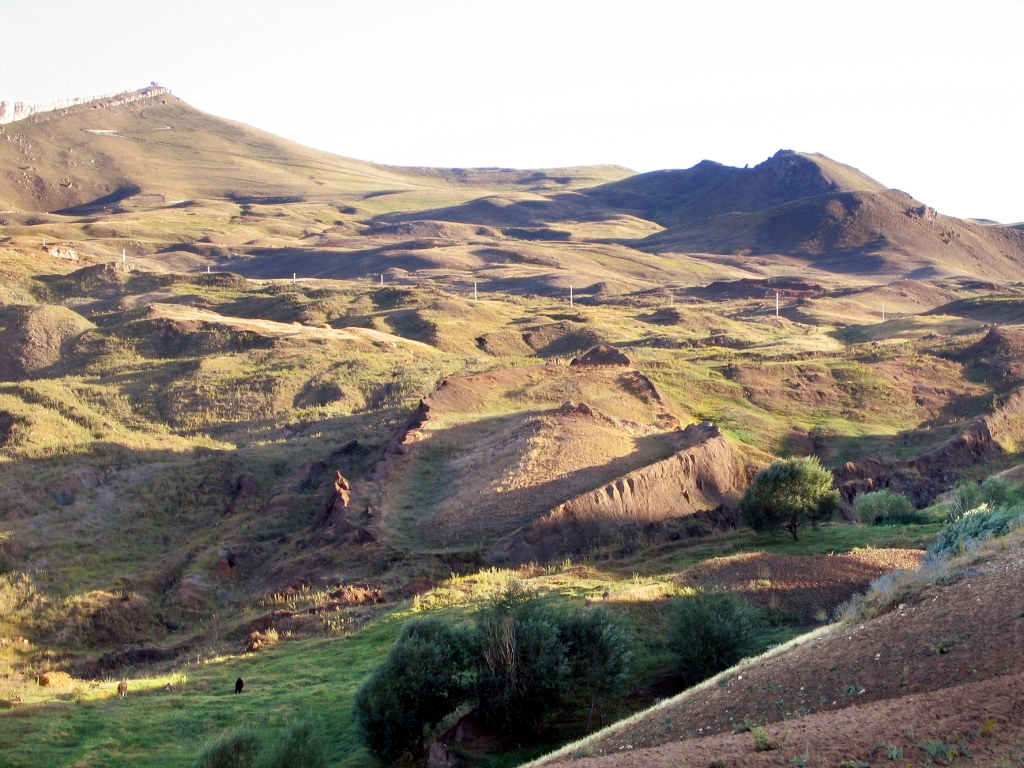
The Durupınar Formation, a rocky outcrop on a mountainside in eastern Türkiye, has attracted Ark hunters for decades. Some see the vessel that survived the flood in Genesis. Geologists who have studied the site offer a natural explanation. Recent radar surveys have revived the argument, and drilling reportedly began this week. Once again, the possibility of finding Noah’s Ark is making news before the evidence has been established.
Noah’s Ark Scans says ground-penetrating radar has detected straight lines, angular intersections and possible cavities. The group interprets some features as corridors or chambers and compares three apparent underground layers with the Ark’s three decks in Genesis 6:16. One widely circulated report quotes a researcher declaring it “100 per cent confirmed” that the formation is human-made. Radar, however, records reflections from underground materials. It cannot identify what produced them.
What can the drill establish?
A core sample can reveal what lies beneath the surface and how underground layers relate. The project has described plans to send a small robot, Gopher, into any suitable spaces. This week the group reported that a drill bit broke against a hard layer roughly four to five metres below the surface, raising the possibility of petrified wood. The broken bit establishes that the drill met resistance. The material remains unidentified.
The cores might strengthen the geological explanation, reveal human activity, or remain inconclusive. Even worked material would need dating and context. Evidence of a vessel would require further argument before it could be identified as Noah’s Ark. The distance between a hard layer and that conclusion is considerable.
Genesis says the Ark came to rest on the “mountains of Ararat” (Genesis 8:4), a regional description that does not identify Durupınar. Supporters regard the formation’s length as close to the Ark’s biblical length of 300 cubits. That comparison depends partly on which ancient cubit is used, while resemblance cannot establish what lies underground.
A history of almost finding the Ark
Earlier claims failed to establish the Ark’s location. In the 1950s, Fernand Navarra said he had recovered timber on Mount Ararat, but subsequent analysis did not establish its connection with the biblical vessel. An early investigation at Durupınar found no visible archaeological remains. David Fasold later became convinced that the formation might be the Ark. After further study, he and geologist Lorence Collins published a 1996 paper concluding that it was natural: folded sedimentary layers explained features presented as parts of a ship.
The current team may obtain better evidence, but its interpretation must account for those findings. Any unusual material recovered by drilling needs identification before it is described as part of a vessel.
An aerial photograph of Durupınar may suggest something other than a boat. With its elongated outline and central line, the formation can also resemble a human vulva and labia to some viewers. This is a visual comparison, not an established archaeological interpretation. It shows how expectation can influence what we see.
At Utroba Cave in Bulgaria, an entrance resembling a vulva leads into a passage associated with the womb. The site appears to have begun as a natural fissure that people enlarged and shaped; a carved altar supports its identification as a Thracian ritual complex. On Thailand’s Ko Samui, Hin Yai, or Grandmother Rock, also resembles female genitalia. It formed naturally before people gave it a name and story. Neither example explains Durupınar. Both show why a suggestive shape cannot settle its origin.
Will this “dismantle Darwinism”?
The expedition has acquired an ambition far beyond identifying a landform. Lauren Witzke, described in recent reporting as the project’s marketing and fundraising director, said its findings would require university curricula to be rewritten and that “Darwinism will be dismantled.” That is her public claim, not necessarily the position of every researcher at the site. Nor is it supported by results from the drilling.
Even an ancient ship would not overturn evolutionary theory. A ship is built by humans; evolution concerns the history of living things. Its evidence comes from genetics, fossils and other independent fields. Finding a vessel would tell us about its builders, not erase the evidence for common ancestry. Nor would a boat alone establish a worldwide flood. The Durupınar drill has yet to produce evidence bearing on evolution.
More fundamentally, there is no inevitable clash between biblical revelation and evolutionary theory. Evolution investigates how populations change and species develop over long periods. Biblical texts ask who God is, what it means to be human, and how we should live in relation to God, one another and the rest of creation. These questions can inform each other without requiring Genesis to supply a biological mechanism or evolutionary theory to pronounce on divine purpose.
Christians who affirm evolution can also confess God as creator, understanding natural processes as part of the means through which life developed. That approach raises serious theological questions about suffering, death and the interpretation of Adam and Eve; it does not make them disappear. But rejecting evolution is not a necessary test of biblical faith. Christian thinkers and institutions have articulated approaches that take both scientific evidence and Scripture seriously.
The promised demolition of “Darwinism” rests on a false choice. It treats a reading of Genesis that demands a recent global flood and rejects common ancestry as the only faithful reading. It then treats a possible archaeological discovery as though it could undo findings established across biology and geology. Neither claim follows from what a drill might find.
What kind of story is Genesis telling?
Many biblical scholars read the flood narrative in Genesis 6–9 as myth rather than a modern record of a datable global event. Here myth describes a story that explores enduring questions through memorable characters and events; it does not simply mean “false.” Neither does the term rule out memories of ancient floods. The Genesis account shares striking features with older Mesopotamian flood traditions and deserves to be read within its ancient literary world.
Genesis gives this kind of story its own theological force. The flood follows the spread of wickedness and violence. Noah’s preservation expresses God’s commitment to life. When the waters recede, God makes a covenant with Noah’s family and every living creature. The rainbow signifies divine restraint and faithfulness (Genesis 9:8–17). The story asks whether a world damaged by violence can begin again, and how its inhabitants should live.
Genesis is an ancient religious text foundational to Jewish and Christian faith, not a scientific textbook. Noah is also important in the Qur’an and Islamic tradition, though Genesis itself is not Islamic scripture. These traditions differ in their interpretations. The biblical text should not have to bear the weight of modern attempts to prove a fundamentalist account of geology or biological history.
Who pays for the search?
The investigation also has a financial dimension. Its public crowdfunding campaign seeks US$600,000 to pay for drilling personnel, equipment and transport to the mountain; it appears that about US$78,800 has so far been raised. The campaign names Noah’s Ark Discovery, Inc. as the recipient. The project also solicits donations for surveys, analysis, visitor-centre improvements and media production. These appeals show that private supporters are being asked to finance substantial costs, though the public information does not establish who has paid for all work already done or the eventual total cost. It would be unfair to claim, without evidence, that the researchers are motivated chiefly by money or that donors are misinformed. It is fair to ask whether claims of certainty and promises to “dismantle Darwinism” encourage Christians to give money on expectations the evidence cannot sustain.
Why the need for proof?
Ark searchers have different motives. Curiosity about an ancient story is understandable, and investigating an unusual formation is legitimate. Trouble begins when the desired conclusion determines the meaning of uncertain evidence. A radar line becomes a timber, a cavity becomes a chamber, and a hard layer becomes petrified wood before testing is complete. A public declaration of certainty can be harder to revise than a hypothesis.
For some believers, the search may express a wish to make faith credible in a culture shaped by modern science. An authenticated Ark would seem to give Genesis the standing of a demonstrated fact. I understand the attraction, especially when faith is dismissed as intellectually embarrassing. But it places too much weight on an ambiguous scan or fragment. Every inconclusive search can then feel like a defeat for belief.
Claims about physical objects should face physical tests. Scripture must also be read with attention to its language, setting and purpose. Neither inquiry gains when evidence is made to serve a conclusion chosen in advance. Of course, drilling may change our understanding of Durupınar. For now, the hard layer has not been identified as wood, the radar features have not been established as chambers, and the formation has not been shown to be a ship. The investigators should publish what they find, including results that disappoint their expectations, so others can assess the evidence.
The most revealing discovery may be how urgently we want the earth to confirm what we already believe. Faith need not depend on a disputed landform, and evolutionary theory cannot be overturned by a publicity claim. The drill should be allowed to tell us what is there; Genesis should be allowed to ask its searching questions about personhood, violence, covenant and ethics whether or not scientific evidence for the existence of Noah’s Ark is found.
Rod Benson lives in Sydney and writes about a range of topics from books and local history to food, faith, philosophy, ethics, research skills, and everyday life. Away from the keyboard, he enjoys cooking for friends, walking in the Australian bush, exploring a beach, discovering new restaurants, and reading philosophy, fiction and poetry. He is married to Emma Goodsir.
Image source: Wikimedia Commons


