
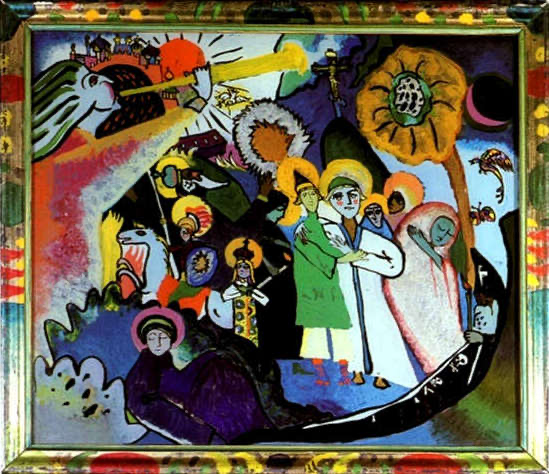
A theological and historical reflection with reference to the Uniting Church in Australia
By Rod Benson
Observed on 1 November, All Saints’ Day is an annual celebration of the communion of saints, the witness of Christians across the centuries and the resurrection hope that gives Christian remembrance its distinctive character. It is celebrated throughout much of Western Christianity; the Eastern Church celebrates All Saints Day on the first Sunday after Pentecost, following the commemoration of the descent of the Holy Spirit.
The focus of All Saints Day is not confined to eminent religious figures or officially canonised saints. Rather, the festival invites the universal Church to give thanks for all those in whom the grace of God has borne fruit, including innumerable people whose names have disappeared from public memory. Theologically, the occasion brings together history, ecclesiology and eschatology. It recalls the Church’s inheritance, identifies its present membership within a larger fellowship, and anticipates the consummation of God’s reconciling purposes. Its central subject is not human excellence considered in isolation, but the grace and faithfulness of God manifested in imperfect human lives.
The vocabulary of sainthood provides an essential starting point for an exploration of the meaning of the day. The Greek adjective hagiosdenotes what is holy or set apart, and the New Testament regularly applies its plural form to ordinary members of Christian communities. Paul addresses the believers in Rome as those called to be saints (Rom 1:7) and uses analogous language in writing to Corinth (1 Cor 1:2), despite the serious disagreements and moral failures evident in that congregation.
Sainthood in this sense denotes belonging to God through union with Christ rather than admission to an elite class of exceptionally virtuous Christians. This inclusive biblical usage should not erase the historical distinctions between churches that formally recognise specially designated saints and Protestant traditions that generally place greater emphasis on the holiness and vocation of all believers. Nevertheless, it supplies a common theological basis for understanding the festival as thanksgiving for grace rather than the unqualified celebration of religious achievement.
The festival arose gradually from early Christian practices of commemorating martyrs, whose deaths were understood as witness or testimony to Christ. Collective commemorations were established in parts of the Christian East by the fourth century, although the dates and customs varied. In Rome, Pope Boniface IV dedicated the Pantheon to Mary and all the martyrs in 609 or 610, with a celebration associated with 13 May. During the eighth century, Pope Gregory III established a dedication to all the saints at St Peter’s, associated with 1 November; in the ninth century, the observance spread more widely in the Carolingian world, notably under Pope Gregory IV and Emperor Louis the Pious. This history does not justify claiming that one pope simply invented the festival or that its November date has a single, demonstrable origin. Eastern Orthodox churches continue to observe All Saints on the Sunday after Pentecost, illustrating the diversity of the Christian liturgical inheritance.[1]
The theological centre of All Saints’ Day is the communion of saints confessed in the Apostles’ Creed. Such communion is grounded in the Church’s participation in Jesus Christ rather than in sentimentality about the deceased. In the New Testament, Hebrews 11:1-40 recounts the persevering faith of earlier witnesses, including Hebrew heroes, before exhorting believers, surrounded by a ‘great cloud of witnesses’, to run their own race while looking to Jesus (Heb 12:1–2). This image supports an understanding of Christian life as historically continuous and mutually sustaining, without requiring the assertion that departed believers literally observe every event on earth. Likewise, Revelation 7:9–17 presents a multitude drawn from every nation and language worshipping before God. Its apocalyptic imagery is not a literal demographic report of heaven, but a theological vision of divine salvation overcoming human frailty and division. The saints matter because their witness directs attention beyond themselves to the crucified and risen Christ.
The relationship between remembrance and resurrection is equally significant. Paul’s argument in 1 Corinthians 15 locates Christian hope in Christ’s resurrection and the promised defeat of death, while Romans 8:38–39 affirms that neither death nor life can separate believers from God’s love in Christ. All Saints’ Day consequently holds grief and gratitude together without denying the reality of the experience of bereavement. It also calls for theological discrimination, since confident Christian hope should not be confused with certainty about the eternal destiny of individuals, nor with an assumption that every deceased church member exemplified holiness in every aspect of life. Remembering faithfully includes acknowledgement of human frailty, failures and, where necessary, sins of commission and omission. Such honesty protects the sacred festival from descending into nostalgia, and makes its emphasis on grace more credible.
For the Uniting Church in Australia, the observance resonates with the Basis of Union, which properly locates the Uniting Church within the “One Holy Catholic and Apostolic Church” and acknowledges the Church’s faith and unity as grounded in Jesus Christ. The Basisreceives the Apostles’ and Nicene Creeds as expressions of the Church’s faith across the ages and presents baptism as incorporation into Christ’s body. Its account of Holy Communion describes the risen Lord nourishing the baptised and giving them a foretaste of the consummated kingdom. These affirmations offer a more substantial basis for commemorating the saints than a merely historical interest in exemplary personalities. At the same time, the Basis insists that every member receives divinely imparted gifts for Christian service. The communion of saints thus includes ordinary worshippers, carers, teachers, activists and neighbours alongside celebrated theologians and church leaders.[2]
In congregational worship, these convictions can be enacted through scriptural readings, intercessions, hymns of thanksgiving, the naming of those who have died and the lighting of candles. A Uniting Church Assembly reflection published in 2023 describes precisely such practices and emphasises the remembrance of ordinary saints whose faith has shaped others.[3] Celebration of Holy Communion may deepen the occasion by placing remembrance within thanksgiving for Christ’s saving work and anticipation of the kingdom.
All Saints’ Day should also be distinguished from All Souls’ Day on 2 November, which in Roman Catholic practice particularly commemorates the faithful departed through prayer. Although some Protestant congregations combine these themes, their differing histories and theological emphases are worth preserving rather than collapsing into a single undifferentiated memorial service.
Finally, the festival makes an ethical claim upon followers of Jesus. To remember the saints is to recognise that Christian identity is received through the witness of others and is entrusted to subsequent generations. The Beatitudes (Mt 5:1–12) identify mercy, peacemaking, righteousness and perseverance as marks of life under God’s reign; they resist any construal of sanctity in terms of prestige, power or institutional success. For small congregations confronting numerical decline, economic pressure or social marginalisation, this perspective offers a particularly important corrective. The Church’s significance cannot be measured solely by attendance, property or public influence. Faithful worship, fellowship, discipleship, witness and service may constitute a lasting legacy even where institutional continuity is uncertain or compromised.
All Saints’ Day therefore looks backward with gratitude, outward towards the contemporary fellowship of believers and forward in resurrection hope. Above all, it calls the Church to follow Jesus, whose grace forms its saints, and whose promised future sustains their witness.
Rev Dr Rod Benson lives in Sydney and writes about a range of topics from books and local history to food, faith, philosophy, ethics, research skills, and everyday life. Away from the keyboard, he enjoys cooking for friends, walking in the Australian bush, exploring a beach, discovering new restaurants, and reading philosophy, fiction and poetry. He is married to Emma and is minister of North Rocks Community Church, a Uniting Church congregation.
References
[1] Catholic University of America, “All Saints Day Facts” (2013), https://communications.catholic.edu/news/2013/10/saints-day.html; Vatican News, “Solemnity of All Saints,” https://www.vaticannews.va/en/liturgical-holidays/solemnity-of-all-saints.html. Historical chronology and variation in liturgical dates.
[2] Uniting Church in Australia, Basis of Union (1977; revised edition 1992), especially paragraphs 2, 3, 7–9 and 13, https://uniting.church/basisofunion/.
[3] Bethany Broadstock, “For all the Saints: An All Saints Reflection,” Uniting Church in Australia, 1 November 2023, https://uniting.church/all-saints-reflection/.
Image source: Kandinsky

