
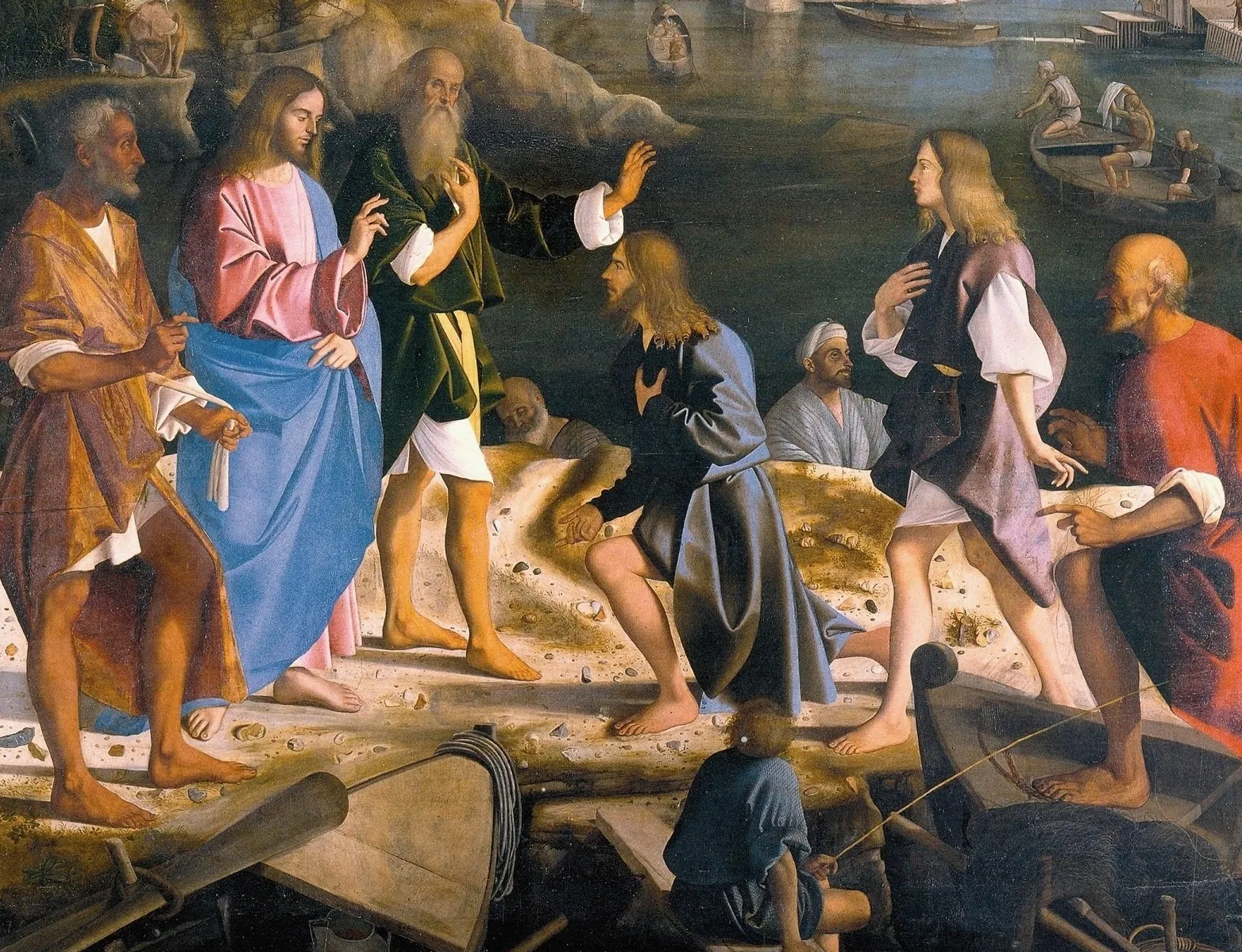
Now and then in the Gospels, we stumble upon the most extraordinary and unexpected interactions with Jesus. One of the most unexpected and divisive is recorded in Mark 10:35-40.
Presumably, the twelve disciples were together, until they weren’t. James and John, the sons of Zebedee, along with their mother (who is mentioned in Matthew’s account of the story, in Matthew 20:20), approach Jesus privately with an astonishing request. “Teacher,” they say, “we want you to do whatever we ask you” (v. 35).
If we are honest, sometimes we do that with our prayers, and although we may not say the actual words, what we are really saying to God is, “My kingdom come, my will be done.” The best prayer you can utter is the sinner’s prayer: “Lord, be merciful to me, a sinner.” And the next best prayer is this: “Your kingdom come, your will be done on earth as it is in heaven.”
The disciples were supposed to be in training under the rabbi they had chosen. It was their intention to be with Jesus, become like him, and do as he did. That is what apprenticeship to a rabbi was all about. But here are two of them doing something very different. They got the first part right, and they have been with Jesus, but they got an F on Part 2 and Part 3 of Discipleship 101.
In response, Jesus does not rebuke them. He probes for more information, and they disclose the true intention of their request: “Allow us to sit at your right and at your left in your glory” (v. 37). And Jesus, perhaps not expecting such an audacious response, simply said, “You don’t know what you are asking” (v. 38a). James Edwards calls it self-serving, callous, and offensive.[1]
Then, in verses 38b-45, Jesus does two significant things – or, rather, he makes two profoundly important statements.
First, he outlines, in greater detail than he has done in the past, the nature of work of salvation for which he came from heaven to earth.
“You don’t know what you’re asking,” he says. “Are you able to drink the cup I drink or to be baptised with the baptism I am baptised with?” (v. 38). And there is more rich teaching on the purpose of his death in verse 45, which we will come to shortly.
James and John are clueless. They contradict Jesus. They are convinced that they are ready for whatever comes, perhaps in the misguided view that Jesus will perform a great miracle and all the Roman soldiers will fall down dead, and all the Jewish religious leaders will sign up to Following Jesus 101, and everyone else will acclaim the Twelve as the greatest rabbis the world has ever seen, and James and John as Viceroys to King Jesus, seated on their very own gold thrones with Jesus in their midst.
But it wasn’t to be like that at all.
Instead of pomp and power, there will be suffering and death. And in verse 40, we catch a glimpse of Jesus’ own understanding of the eschaton and the holy principles that apply at the end of time:
- heavenly rewards are sovereignly dispensed by God
- everything proceeds according to God’s perfect plan
James and John thought they had a special relationship with Jesus that they could leverage to gain power for themselves when Jesus assumed power and authority in their political and religious world.
The other ten disciples put them in their place (v. 41). They were astonished at the audacity and subterfuge, then outraged. And the outcome of James and John’s greed and scheming was disunity among the closest friends and confidants Jesus had.
In verses 42-44, Jesus rebukes them all for the shallowness of their thinking and the heartlessness of their hearts. And he teaches them the secret of living in accordance with the values of the kingdom of God: They must seek earnestly to serve each other, and their neighbours, and the strangers among them. They must look out for the lowly tasks, and perform them in a spirit of excellence, and not look for praise or other reward. They must live every day with humility and godly wisdom, pursuing a life of prayer and humble dependence on God.
In Luke 22:27, Jesus says, “For who is greater, the one at the table or the one serving? Isn’t it the one at the table? But I am among you as the one who serves.” That should be our guiding principle too, especially for those of us who aspire to leadership in the church, or are elected or appointed to positions of authority.
When Jesus observes that Gentile rulers “lord it over” others and then tells his disciples, “It shall not be so among you,” he does not abolish authority but radically redefines its character and purpose. Power should not be treated simplistically as inherently corrupt. We should distinguish between power over others, power to act, power exercised with others, and the moral authority generated through truth, integrity, solidarity and sacrifice.
Jesus’ model of power is directed toward service and the flourishing of others rather than domination or self-aggrandisement. That is the lesson those disciples needed to learn. It is a lesson each of us needs to learn too.
The key question is not merely who possesses power, but what power is for, whom it serves, and how those exercising it are held accountable. Jesus calls them over and says to them,
You know that those who are regarded as rulers of the Gentiles lord it over them, and those in high positions act as tyrants over them. But it is not so among you. On the contrary, whoever wants to become great among you will be your servant, and whoever wants to be first among you will be a slave to all (vv. 42-44).
The second profoundly important statement Jesus makes in Mark chapter 10 relates to the meaning of his life and death. In verse 45, Jesus says, “For even the Son of Man did not come to be served, but to serve, and to give his life as a ransom for many.” This is an enlargement of his teaching in 8:31, 9:31, and 10:33-34. After each instance, the disciples jockey for positions of power and prestige in the face of Jesus’ prediction of his suffering and death.
The title “Son of Man” carries great weight for biblical theologians today, who often link it to Daniel 7:13 and identify Jesus’ use of the term as code for his mission as God’s agent of final judgment on earth. But the references to a Son of Man in the Hebrew Scriptures do not speak of forgiveness of sins, and the disciples of Jesus seemed to take his use of the term as unremarkable.
What is remarkable is that this is the first time that Jesus precisely explains the purpose of his death, and he uses the term “ransom” (v. 45). A ransom is a price paid to liberate a slave, a prisoner, or a condemned criminal. The paying of the price wiped the slate clean (see Lk 1:68; 2:38; Tit 2:14; Heb 9:12; 1 Pet 1:18; and Isa 53:10). Commenting on this verse, Donald English writes,
There is no benefit in asking to whom the ransom price was paid: this is not the point of the image. Its single purpose is to make clear that Jesus Christ, Son of God and Son of Man was himself the price paid to set us free. At the source of all Christian service in the world is the crucified and risen Lord who died to liberate us into such service.[2]
In Mark 3:27, Jesus presents a vivid image of salvation, describing someone entering a strong man’s house and plundering his possessions after first tying up the strong man.But here, the image is altogether different: “There is no violent assault on hell to lead a great escape. The violence will be done to Jesus, who gives his life as payment to set the prisoners free.”[3]
As we reflect on the rich practical and spiritual teaching of these eleven verses, hear this extract from a sonnet by Malcolm Guite:
The first shall be the last, the last the first.
You make rich havoc of our sense of place
As every strain of status is reversed.
With one swift look of love, your sacred face
Outfaces us. Disgrace is met with grace,
And blessings fall on those we call accursed.
Strive as they might, the swift don’t win the race,
But still the cup is full for those who thirst.[4]
Sermon 874 copyright © 2026 Rod Benson. Preached at North Rocks Community Church, Sydney, Australia, on Sunday 4 October 2026. Unless otherwise noted, Scripture quotations are from The Christian Standard Bible (Nashville: Holman Bible Publishers, 2020).
Rev Dr Rod Benson is General Secretary of the NSW Ecumenical Council and a minister of the Uniting Church in Australia serving at North Rocks Community Church in Sydney.
References
[1] James R. Edwards, The Gospel According to Mark (Leicester: Apollos, 2002), 321.
[2] Donald English, The Message of Mark (Nottingham: IVP, 1992), 182.
[3] David E. Garland, A Theology of Mark’s Gospel (Grand Rapids: Zondervan, 2015), 475.
[4] Malcolm Guite, Parable and Paradox: Sonnets on the Sayings of Jesus and Other Poems (Norwich: Canterbury Press, 2016), 72.
Image source: Christian Art
Taking it further…
Reflection questions
- What does James and John’s request reveal about their understanding of Jesus’ mission and their own place within it? How does Jesus challenge their expectations?
- The sermon describes discipleship as being with Jesus, becoming like him, and doing as he did. Why might someone succeed in the first while struggling with the other two?
- What do Jesus’ images of the “cup” and “baptism” suggest about his path to glory? How does this challenge the disciples’ assumptions about greatness?
Application questions
- When might our prayers express “my kingdom come, my will be done”? Choose one concern you are praying about: how could you bring it to God with greater openness to God’s will?
- How does Jesus redefine the character and purpose of authority? Why is distinguishing between power used to dominate and power used to serve important?
- What overlooked task could you undertake this week as an act of service? How could you do it thoughtfully and well without seeking recognition?

