
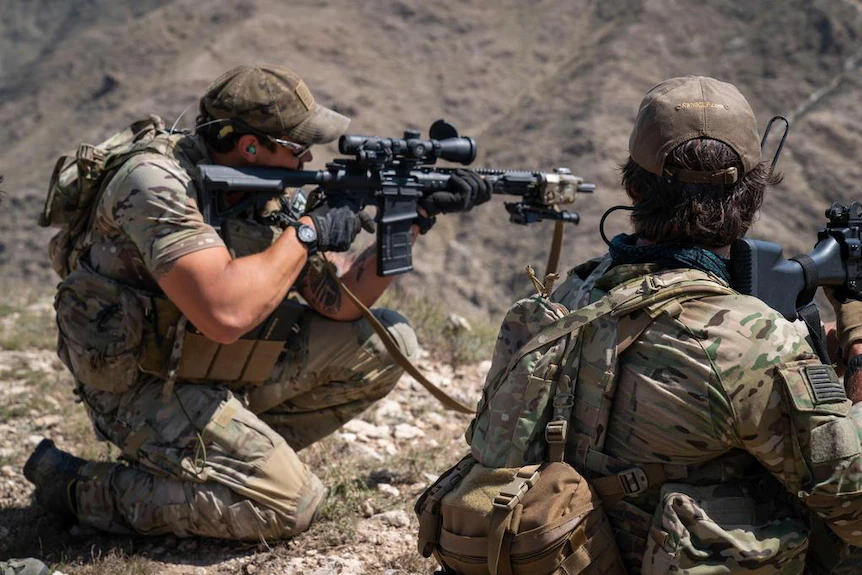
Imagine you are a Christian office worker or builder, and Australia enters a war with China, and enacts laws requiring conscription to military service for all citizens aged 18–30. Or imagine that you are an officer in the Australian Defence Force, and you subsequently identify as a Christian and form the conviction that it is morally wrong to bear arms or kill another person.
What guidance does the Bible offer for decision-making in such situations? There is no urgency, and no pressure, but it’s good to explore and model how the Bible speaks to us on the ordinary issues of life, and it seems a good opportunity to explore this topic today.
What is conscientious objection? First, it is not the same as civil disobedience because it involves a refusal to perform what the state demands (or an insistence on performing what the state forbids), and it seeks exemption from a legal duty rather than seeking to change the laws, policies or practises of the state.
Yet conscientious objection is a form of dissent. It refers to a person’s moral or religious opposition to the demands or requirements of an external authority, usually the state, on the basis of conscience. It usually relates to military service or participation in war. The conscientious objector claims that to act as required by the state would violate their conscience and result in a loss of integrity, along with feelings of guilt and shame at not being free to express their strongly held belief.
The first Christians, and the early Church fathers, generally opposed military service on the grounds of avoiding bloodshed and practicing the radical kind of neighbour-love that Jesus taught. The conversion of Emperor Constantine in 312 turned that teaching on its head for a large majority of the church. Yet a small minority in every generation, especially since the 16th century, continued to affirm the pacifist tradition of the early church.
The “just war” tradition first articulated by Augustine in the early 400s has been the dominant tradition. Logically, this should have produced large numbers of conscientious objectors to many of the wars fought by countries whose citizens included Christians, but this has not been the case. Christian pacifists and nonviolence advocates should probably also have expressed a louder dissenting voice than history demonstrates.
Conscientious objection affirms that the state’s authority is not absolute, and reminds us that the state may not demand total obedience from its citizens, especially when such a demand would violate an individual’s conscience. From the perspective of the state, it may be prudent to permit conscientious objection in some cases to avoid disrupting military action and to preserve conscientious objection for religious reasons.
It is generally agreed today that it is morally wrong to force a person to act against their conscience, although it may sometimes be necessary and justifiable for the state to do so. The World Council of Churches confirmed its support for conscientious objection in 1953, and the Catholic Church did likewise at Vatican II (Gaudium et Spes, 79). The Uniting Church grounds its commitment to peacemaking in Jesus and calls Christians to protect life and pursue reconciliation. Our 1982 Assembly statement on militarism and disarmament places the burden of justification on those who use military force to settle international disputes.
Within this framework, the Uniting Church recognises conscientious objection to military service as a faithful response to the teaching of Jesus that his followers should be peacemakers. The Uniting Church also provides pastoral care through its Defence Force chaplaincy.
For those whose conscience obliges them to refuse to participate in military service, most modern states now provide forms of alternative or non-combatant service, such as medical service within the military, or other work of national importance such as chaplaincy or code breaking, in exchange for exemption from direct military service.
But this raises all kinds of questions. For example, should conscientious objection be permitted for non-religious objectors? Should it be permitted for universal objectors (those who oppose participation in all wars) as well as selective objectors (those who oppose service in a specific war, or the use of certain kinds of weapon)? Should recognition of conscientious objection be conditional or unconditional?
What does the Bible have to say on these matters? There is no direct teaching in Scripture about conscientious objection, and Jesus did not specifically address the issue, although the Bible has much to say about war and peace, violence, conscience, moral responsibility, and church-state relations.
In the Hebrew Scriptures, Deuteronomy 20:5-8 sets forth laws prescribing who must participate in war, with exceptions for certain categories of persons. Historically, various states have granted exemptions from military service to priests, religious, Jews and Mennonites, and to citizens whose loyalty to the state was questionable.
From my perspective, the New Testament texts are Matthew 5:9, 43-46; 22:37-39; Acts 5:25-32; Romans 12:1, 14-21; 13:1ff; Galatians 5:22-23; and Philippians 3:20.
Matthew 5:44 applies to various settings, such as people defending their family from an armed intruder; a person living with an abusive spouse or other family member; or a citizen conscripted to active military duty. The often-quoted words of Acts 5:29, “We must obey God rather than men” (NIV) are the basis for many courageous acts of civil disobedience, and may also be applied to conscientious objection.
But how do we discern when to lift the words out of their original context and apply this basic ethical principle to new situations? It is clearly God’s will for Christians to be conscientious citizens and, except in extreme situations, to submit to human authorities.
But as John Stott puts it, “If the authority concerned misuses its God-given power to command what he forbids or forbid what he commands, then the Christian’s duty is to disobey the human authority in order to obey God’s.”[1]
Each of us needs to be aware of the general teaching of Scripture, or willing to learn, and then apply relevant biblical principles to our specific situation or dilemma. On difficult ethical issues, and situations we have not previously encountered, it is also good to consult reliable and trustworthy friends, and do some research, but ultimately each of us must make our own decisions and not be coerced by others.
The final biblical text I want to consider today is Philippians 3:20, where Paul declares that “Our citizenship is in heaven, and we eagerly wait for a Saviour from there, the Lord Jesus Christ.”
Philippi was a distinctive colony of Rome in the province of Macedonia, and the Christians at Philippi were proud of their Roman citizenship. Paul refers to it in 1:27 as well as in 3:20. He is not calling on them to renounce their common citizenship in the earthly commonwealth of Rome, but he wants them to know the greater reality that they are subjects of the Lord from heaven, their supreme allegiance is to the Saviour, Jesus Christ, and their true identity and with God rather than Caesar.[2]
As they go about their daily lives in Philippi, they are to recognise the change that has come through knowing Jesus as Lord and Saviour – a change that has implications for worship, business life, sexuality, and all aspects of ethics including the limits of allegiance to Rome.
This text is appealed to by many Mennonites and Christian pacifists who argue against involvement in politics and the military. Article six of the Schleitheim Confession, adopted by Swiss Anabaptists in 1527, states, “The worldly are armed with steel and iron, but Christians are armed with the armour of God, with truth, righteousness, peace, faith, salvation, and with the word of God.”[3]
It’s not too hard for us to connect Philippians 3:20 with Acts 5:29 and our own context, and the ethical decisions we may be obliged to make. What would you do if you were called up, or if you were already serving in the military and came to believe that you could no longer bear arms or support the prosecution of a particular war?
How would you counsel your Christian son or daughter, or grandchild, on this issue? We can begin to think and pray about it today, while there is no pressure. We can listen to Scripture, seek the counsel of people we trust, and ask what it would mean to love our neighbours and our enemies in such a situation.
May God give us the wisdom to discern what following Jesus requires, and the courage to embrace that life, come what may.
Sermon 878 copyright © 2026 Rod Benson. Preached at North Rocks Community Church, Sydney, Australia, on Sunday 15 November 2026. Unless otherwise noted, Scripture quotations are from The Christian Standard Bible (Nashville: Holman Bible Publishers, 2020).
Rev Dr Rod Benson is a minister of the Uniting Church in Australia serving at North Rocks Community Church in Sydney.
Taking it further…
Reflection questions
- How does the sermon define conscientious objection, and what distinction does it draw between conscientious objection and civil disobedience?
- How does reading Romans 13:1–7 alongside Romans 12:14–21 and Acts 5:25–32 help us understand both the responsibilities and the limits of obedience to the state?
- What does Paul’s claim that “our citizenship is in heaven” (Philippians 3:20) imply about allegiance to Christ and the responsibilities of earthly citizenship?
Application questions
- If you were called up for military service, what questions about the war, the role you were asked to undertake, and your responsibilities to others would you need to answer before deciding how to respond?
- What could your congregation do to support a conscientious objector and a serving ADF member who have reached different conclusions about faithful service?
- What is one practice you could begin this week to cultivate love of enemies, and how might it prepare you to respond faithfully in a time of conflict?
References
[1] John R. W. Stott, The Message of Acts (Leicester: IVP, 1990), 116.
[2] Gordon D. Fee, Paul’s Letter to the Philippians (Grand Rapids: Eerdmans, 1995), 379.
[3] https://pages.uoregon.edu/sshoemak/323/texts/schleitheim.htm
Image source: ABC News

