
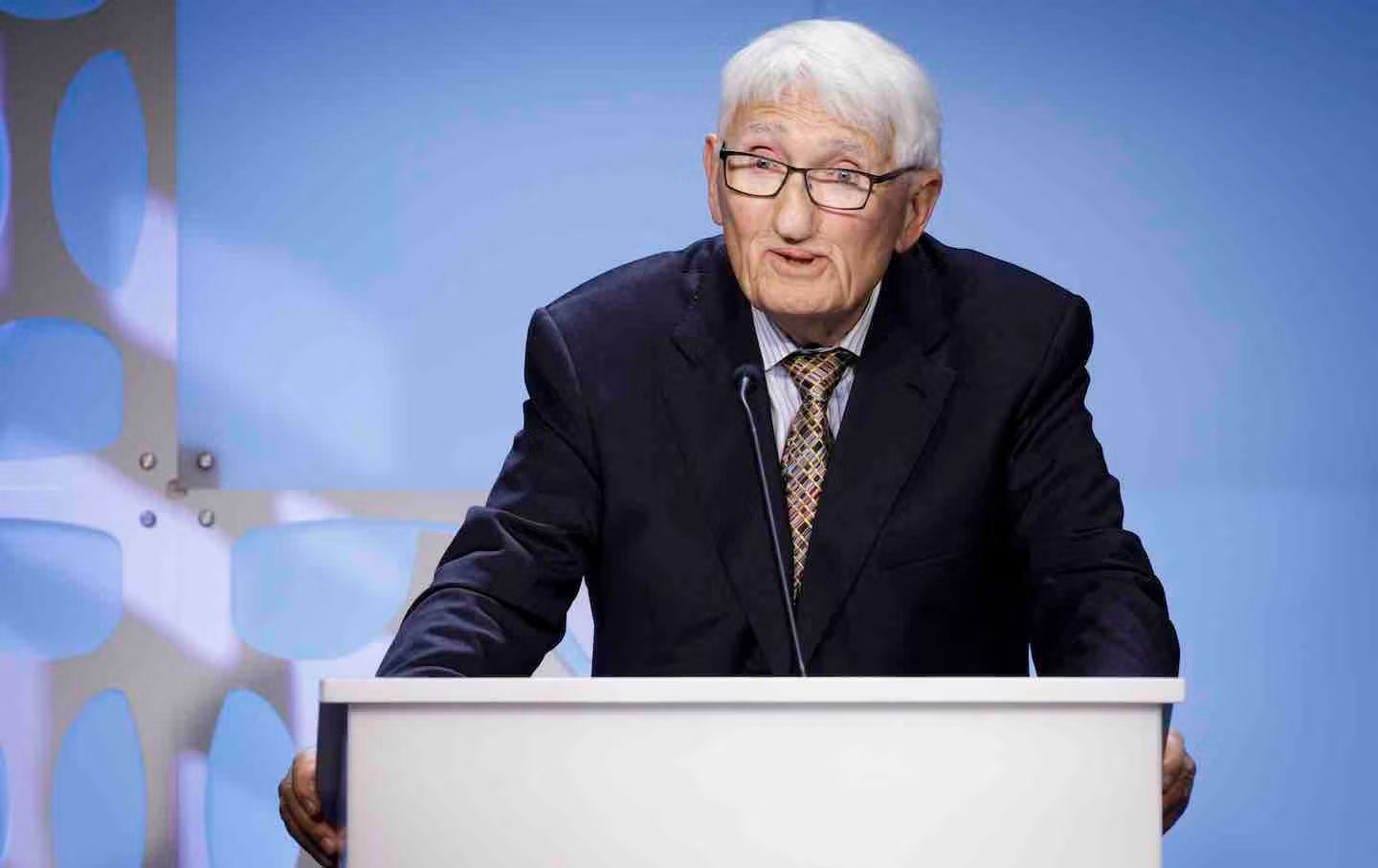
An analysis of Jürgen Habermas’s trilogy, Also a History of Philosophy
By Rod Benson
PART 1
Jürgen Habermas’s most recent major publication, Also a History of Philosophy (London: Polity, 2023-2025), represents the culmination of more than fifty years of reflection on reason, democracy, religion, and communication. The work was originally published in German in 2019 and translated into English as three volumes between 2023 and 2025. Presented as a history of philosophy, it outlines a genealogy of Western rationality seeking to explain how the moral and political ideas central to modern democratic societies emerged through a long dialogue between faith and reason.
The central thesis of the work challenges two familiar narratives about modernity. He rejects the Enlightenment story that secular reason liberated itself from the constraints of religion. He also rejects conservative claims that modernity represents a catastrophic abandonment of Christianity and its moral foundations. Instead, he argues that the relationship between philosophy and religion has been one of continuous interaction, criticism, and mutual learning.
Many of the concepts that underpin constitutional democracy, such as human dignity, universal equality, freedom of conscience, solidarity, and justice, were shaped within Jewish and Christian traditions before being translated into a secular vocabulary capable of commanding assent within pluralistic societies.
The trilogy offers more than an intellectual history. It proposes an account of the historical formation of what might be called the moral grammar of modernity: the network of concepts through which contemporary societies understand freedom, responsibility, rights, and the common good. Habermas’s concern is not simply where these concepts originated, but how they acquired their present meaning through successive processes of reinterpretation.
The first volume of the trilogy, The Project of a Genealogy of Postmetaphysical Thinking, establishes the methodological framework for the entire work. Rather than recounting philosophical systems in chronological order, Habermas adopts a genealogical approach that traces the historical development of concepts. Unlike the genealogies of Friedrich Nietzsche or Michel Foucault, which typically expose the operation of power beneath moral claims, Habermas understands history as containing genuine processes of moral learning. Societies may broaden their understanding of justice and reciprocity, even if such progress remains incomplete and contested.
This commitment to moral learning underpins Habermas’s defence of modernity. While acknowledging the crises and failures of contemporary liberal democracies, he rejects both Enlightenment triumphalism and narratives of cultural decline advanced by certain other thinkers in the field of cultural studies such as Martin Heidegger, Carl Schmitt, Leo Strauss, and Karl Löwith. For Habermas, the answer to the destructive shortcomings of modernity is neither a return to premodern metaphysics nor resignation to relativism, but the continued cultivation of communicative reason.
Central to this project is Habermas’s concept of postmetaphysical thinking. He argues that comprehensive metaphysical systems can no longer command universal assent in religiously and culturally diverse societies. Classical philosophers sought timeless accounts of reality, and medieval theologians integrated these into Christian doctrine. Habermas argues that contemporary philosophy must instead proceed through fallibilism, public reasoning, and intersubjective dialogue. Truth claims remain possible, but they are always open to criticism and revision through better arguments.
This development reflects the broader linguistic turn in twentieth-century philosophy. Building on figures such as Ludwig Wittgenstein, Charles Sanders Peirce, and George Herbert Mead, Habermas locates rationality not primarily within the isolated thinking subject but within communicative practices through which people exchange reasons and seek mutual understanding. Philosophy thus moves from consciousness to communication, laying the foundations for his later theories of discourse ethics and deliberative democracy.
Habermas begins his historical reconstruction with the Axial Age, during which traditions including Judaism, Greek philosophy, Buddhism, and Confucianism independently developed more universal moral and philosophical outlooks. Within the Western tradition, however, the decisive transformation occurred through the encounter between Greek philosophy and biblical religion. Greek metaphysics supplied Christianity with conceptual tools for articulating theological doctrines, while Christianity transformed philosophy by introducing distinctive understandings of history, personhood, and morality.
At the same time, a biblical-theological understanding of creation, covenant, prophecy, and redemption reoriented philosophical reflection away from cyclical conceptions of history towards a linear and dynamic understanding of history, personhood and moral responsibility. Human beings came to be understood not merely as rational animals but as morally accountable persons possessing equal and inherent dignity before a transcendent God.
PART 2
The second volume, The Occidental Constellation of Faith and Knowledge, traces this dialogue through the history of Christianity. Habermas argues that Christianity made enduring contributions to Western moral consciousness by articulating principles of universal human worth, moral responsibility, solidarity with the vulnerable, and freedom of conscience. These ideas were not uniquely Christian, but Christianity gave them a distinctive historical expression that profoundly influenced the subsequent development of Western philosophy and political institutions.
Augustine occupies a pivotal place within this genealogy. His synthesis of Christian theology and Platonism redirected philosophy towards questions of interiority, conscience, memory, and freedom, themes that became central to the Western intellectual tradition. Medieval scholastic thinkers, especially Thomas Aquinas, John Duns Scotus, and William of Ockham, further refined the relationship between faith and reason, demonstrating that theological inquiry could cultivate habits of rigorous philosophical argument rather than suppress them.
The Protestant Reformation introduced another decisive transformation. Martin Luther’s emphasis on individual conscience and the distinction between spiritual and temporal authority unintentionally contributed to the differentiation of religion, politics, law, and civil society that characterises modern constitutional democracies. Far from simply opposing secular modernity, Christianity helped create many of the intellectual and institutional conditions that made it possible.
The third volume, Rational Freedom, follows the development of philosophy from the Enlightenment to the present. Having traced the centuries-long interaction between biblical faith and philosophical reason, Habermas asks what becomes of philosophy once it no longer rests upon revealed theology or comprehensive metaphysical systems. His answer is that philosophy does not abandon the moral insights inherited from religious traditions; rather, it seeks to reconstruct them in forms that can be justified through public reason within pluralistic societies.
Immanuel Kant occupies a pivotal position in this transition. By grounding morality in practical reason rather than ecclesiastical authority, Kant established the autonomy of the moral subject and provided one of the defining achievements of Enlightenment philosophy. Habermas regards this as an indispensable step in the development of modern democratic thought. Yet he also argues that Kant’s account remains too closely tied to the reasoning of the individual subject. Moral norms cannot be validated simply because they satisfy an individual’s rational consistency. They must also be capable of receiving the reasoned agreement of others who are affected by them.
This conviction leads Habermas to reformulate Kant’s deontological ethics as a theory of discourse ethics. Moral validity arises not from isolated reflection but from communicative processes in which participants seek agreement through free, inclusive, and rational dialogue. A moral norm is legitimate only if all those affected could reasonably accept it under conditions of fair deliberation. Ethics therefore becomes fundamentally intersubjective. Rationality is realised through communication rather than solitary thought.
Habermas similarly appropriates important insights from Georg Wilhelm Friedrich Hegel while rejecting Hegel’s comprehensive metaphysical system. Hegel recognised that freedom is not merely individual independence but participation in social institutions that enable persons to flourish together. Habermas retains this social understanding of freedom but locates its foundation not in an unfolding metaphysical Spirit but in democratic institutions sustained by communicative rationality. Freedom becomes a practical achievement realised through public deliberation, constitutional government, and the shared pursuit of justice.
These developments culminate in Habermas’s mature theory of communicative rationality. Modern societies cannot rely upon inherited religious authority or comprehensive philosophical systems to secure agreement. Instead, legitimacy depends upon the quality of public communication. Laws and political decisions acquire authority not because they reflect divine revelation or sovereign power, but because they emerge from inclusive processes of democratic deliberation in which citizens exchange reasons as moral equals.
This emphasis on communication reflects Habermas’s broader understanding of philosophy after the linguistic turn. Influenced by Wittgenstein, Peirce, Mead, and speech-act theory, he argues that human rationality is fundamentally dialogical. Language is not merely a vehicle for expressing private thoughts but the medium through which people coordinate action, test truth claims, and negotiate shared norms. The search for truth therefore becomes inseparable from the practices of communication that sustain democratic life.
PART 3
One of the trilogy’s most significant contributions is Habermas’s revised understanding of secularisation. Earlier sociological theories often assumed that scientific progress and modernisation would gradually eliminate religion from public life. Habermas now rejects this prediction. Contemporary Western societies, he argues, are better understood as post-secular societies in which religious communities continue to exercise intellectual, ethical, and cultural influence.
Religion remains important because it preserves moral intuitions and symbolic resources that secular philosophy cannot simply replace. Religious traditions continue to articulate visions of justice, reconciliation, forgiveness, hope, and human dignity that enrich democratic societies. Excluding these traditions from public discussion would unnecessarily impoverish public reasoning.
At the same time, Habermas insists that democratic legitimacy requires political decisions to be justified in language accessible to all citizens, regardless of their religious commitments. This requirement gives rise to what has become known as the translation proviso. Religious citizens are encouraged to participate fully in democratic debate, drawing upon the moral resources of their own traditions. However, arguments that ultimately shape public law must be translated into forms of reasoning that citizens of differing convictions can understand and evaluate.
Crucially, Habermas does not regard this obligation as falling solely upon religious believers. Secular citizens likewise bear responsibilities within democratic dialogue. They should not dismiss religious arguments simply because they arise from theological traditions, but remain open to the possibility that religious communities may preserve important moral insights not yet adequately expressed within secular discourse. Democratic citizenship therefore requires reciprocal learning. Religious and secular perspectives each possess resources that can contribute to the common good when approached with intellectual humility.
This emphasis on mutual learning distinguishes Habermas from both religious fundamentalism and militant secularism. He rejects attempts to impose theological doctrines through political authority, but he also resists forms of secularism that seek to exclude religious reasoning from public life altogether. Instead, he proposes a model of democratic coexistence in which differing traditions contribute to a common political culture while accepting the need for public justification.
Underlying this reconstruction is Habermas’s conviction that history exhibits genuine processes of moral learning. Human societies gradually expand their understanding of justice by recognising wider communities of moral concern. The emergence of constitutional government, universal human rights, democratic participation, and equal citizenship reflects more than changing political circumstances; it represents an enlargement of humanity’s moral imagination.
In this respect, Habermas differs sharply from genealogical thinkers such as Nietzsche and Foucault, who emphasise the role of power in shaping moral discourse. While he acknowledges that power and conflict remain pervasive features of history, he argues that communicative reason makes genuine normative progress possible. Democratic institutions embody this hope by providing structures within which citizens can continue the unfinished task of collective moral learning.
Habermas’s reconstruction of Western intellectual history has generated considerable discussion because it occupies a distinctive position between secular liberalism and political theology. He neither advocates a return to confessional politics nor accepts the view that religion has become irrelevant to public life. Instead, he argues that modern democratic societies are best understood as the product of a long conversation between faith and reason—a conversation that remains unfinished.
PART 4
Habermas’s Also a History of Philosophy argues that modern democratic societies are best understood as the outcome of a long and unfinished conversation between faith and reason. Rather than depicting secular modernity as a decisive break with religion, Habermas reconstructs Western intellectual history as a process in which religious traditions, especially Christianity, generated moral and conceptual resources that were gradually translated into forms accessible to all citizens. The result is an account of mutual learning in which both religious and secular voices continue to shape democratic life.
This argument invites comparison with several influential contemporary thinkers. Like Charles Taylor, Habermas rejects simplistic theories of secularisation that portray modernity as the inevitable triumph of reason over religion. Both contend that the modern West emerged from within Christian civilisation and continues to draw upon moral resources shaped by its religious inheritance. Neither accepts the view that religion has simply disappeared from public significance. Yet their emphases differ in important respects.
Taylor is primarily concerned with the historical formation of identity, the emergence of the modern social imaginary, and the moral sources that enable individuals to live meaningful lives. His account is descriptive and cultural, exploring how belief and unbelief have become equally plausible options within the “secular age.” Habermas, by contrast, is principally concerned with political legitimacy. His central question is not how modern identities are formed but how citizens who hold profoundly different worldviews can nevertheless deliberate together within democratic institutions. Taylor explains the conditions of modern selfhood; Habermas explains the conditions of democratic coexistence.
Habermas also enters into conversation with Karl Löwith’s influential thesis that modern philosophies of history merely secularise Christian eschatology. Löwith argued that Enlightenment ideas of historical progress inherited the linear, future-oriented structure of biblical salvation history while abandoning its theological foundations. Habermas accepts that modernity owes an immense intellectual debt to Christianity but rejects the conclusion that modern concepts therefore remain disguised theology.
Instead, theological ideas undergo what he describes as processes of rational reconstruction and linguistic translation. Their authority no longer rests upon divine revelation or ecclesiastical tradition but upon their ability to survive critical examination within open public discourse. The continuity between Christianity and modernity is therefore neither simple continuity nor radical discontinuity but creative transformation, in which inherited moral insights acquire new justification within democratic reason.
Habermas’s engagement with Max Weber is equally significant. Weber famously described modernity as an age of rationalisation and the “disenchantment of the world,” in which scientific explanation increasingly displaced religious understandings of reality. Habermas accepts much of Weber’s diagnosis but resists the implication that instrumental rationality is sufficient for sustaining democratic societies. Communicative rationality—the capacity of citizens to justify norms through dialogue and mutual recognition—provides a richer conception of reason than Weber’s emphasis on bureaucratic and instrumental forms of rationalisation. In this respect, Habermas seeks to recover the normative possibilities of reason without returning to pre-modern metaphysical certainties.
An equally important dialogue is enjoined with Carl Schmitt. Schmitt located the foundation of politics in sovereignty, decisive authority, and the enduring distinction between friend and enemy. Political order ultimately depends upon the sovereign’s capacity to decide in moments of exception rather than upon rational consensus. Habermas offers a fundamentally different vision. Political legitimacy arises not from sovereign decision but from communicative rationality embodied in constitutional institutions, the rule of law, and democratic deliberation.
The task of politics is not to identify enemies but to establish fair procedures through which disagreement can be negotiated peacefully. In this respect, Habermas provides one of the most sustained philosophical alternatives to authoritarian, populist, and decisionist conceptions of political life. His work also intersects with theologians such as Johann Baptist Metz, Rowan Williams, Stanley Hauerwas, and John Milbank. Each insists that Christian theology cannot be reduced to private spirituality but necessarily bears upon public life. Habermas shares this conviction while maintaining that religious arguments entering democratic deliberation should, wherever possible, be translated into publicly accessible forms of reasoning. This “translation proviso” has become one of the defining features of his later political philosophy.
Some theologians, including Williams, have found the proposal broadly compatible with responsible Christian participation in pluralistic democracy, while others, particularly Hauerwas and Milbank, question whether the distinctive grammar of Christian faith can ever be translated without significant theological loss. Conversely, some secular critics argue that Habermas grants religion a more substantial role in public life than liberal neutrality requires. These disagreements illustrate the continuing significance of Habermas’s project for contemporary political theology.
The trilogy’s strengths are considerable. It offers one of the richest historical accounts available of the relationship between Christianity and modern philosophy, avoiding both secular triumphalism and religious nostalgia. Habermas demonstrates that concepts now regarded as self-evidently secular—including human dignity, equality, solidarity, universal justice, conscience, and freedom—were shaped through centuries of theological reflection before becoming embedded within constitutional democracies. His account encourages both religious and secular readers to recognise the shared intellectual history from which modern political values have emerged.
At the same time, Habermas’s defence of democratic legitimacy through communicative reason provides a powerful response to contemporary authoritarianism, religious nationalism, and political polarisation. By portraying democracy as an ongoing practice of mutual learning rather than ideological victory, Also a History of Philosophy is arguably one of the most significant philosophical defences of pluralistic democracy to have arisen so far in the twenty-first century.
PART 5
Although Also a History of Philosophy has been widely praised as one of the most ambitious works of contemporary philosophy, it has also attracted substantial criticism. Some scholars argue that Habermas’s narrative remains predominantly centred upon the Western intellectual tradition, giving comparatively limited attention to the continuing contributions of Jewish, Islamic, Indian, and Chinese philosophy beyond the Axial Age. While these traditions appear in his account of the emergence of reflective reason, they play a comparatively modest role in the subsequent development of modernity, leaving open the question of whether his genealogy is genuinely global or remains fundamentally Eurocentric.
Others question whether Habermas’s confidence in rational consensus underestimates the depth of moral disagreement in contemporary societies. Conflicts often arise not merely from insufficient dialogue but from fundamentally incompatible conceptions of reality, human flourishing, and the common good. Critics influenced by communitarianism, political realism, and postmodern thought argue that public disagreement frequently reflects competing moral traditions that cannot always be reconciled through procedural deliberation alone.
Related concerns arise from Habermas’s understanding of history. Throughout the trilogy, he presents philosophy as participating in a cumulative process of moral learning through which humanity gradually refines its understanding of justice, freedom, and responsibility. Some historians and philosophers regard this narrative as overly linear and optimistic. The catastrophes of the twentieth century—including totalitarianism, genocide, colonialism, and persistent forms of oppression—raise questions about whether history can plausibly be described as progressive moral learning rather than as a more ambiguous mixture of advance, regression, and recurring violence.
Habermas has likewise been criticised for giving communicative rationality greater explanatory weight than relations of power. Although Also a History of Philosophy pays considerably more attention to historical institutions than many of his earlier writings, critics influenced by Michel Foucault and postcolonial theory argue that philosophy’s development cannot be understood simply as the triumph of better arguments. Political authority, imperial expansion, economic interests, technological change, and social institutions have profoundly shaped which traditions became authoritative, whose voices entered the canon, and which forms of knowledge were marginalised or forgotten.
The translation proviso has likewise attracted sustained criticism. Some theologians contend that central Christian convictions cannot be fully translated into secular language without losing their theological substance. The language of grace, revelation, resurrection, covenant, and salvation does not merely express moral insights but articulates claims about divine reality that resist reduction to universally accessible secular concepts.
Others argue that the burden of translation falls disproportionately upon religious citizens, while secular assumptions are too readily treated as intellectually neutral. Conversely, some secular critics maintain that Habermas grants religion a more prominent role in democratic life than liberal neutrality should permit. These debates illustrate the continuing difficulty of balancing democratic inclusiveness with political neutrality.
Questions also remain regarding Habermas’s interpretation of Christianity itself. Some historians argue that he attributes too much of modern democracy’s moral inheritance to Christianity, underestimating the independent contributions of Roman law, Renaissance humanism, the Scientific Revolution, commercial society, and Enlightenment political thought.
Others, particularly Christian theologians, almost reach the opposite conclusion, suggesting that Habermas ultimately domesticates Christianity by valuing it primarily as the historical source of moral concepts that later became secularised. Christianity thereby functions less as a living theological tradition centred upon divine revelation than as a repository of ethical insights available for philosophical appropriation.
The trilogy has also been criticised for paying insufficient attention to the realities of contemporary religious pluralism. Habermas’s dialogue is conducted primarily with Christianity because of its formative influence upon European intellectual history. Yet modern liberal democracies increasingly comprise multiple religious traditions whose philosophical and ethical contributions extend well beyond the Christian–secular conversation. The resulting questions of democratic coexistence are therefore considerably more complex than those arising within post-Christian Europe alone.
A further criticism concerns Habermas’s understanding of democratic life. Political psychologists, sociologists, and historians increasingly argue that public life is shaped not only by rational argument but also by identity, emotion, memory, trauma, loyalty, and symbolic narratives. The persistence of populism, conspiracy movements, digital misinformation, and political polarisation suggests that citizens often remain unmoved by better arguments alone. Critics therefore question whether communicative rationality adequately accounts for the social and psychological dynamics that increasingly shape democratic politics.
Related to this is the comparatively limited place accorded to virtue. Habermas’s account remains primarily procedural, emphasising fair institutions and inclusive deliberation. Virtue ethicists respond that healthy democracies require not only just procedures but citizens formed in habits of honesty, humility, courage, patience, prudence, and practical wisdom. Without such moral formation, even well-designed democratic institutions may prove fragile.
The trilogy also leaves unresolved a deeper philosophical question concerning truth itself. Habermas offers an account of how moral claims ought to be justified within public discourse, yet critics ask whether rational agreement is sufficient to establish moral truth. Philosophical realists, natural law theorists, and many theologians argue that justice ultimately depends upon realities that transcend democratic consensus. Public agreement may recognise truth, but it does not necessarily constitute it.
PART 6
Finally, Habermas leaves unresolved a question that has become crucial to contemporary political philosophy: are liberal democracies able to sustain noble ideals such as human dignity, equality, and solidarity once they become detached from the religious traditions that historically nurtured them? Habermas acknowledges the force of this concern but remains cautiously optimistic. His confidence lies in the capacity of democratic societies to preserve and renew these moral inheritances through continuing processes of public deliberation and mutual learning rather than through the restoration of religious establishment. Whether such optimism remains justified amid declining institutional trust, increasing social fragmentation, and weakening civic cultures remains an open question.
The significance of Also a History of Philosophy nevertheless extends well beyond the history of ideas. Habermas presents philosophy itself as a participant in an ongoing process of moral learning through which societies refine their understanding of justice, freedom, responsibility, and the common good. The history of philosophy is therefore inseparable from humanity’s continuing attempt to understand itself.
For theologians, the trilogy offers a reminder that Christianity has been not merely an object of philosophical criticism but one of philosophy’s most creative interlocutors. Many of the moral convictions underpinning modern democratic societies emerged through centuries of theological reflection before being reformulated within secular political thought. At the same time, Habermas invites theology to consider how its convictions may participate constructively within democratic public discourse without abandoning their distinctive theological identity. Whether such translation represents faithful witness or theological reduction remains an enduring point of debate.
For philosophers, Habermas demonstrates that secular reason cannot fully understand its own conceptual inheritance without acknowledging its long conversation with biblical religion. Yet his project also raises the broader question of whether modern philosophy can remain normatively self-sustaining once its religious sources become culturally attenuated.
The trilogy also invites fruitful comparison with Charles Taylor. Both philosophers reject simplistic narratives of secularisation and insist that modernity cannot be understood apart from Christianity’s formative influence. Yet whereas Habermas emphasises communicative rationality and democratic deliberation, Taylor gives greater attention to the social imaginaries, historical narratives, and cultural horizons through which persons inhabit modernity. Together they offer complementary but distinct accounts of the relationship between faith, reason, and democratic life.
For scholars of public theology and theological ethics, the trilogy is especially significant because it provides a historical account of how moral concepts acquire public authority. Habermas traces the formation of the conceptual grammar through which Western societies have learned to speak about dignity, justice, equality, freedom, solidarity, rights, and democratic legitimacy. His genealogy therefore offers more than a history of philosophy; it reconstructs the historical development of the public moral grammar through which democratic societies deliberate about the common good.
While Habermas rarely employs the language of “grammar” in the Wittgensteinian sense, his project can fruitfully be understood as tracing the historical emergence, transformation, and continuing refinement of the moral grammar of Western civilisation. In this respect, Also a History of Philosophy provides an especially valuable dialogue partner for contemporary studies of theological grammars and counter-grammars.
Habermas neither advocates the restoration of Christendom nor embraces an exclusionary secularism. Instead, he presents philosophy, theology, and democratic politics as participants in an unfinished conversation in which both religious and secular traditions remain open to criticism, correction, and mutual learning. Whether this ambitious project can withstand the cultural, political, and intellectual pressures of the twenty-first century remains uncertain. Yet it is this refusal to regard either faith or reason as intellectually complete that gives Also a History of Philosophy its enduring significance.
Conclusion
Jürgen Habermas’s Also a History of Philosophy offers a major reinterpretation of Western intellectual history by arguing that modern reason emerged through a long and productive dialogue with religious traditions, particularly Judaism and Christianity. Its principal strengths lie in its rejection of simplistic secularisation narratives, its nuanced account of the mutual learning between faith and reason, and its defence of democratic public discourse grounded in communicative rationality. Habermas combines remarkable historical breadth with philosophical depth, showing how religious concepts have been transformed into universal moral and political principles without reducing either faith or reason to the other.
However, the work has its limitations. The narrative remains largely centred on the Western philosophical tradition, giving comparatively limited attention to non-Western philosophies. Moreover, Habermas’s confidence in rational consensus underestimates persistent moral and metaphysical disagreement, while the “translation proviso” is contested by both religious and secular thinkers.
Nevertheless, Habermas’s later work, of which this trilogy is a fine example, is an important attempt to explain how faith and reason, acting in concert, may be said to sustain the moral foundations of contemporary democratic society. In my view, Habermas has given us an innovative and valuable history of philosophy, and a fine contemporary genealogy of the moral grammar through which democratic societies continue to pursue truth, justice, and the common good. As such, it has the potential to launch numerous future projects in philosophy, history and theology.
Rev Dr Rod Benson lives in Sydney and writes about a range of topics from books and local history to food, faith, philosophy, ethics, research skills, and everyday life. Away from the keyboard, he enjoys cooking for friends, walking in the Australian bush, exploring a beach, discovering new restaurants, and reading philosophy, fiction and poetry. He is married to Emma and is minister of North Rocks Community Church, a Uniting Church congregation. He is currently working on a project applying theological grammars to the Palestine-Israel conflict.
Image source: The Nation

