
By Rod Benson
The thought of Jürgen Habermas principally asks what makes collective decisions legitimate amid deep disagreement. For scholars and activists pursuing justice and peace in places scarred by protracted warfare and religious or cultural division, his account of communicative action offers a demanding test. Are those affected really able to speak freely, challenge entrenched power, and bring religious and secular convictions into a conversation capable of shaping political decisions?
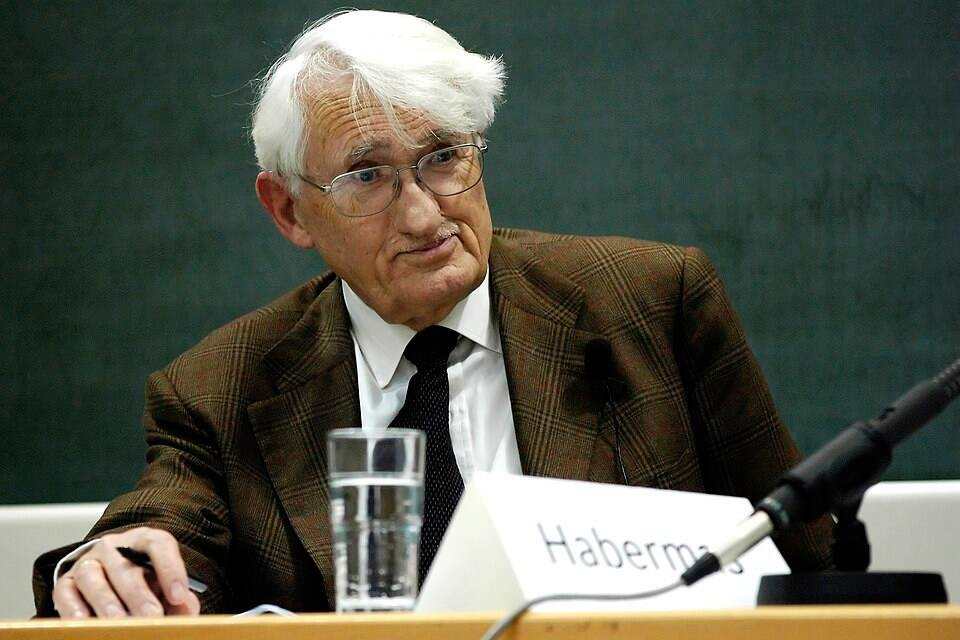
Habermas (1929–2026) was a German philosopher, sociologist and public intellectual, and a leading figure in the second generation of the Frankfurt School. He was aged 15 when Nazi Germany fell. Coming to terms with the crimes of the Nazi regime helped set him on the path to his academic career in philosophy and social theory. In The Theory of Communicative Action, arguably his best known work, Habermas examined how people use language to reach understanding. He brought that idea into democratic theory, arguing that laws gain legitimacy through public debate in which citizens can question decisions and offer reasons of their own. In his later work, he explored how religious and secular citizens could learn from one another and contribute to a shared political conversation.
A religious conviction may disclose a form of injustice that other citizens have overlooked. If the remedy requires a law, its proponents owe those citizens reasons they can examine independently of the conviction that prompted it. Habermas’s Also a History of Philosophy helps explain why both propositions matter. First published in German in two volumes in 2019, the work appeared in Ciaran Cronin’s three-volume English translation between 2023 and 2025. It traces the emergence of philosophical reasoning from a long engagement with religious traditions and illuminates a question Habermas had addressed in his earlier work on democracy. How can citizens draw on those traditions while justifying decisions to people who understand their obligations differently?
Habermas’s argument is most persuasive when it distinguishes the origins of moral convictions, the practices that sustain them, and the reasons that can justify their enforcement. Religious traditions may contribute to the first two. The third requires public justification, for which Habermas proposes a cooperative practice of translation. The proposal protects freedom of religious expression and gives citizens grounds to challenge coercive decisions. Its promise depends on whose interpretations carry authority, which aspects of a conviction survive translation, and whether institutions give those affected an effective opportunity to contest the result.
The genealogy of postmetaphysical reason
The collapse of National Socialism in Germany shaped Habermas’s appreciation of constitutional democracy as a historic achievement (Finlayson and Rees 2026, sec. 1.1). In the preface to his late work, he identifies a related concern about the vocation of philosophy. Increasing specialisation may leave the discipline less able to address questions about what people owe one another and what they may reasonably ground their hopes in.
Habermas uses the term postmetaphysical to describe a philosophical orientation that addresses such questions through fallible inquiry and public argument without presupposing a comprehensive account of reality. To reconstruct its genealogy is to ask how people acquired these intellectual practices and which problems made their development possible. Habermas reads some changes as instances of collective learning because they enabled people to identify and criticise assumptions they had previously taken for granted (Habermas 2019, 9–12).
The first volume adopts the Axial Age as a framework for comparing ancient Greek philosophy, Judaism, Buddhism, Confucianism and Daoism. In Habermas’s reconstruction, these traditions developed ways to evaluate inherited practices by reference to standards that could call existing arrangements into question. Biblical prophecy, for instance, could place rulers under obligations that their position gave them no authority to set aside. The comparison allows for several intellectual histories of moral criticism. Its reach becomes uncertain when categories drawn from one tradition are made to do explanatory work in another. William Rehg observes that a common emphasis on salvation, for example, fits some traditions more readily than it fits Confucian ethics. The Axial Age remains a comparative hypothesis, and the histories it brings together warrant attention to their differences (Rehg 2026).
The second volume concentrates on Western Christianity. Augustine’s engagement with Platonism and the medieval reception of Aristotle show how theological disputes could generate philosophical inquiry about the will, the natural world and the grounds of knowledge. As Martin Jay notes, Habermas gives institutional changes a role in the differentiation of philosophy from theology, including the rise of university arts faculties. The treatment of Luther likewise places the doctrine of justification by faith alongside disputes about the proper jurisdiction of ecclesiastical and temporal authorities. The wider significance of such disputes lies in how they made the boundaries of those authorities open to argument. Their contribution to later freedom of conscience is a question of historical mediation, including how subsequent thinkers and institutions took them up (Habermas 2023–25, vol. 2; Jay 2025).
Francisco de Vitoria’s treatment of the Spanish conquest gives this account of learning a sharper test. In his 1539 lectures, Vitoria recognised the dominium, or rightful ownership and rule, of Indigenous peoples and rejected their refusal to accept Christianity as a title to conquest. He also held that Spanish travellers and merchants had rights under the law of nations and considered circumstances in which resistance to the exercise of those rights might justify force. The same conceptual framework could therefore restrain some claims to imperial power and supply grounds for others. For the purposes of democratic theory, the difficulty concerns who interprets a principle and determines when it has been violated. A principle may have universal scope in its formulation while its application leaves those most affected with little authority to dispute what is done in its name (Habermas 2023–25, vol. 2; Izbicki and Kaufmann 2023, sec. 6).
The Vitoria example also clarifies what the designation of an episode as moral learning entails. Habermas’s preface makes room for learning as an explanation of philosophical change (Habermas 2019, 10–11). A retrospective account still needs to show what was learned and by whom. Vitoria’s acknowledgement of Indigenous authority brought an objection to dispossession within the terms of scholastic argument. That intellectual achievement can be identified while leaving open what it achieved in practice. The distinction matters to a genealogy of freedom because the ability to formulate an objection and the power to make it count in a decision are different historical achievements.
Rational freedom and democratic justification
The third volume follows the development of postmetaphysical thought from Hume and Kant through German Idealism and into the nineteenth century. Kant provides an account of autonomy as rational self-legislation. Habermas takes from Hegel the further insight that freedom develops through social relations and institutions. On Habermas’s reconstruction, people exercise rational freedom together when they can give reasons, consider how a proposed course of action affects others, and revise their judgements in response to objections.
In his wider discourse theory, the possible agreement of those affected under fair conditions supplies a standard for assessing norms. This leaves room for political decisions under conditions of actual disagreement. A vote can authorise a decision provisionally while the reasons for it remain subject to public scrutiny (Buchwalter 2026; Finlayson and Rees 2026, secs. 3.3 and 4.3).
The connection between the genealogy and that political theory is a distinction between historical dependence and justificatory independence. An argument may depend historically on concepts elaborated in theology while being defensible today on grounds that people of different convictions can assess. The genealogy describes changes in the meaning and use of inherited ideas over centuries. The political theory asks what happens when citizens seek to carry a claim from public discussion into an institution whose decisions bind others. Historical transformations make such reinterpretation intelligible. The democratic requirement for it follows from the equal standing of citizens subject to the decision.
In his 2006 essay “Religion in the Public Sphere,” Habermas develops this requirement in conversation with John Rawls. Rawls allows citizens to introduce religious or other comprehensive doctrines into political discussion of fundamental questions, provided that adequate public political reasons are forthcoming in due course (Rawls 1997, 783–84).
Habermas locates the translation requirement at the boundary between informal public debate and formal decision-making. Religious citizens may use their own language in civil society, and secular citizens share responsibility for attending to its possible insights and helping articulate them in generally accessible terms. In parliaments, courts and public administrations, justification must be available for scrutiny independently of assent to a particular revelation. Habermas’s account of post-secular citizenship concerns the continuing public presence of religion and the demands this places on fellow citizens in a secular constitutional order (Habermas 2006, 9–16).
Public accessibility in this sense concerns how a reason may be evaluated. For example, an argument that a proposal will restrict freedom of conscience must allow citizens to ask whose freedom it restricts, what the restriction consists in and whether it can be justified. Citizens can pursue those questions while disagreeing about whether conscience is answerable to God. They may also disagree over how to resolve the question of public policy. A reason acquires democratic standing through its availability for scrutiny, and its merit remains open to challenge. The same scrutiny is due when the argument comes from a secular moral tradition.
The scope and limits of translation
Habermas’s 2001 address “Glauben und Wissen” (“Faith and Knowledge”) offers an example. He reads the portrayal in Genesis of humanity made in God’s image as expressing an understanding of freedom and mutual recognition. In a discussion of genetic intervention, he asks what happens to a relationship between equals when one person intentionally determines aspects of another person’s biological constitution according to their own preferences.
The biblical account supplies an analogy through the distinction between creator and creature. A citizen who has no theological commitment to that account can still consider whether such an intervention creates a morally significant asymmetry. A policy judgement would require additional argument about which interventions give rise to that asymmetry and why. The example shows how translation can make an ethical question available to more people, even as the translated argument leaves part of its theological meaning behind (Habermas 2001, 14–15).
The translation of a Christian appeal to grace into an argument for rehabilitation illustrates a related issue. The appeal can direct attention to the harm done by assigning someone a permanent civic identity on the basis of an offence. A proposal to restore a person’s eligibility for employment or civic participation can then be evaluated on its own terms. The originating appeal speaks also of reconciliation as a divine initiative, a claim that carries weight within Christian worship and practice. Public theology benefits from stating the relationship between these claims with precision. Listeners can then assess the proposed reform and understand what the community believes it is doing in advocating it.
A further difficulty concerns what reciprocity can reasonably demand. Cristina Lafont questions whether the epistemic changes Habermas regards as conducive to democratic inclusion can be required as duties of citizenship. Citizens may be able to take an objection seriously while continuing to doubt the religious or secular outlook from which it arises. The institutional principle is easier to defend if it requires attentiveness to arguments and a willingness to explain decisions.
Something stronger is at stake when citizens are asked to revise their convictions about the cognitive standing of religion itself. There is also an institutional question. Citizens with access to legislators, professional advocates or influential media may be better placed to secure a hearing for their interpretation of another group’s claim. The opportunity to challenge a translation can matter as much as the opportunity to offer one (Habermas 2006, 15–18; Lafont 2008).
The genealogy has limits. For example, Jay observes that Judaism receives comparatively little sustained attention once the account turns to the fortunes of Western Christianity. Andrew Buchwalter identifies a related asymmetry in the direction of explanation. The trilogy has much to say about how secular thought takes up religious insights and less about how religious communities might be changed by secular criticism (Jay 2025; Buchwalter 2026).
These are distinct concerns. The first limits what a largely European genealogy can establish about the emergence of ideas of moral equality elsewhere. The second qualifies the reciprocity Habermas envisages. For public theology, a church’s encounter with criticism may disclose how its own interpretation of a teaching has supported exclusion or suppression. That encounter may change its understanding of doctrine and the public language it uses.
Applying the universal principle
Habermas’s genealogy shows why the religious origins of a moral insight may remain significant after the insight acquires a different form of justification. The argument leaves open the ways in which citizens may acquire and sustain the dispositions that democratic deliberation requires. Habermas recognises that the constitutional state has limited means of cultivating the attitudes on which its account of public reason depends (Habermas 2006, 18–19).
Religious communities may help to sustain solidarity through worship and collective practices. Whether particular communities do so, and which other associations can sustain similar commitments, calls for historical and social inquiry. By itself, the genealogy cannot establish the continuing indispensability of religious institutions nor the durability of solidarity once they recede.
The qualified case for translation rests on the accountability of institutions to the people whose lives they govern. Religious convictions can retain their integrity in public argument while helping to identify questions that officials must answer in terms citizens can examine. The quality of that process depends on whether citizens can challenge how their claims have been represented and whether decision-makers respond to objections from those most affected.
These conditions give democratic content to Habermas’s account of mutual learning. They also explain why the historical achievement of articulating a universal principle remains incomplete until those who are governed by it are able to participate in determining what it requires.
For example, imagine that after a civil war a peace agreement guarantees displaced families the right to return. Officials initially propose using land titles to verify claims. At a public hearing, displaced women explain that family land was often registered in their husbands’ names. Families now living on the land explain that many of them were displaced too and have nowhere else to go. Representatives from both groups help rewrite the rules. The land commission agrees to accept other evidence, including testimony from former neighbours, and to arrange temporary housing for current occupants who would otherwise be made homeless. The hearing changes what each group understands a fair return to require, and that learning changes how the right is enforced.
Conclusion
Habermas’s thought, especially his late work, reminds us how much democratic reason owes to religious traditions and how much it may still learn from them. That learning is reciprocal. Secular citizens may hear in religious language an account of injuries they have overlooked, while communities of faith may reconsider their own practices in light of public criticism. The test is whether those whose lives are at stake can help to determine what justice requires.
Rev Dr Rod Benson lives in Sydney and writes about a range of topics from books and local history to food, faith, philosophy, ethics, research skills, and everyday life. Away from the keyboard, he enjoys cooking for friends, walking in the Australian bush, exploring a beach, discovering new restaurants, and reading philosophy, fiction and poetry. He is married to Emma and is minister of North Rocks Community Church, a Uniting Church congregation.
Bibliography
Buchwalter, Andrew, Review of Also a History of Philosophy, vol. 3, Rational Freedom: Traces of the Discourse on Faith and Knowledge, by Jürgen Habermas. Notre Dame Philosophical Reviews, February 6, 2026. Review.
Finlayson, James Gordon, and Dafydd Huw Rees, “Jürgen Habermas,” in Edward N. Zalta and Uri Nodelman (eds), The Stanford Encyclopedia of Philosophy, Spring 2026 ed. Entry.
Habermas, Jürgen, “Glauben und Wissen.” Acceptance address for the Peace Prize of the German Book Trade, Frankfurt, 2001. Official transcript.
Habermas, Jürgen, “Religion in the Public Sphere.” European Journal of Philosophy 14 (1), 2006, 1–25. https://doi.org/10.1111/j.1468-0378.2006.00241.x.
Habermas, Jürgen, Also a History of Philosophy (translated by Ciaran Cronin; 3 vols. London: Polity Press, 2023–2025. Vol. 1, vol. 2, vol. 3.
Habermas, Jürgen, Auch eine Geschichte der Philosophie (2 vols; Suhrkamp, 2019). Publisher’s excerpt.
Izbicki, Thomas, and Matthias Kaufmann, “School of Salamanca,” in Edward N. Zalta and Uri Nodelman (eds), The Stanford Encyclopedia of Philosophy, Fall 2023 ed. Entry.
Jay, Martin, Review of Also a History of Philosophy, vol. 2, The Occidental Constellation of Faith and Knowledge, by Jürgen Habermas. Notre Dame Philosophical Reviews, 6 May 2025. Review.
Lafont, Cristina, “Inclusion and Accountability in the Public Sphere,” The Immanent Frame, 29 January 2008. Article.
Rawls, John, “The idea of public reason revisited,” University of Chicago Law Review 64 (3), 1997, 765–807. Article.
Rehg, William, Review of Also a History of Philosophy, vol. 1, The Project of a Genealogy of Postmetaphysical Thinking, by Jürgen Habermas. Notre Dame Philosophical Reviews, 8 July 2026. Review.
Image source: La Nation

