
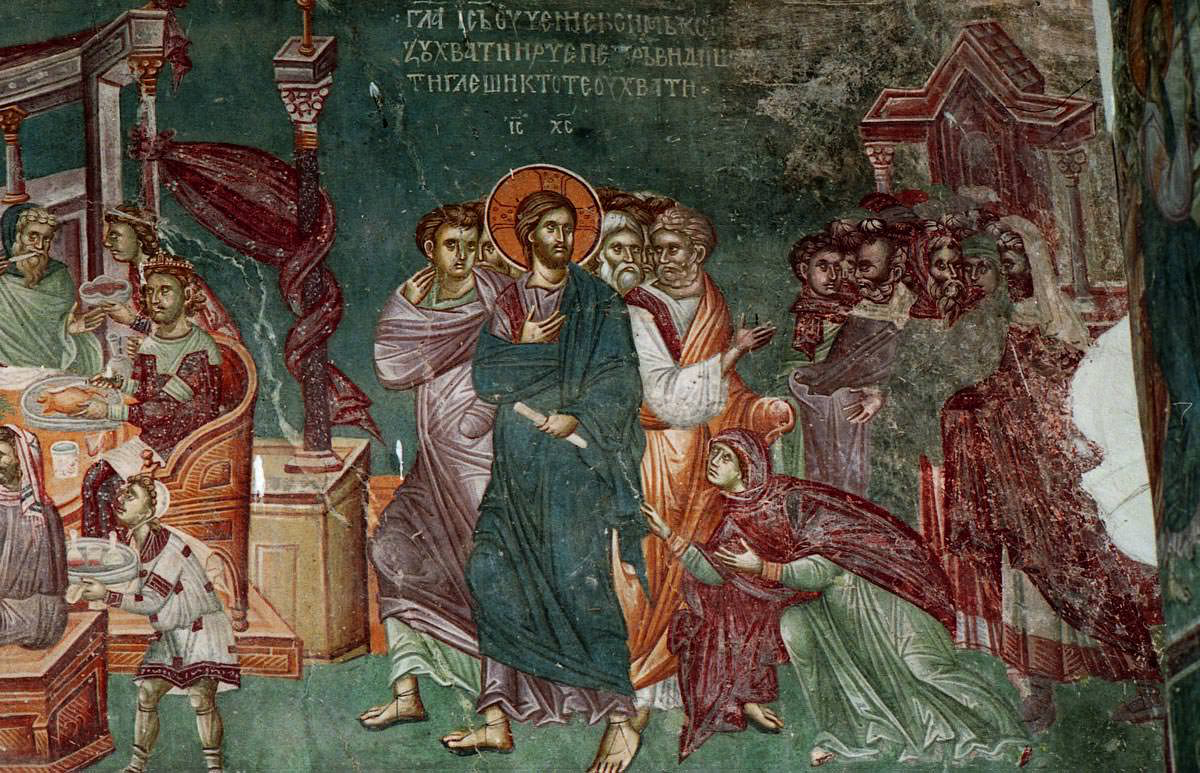
Our Gospel reading today is a story within a story. Jesus is on his way to the house of Jairus, a synagogue leader, whose daughter is dying, and he is interrupted by a woman with an unrelated chronic illness.
This is the last of a series of eight sermons I have presented on “The politics of Jesus.” We have looked at how Jesus would vote, what it means to call Jesus Lord, and the ways in which Jesus overturned the assumptions associated with power and authority. We have reflected on what the teaching of Jesus has to say about social cohesion, foreign policy, economics, and conscientious objection.
You may be wondering why I chose to conclude the series with a reflection on a healing story from the early ministry of Jesus. Politics is about power, but good politics is not about coercion and enforcement: it is about justice and mercy. Good politics is always about the right use of power and authority, or its restraint.
Those first followers of Jesus had already witnessed the extraordinary power and authority of their master. Mark’s Gospel tells us that they had seen several miraculous healings, the calming of the storm on the Sea of Galilee, and an exorcism. Mark’s Gospel is a Gospel of action, and now, in chapter five, Jesus is off to Jairus’s house to heal his daughter who is at death’s door.
A large crowd accompanies the two men, and in their hurry or earnestness they jostle and push, and press against Jesus. And Jesus stops in his tracks, and turns. Verse 30 tells us that he sensed that “power had gone out from him.”
He says, “Who touched my clothes?” (v. 30b).
His disciples are incredulous: “You see the crowd pressing alainst you, and yet you say, ‘Who touched me?’ ” (v. 31). But power had passed out of his body and done its intended work.
An unnamed woman among the crowd, with a long history of haemorrhaging, who had spent all her savings on medical intervention without success, had come up behind him in the crowd and touched the hem of his outer garment (vv. 26-27). Her plan was as simple as it was humble: she says to herself, “If I just touch his clothes, I’ll be made well” (v. 28). And she reaches out her trembling hand in the dusty throng, and connects with deity.
And Mark tells us, “Instantly her flow of blood ceased, and she sensed in her body that she was healed of her affliction” (v. 29).
The crowd has come to a standstill, and in the quiet the woman, knowing what had happened to her, falls down before Jesus and tells him the whole truth (v. 33).
“Daughter,” he says to her, your faith has saved you. Go in peace and be healed of your affliction” (v. 34). And Jesus proceeds on to the next crisis, at the house of Jairus.
Why did he stop? How did he know? Why turn now, when a desperate father is waiting for the healer to arrive? There is no prayer for healing. There is no confession or penitence. What is going on here?
We do know from the text that Jesus expressed words of kinship (“daughter”), he honours her faith, and he sends her home in peace. In his commentary on Mark, New Testament scholar N. T. Wright wisely writes,
Healing by touch, not least when the healer wasn’t expecting it, is such a strange phenomenon that we probably can’t probe much further about how such things work. But they highlight for us the intimate nature of the contact between the individual and Jesus that Mark expects and hopes his readers to develop for themselves. When life crowds in with all its pressures, there is still room for us to creep up behind Jesus – if that’s all we feel we can do – and reach out to touch him, in that odd mixture of fear and faith that characterises so much Christian discipleship.[1]
In the time remaining, I want to connect this extraordinary story of the power of God at work in the ministry of Jesus with what Paul tells us in Romans 8 about how God works with and through us.
In every kind of distress or need, God meets us in our brokenness with love and healing, and invites us to share that same care with one another. We come to God with different needs. Some of us need physical healing; others carry grief, anxiety, guilt, loneliness or broken relationships. Often these needs overlap. We may ask God to remove our suffering. Sometimes healing comes through recovery; sometimes we experience strength, peace or renewed hope while suffering continues.
We can bring every need to God. The Father, the Son and the Holy Spirit share in a single ministry of healing. I want to suggest four movements that help us recognise and respond to that ministry.
1. The Father loves and receives us
Paul says, “You have received a spirit of adoption” (Rom 8:15). You and I belong to God. Our weakness does not make us less precious to him. We can bring God our fears, disappointments and wounds. Knowing that we are unconditionally loved is the start of a journey to heal shame, loneliness and fear of rejection.
Come to God as you are. You do not have to become strong, or wise, before receiving his love.
2. Jesus comes close and restores us
Recall again that encounter between Jesus and the woman who had suffered bleeding (Mk 5:25–34). Jesus takes her physical suffering seriously. He gives her personal attention amid the chaos of the crowd. He calls her “daughter.” His non-anxious presence and his care embraces her body, respects her dignity and privacy, and restores her sense of self-worth and belonging.
Through his death and resurrection, Jesus offers us forgiveness, reconciliation with God, healing and hope beyond death. Talk to Jesus about the pain you carry, including the pain others cannot see. Chronic illness is not evidence that you lack faith.
3. The Holy Spirit strengthens and renews us
“The Spirit helps us in our weakness” (Rom 8:26). The Spirit of God helps us pray when we cannot find words, nurtures hope and gives strength for the next step, and enables love, patience and gentleness to grow within us.
We experience this help in various ways: resilience in the face of a difficult challenge, courage to face another day, willingness to receive care from others, or strength to begin a difficult conversation. Ask the Holy Spirit to help and hold you in the situation you face today.
4. We share God’s healing care with one another
In Galatians 6:2, Paul encourages us to “Bear one another’s burdens.” We listen and stay alongside people who are hurting. We pray and offer practical help. We support family and friends as they access medical and professional care. We acknowledge harm, we seek to repair broken relationships, and we try to make room for everyone to belong in community. A visit, a meal, an apology or a patient conversation can become an expression not just of friendship but of God’s healing love.
We do not always receive the recovery we seek. We can be honest about our disappointment and continue to pray. But God’s love remains faithful. The Father receives us; Jesus comes close to us; the Spirit strengthens us. And through one another, we experience the love and care of Jesus in practical ways.
In the end, we learn that God’s power is made perfect in weakness (2 Cor 12:9). That is the beauty of the message and mission of Jesus. That is the genius of the politics of Jesus: power made perfect in our weakness.
Rev Dr Rod Benson lives in Sydney and writes about a range of topics from books and local history to food, faith, philosophy, ethics, research skills, and everyday life. Away from the keyboard, he enjoys cooking for friends, walking in the Australian bush, exploring a beach, discovering new restaurants, and reading philosophy, fiction and poetry. He is married to Emma and is minister of North Rocks Community Church, a Uniting Church congregation.
Reference
[1] N. T. Wright, Mark for Everyone (Louisville, KY: Westminster John Knox Press, 2004), 60f.
Image source: Orthodoxy Then and Now
Taking it further…
Reflection questions
- The woman’s bleeding has already stopped when Jesus calls her “daughter” and sends her in peace. What do his words give her, and how do they echo Paul’s words about adoption in Romans 8:14–17?
- How does Romans 8:26–27 deepen the sermon’s account of healing, especially for someone whose suffering continues and who can no longer find words to pray?
- Why does Rod end his sermon series on “the politics of Jesus” with a healing story? How does this encounter help you understand his claim that God’s power is made perfect in weakness?
Application questions
- If someone living with chronic illness told you, “Perhaps I just don’t have enough faith,” what would you say to make room for their disappointment and affirm their belonging to God?
- Who is carrying a burden you could help bear this week? How could you offer something specific, such as a meal or a lift to an appointment, while leaving them free to say what would help most?
- Think of a relationship in which something you said or did caused hurt. What first step towards repair could you take while respecting the other person’s choice about how to respond?

