
Biblical authority, intellectual humility and the moral responsibility of interpretation
By Rod Benson
A question generated by the incarnation
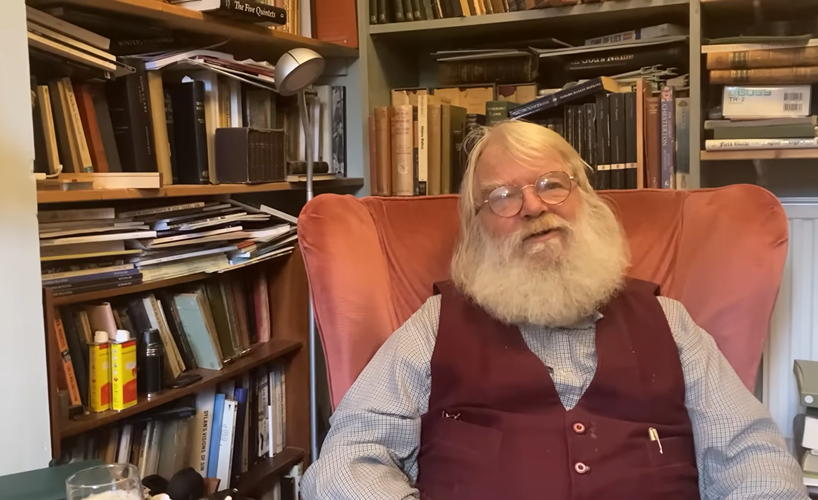
By his own admission, English poet and Anglican priest Malcolm Guite’s mission is “to kindle my own and other people’s imagination for Christ.” My previous article argued that his poetic imagination is an account of truthful perception grounded in a Christian theology of creation, illumination and incarnation. If that is true, it cannot remain a theory about literature alone but reaches into the realms of biblical interpretation and the life of the Church. We all understand that Scripture communicates in stories, psalms, parables, prophecy, metaphor and visions. What would be lost if these forms were treated merely as containers for propositions? Yet this is effectively what modernist fundamentalism has attempted to do, and we see the cultural and theological ruins it produces everywhere we look.
Christian fundamentalism is neither a single doctrine nor a synonym for traditional belief. Historically, the movement arose among Protestants defending what they regarded as essential Christian teachings amid theological and cultural disputes, but it is discernible among Catholic believers too. Its traditions vary, and many conservative Christians do read biblical genres in an intelligent manner. The difficulty addressed here is more specific: an interpretive posture that makes the authority of Scripture inseparable from a closed system of harmonised meanings, or minimises historical complexity, or treats textual ambiguity as evidence of unfaithfulness to the notion of propositional revelation.
Truthful language is not always literal language
We all know that language is frequently used in non-literal senses. A psalm that calls God a rock says something about security and steadfastness; it does not identify God as a geological specimen. Likewise, biblical parables do more than relay moral rules. Their imaginative arrangements make listeners judge a situation before recognising their own involvement. In 2 Samuel 12, Nathan’s story of a stolen lamb prompts David’s indignation before exposing David’s own behaviour. In Luke 10:25–37, the exemplary neighbour is the unexpected Samaritan. These narratives work on the reader’s judgments in ways a bare command may not.
Distinguishing literal sense from literalism is vital. In responsible biblical interpretation, the literal sense is what the language communicates in its context; where a passage uses metaphor, its intended sense is metaphorical. Literalism arises when the reader demands direct factual correspondence where the text is doing something else. Rejecting literalism therefore does not require denying historical claims about Jesus or abandoning belief in revelation. It requires asking what kind of text one is reading before deciding how it makes a claim.
The Pontifical Biblical Commission’s 1993 document, The Interpretation of the Bible in the Church, makes a pointed theological argument: treating Scripture as though its human language and historical setting were irrelevant fails to take seriously the consequences of incarnation. The commission commends historical-critical study while insisting that interpretation must also serve the life and faith of the church. The connection is instructive for Guite’s project. If the Word truly became flesh, the historical and linguistic particularity of biblical testimony is not an embarrassment to be overcome.
Fundamentalism and the problem of literal readings
Biblical scholar James Barr’s Fundamentalism (1977) cautions against caricature. The decisive issue is not that every fundamentalist reads every verse literally. Literal interpretation may be modified when it threatens a wider commitment, especially the insistence that Scripture be without error in a tightly prescribed sense. Thus the deeper question concerns the doctrinal framework controlling what counts as an admissible reading and how alternative evidence may be handled.
Guite’s work raises three challenges to this framework. First, it contests the reduction of truth to propositions detached from their linguistic form. Second, it distinguishes confidence in Christian revelation from infallibility in one’s own interpretation of that revelation. Third, it treats uncertainty, lament and questioning as potentially fruitful conditions of attentive faith rather than merely deficiencies to be suppressed. His extended readings of Thomas Hardy, Philip Larkin and Geoffrey Hill are pertinent because theological significance may be found in poems that do not resolve religious doubt.
None of these arguments establishes that all readings are valid. Imaginative perception can distort as well as disclose; strong emotion cannot validate a historical claim; and a poet’s suggestive language does not replace sound argument. A more responsible alternative to fundamentalist closure is not boundless interpretation but criticism joined with humility.
Interpretive freedom needs interpretive discipline
Two conversation partners sharpen this point. Paul Ricoeur’s account of metaphor helps explain how texts open possibilities of meaning without becoming factual reports in disguise. Kevin Vanhoozer’s Is There a Meaning in This Text? (1998), written from a recognisably evangelical perspective, defends the possibility of literary knowledge and understands meaning as communicative action. Taken together, as a constructive comparison, they suggest that imagination can be both receptive and answerable: attentive to words and genres, historical contexts, communicative purposes and the moral obligations of readers.
N. T. Wright adds a wider account of scriptural authority. His revised Scripture and the Authority of God (2011) locates biblical reading within God’s purposes and the life of a community formed by the biblical story. This discourages treating the Bible as a collection of isolated proof-texts, while preserving the importance of historical inquiry and substantive Christian claims. The resulting approach is neither a denial of authority nor a licence to overwrite the text with contemporary preference.
A practical discipline follows. One should begin with the genre and historical setting, perform a close reading of the text, distinguish what the passage asserts from what it evokes, compare an interpretation with the wider biblical witness and responsible scholarship, and ask how its use affects real persons. While such a procedure does not eliminate disagreement, it exposes interpretations to reasoned analysis beyond the reader’s cultural and theological preferences and inherited certainty.
From artistic imagination to moral responsibility
The strongest test of Guite’s account may be ethical. For example, imagine a congregation that assents to the biblical command to love its neighbour while failing to recognise actual suffering, exclusion or dignity in its local context. Narrative and poetry has the capacity to interrupt that failure of attention. Lifting the Veil links the awakening of artistic imagination with moral and prophetic imagination and describes Jesus’ parables as capable of opening fresh awareness of God’s kingdom.
Walter Brueggemann’s The Prophetic Imagination (1978) offers an illuminating, independent comparison. Prophetic speech can criticise dominant habits of consciousness and energise alternatives that seem unavailable within the present order. This helps extend Guite’s concerns from individual perception to communities and institutions. Yet a warning is necessary: imaginative sympathy does not automatically change policy, redistribute power or heal injustice. Institutions, practical wisdom, evidence and sustained action are still required.
The same caution matters when applying the argument to contested contemporary questions. Poetry can expose blind spots and enlarge the circle of attention, but it does not itself settle arguments about church order, sexuality, gender, economic justice or public policy. An ethically responsible church must combine imaginative receptivity with scriptural interpretation, historical knowledge, discernment of consequences and fair engagement with those who disagree.
Worship, sacraments and the formation of attention
Guite’s approach also illuminates aspects of Christian liturgy. Spoken and sung prayer, psalmody, silence, ritual and visual symbols do not simply transfer information. They train memory, direct attention and embody communal commitments. His short theological book The Word within the Words expressly considers Scripture, liturgy and sacrament as dimensions of the poetic and incarnational imagination.
Poetry is not intrinsically a sacrament, and aesthetic delight is not to be confused with the experience of grace. Nevertheless, both poetic form and liturgical action remind the church that embodied expression matters. A sermon that explains a metaphor may be helpful; a sermon that strips the metaphor of every evocative possibility may leave the listener with less understanding than the biblical text itself afforded.
The concern has broad ecumenical relevance, including to churches that hold together scriptural authority, responsible scholarship, sacramental worship and commitments to justice. It invites a less defensive account of orthodoxy, a perspective capable of confessing the church’s faith while admitting that the church’s present understanding is partial, historically situated and open to correction.
Limits of the case against fundamentalism
Three qualifications prevent the argument from descending into polemical overreach. First, Guite’s principal books are a defence of theological imagination, not an empirical study of actual fundamentalist communities. The critique here is a reasoned application of his work.
Second, Guite does not seek to prove the veracity of Christian doctrines by demonstrating the subtle truth-bearing work of poetry. For example, the incarnation is a theological commitment that shapes his philosophy rather than an inference established by aesthetic experience.
Third, imagination is not a self-authenticating and value-free construct. Propaganda, prejudice and seductive falsehood may be imaginatively powerful, but the Church needs to foster critical intellectual scrutiny as well as inspiring wonder and engaging with the numinous.
Guite’s literary examples are also instructive. His attention to an Anglo-centric religious tradition and an English-language canon could be enriched and challenged by Indigenous, feminist, postcolonial and non-Western traditions, whose approaches to land, memory, power and communal identity may disclose assumptions the inherited canon leaves unexamined. Such engagement should be reciprocal and specific, not a gesture towards inclusiveness without serious reading.
Conclusion: conviction without interpretive closure
What, then, does Guite ask of Christian faith? Not the abandonment of doctrine, nor an escape from evidence into attractive images. His work asks readers to treat imagination as one of the faculties through which objective truth may be apprehended, tested and embodied. The incarnation offers a theological reason to respect particular language, historical life and material form. For that very reason, invoking biblical authority cannot excuse inattentiveness to the actual kinds of language the Bible uses.
In Christian confession, the Logos through whom all things came to be establishes a meaningful creation. The light of the Logos draws human perception toward renewal, and the incarnation of the Logos in the person of Jesus directs attention to embodied, historically situated revelation. Guite’s recovery of poetry develops the epistemological and spiritual consequences of that confession. Applied critically, it challenges the substitution of rigid interpretation for living faith. Orthodoxy need not be a sealed collection of statements: it may be a disciplined and revisable practice of understanding, formed by the Word and accountable to the world and the neighbour it is called to love.
Rev Dr Rod Benson lives in Sydney and writes about a range of topics from books and local history to food, faith, philosophy, ethics, research skills, and everyday life. Away from the keyboard, he enjoys cooking for friends, walking in the Australian bush, exploring a beach, discovering new restaurants, and reading philosophy, fiction and poetry. He is married to Emma and is minister of North Rocks Community Church, a Uniting Church congregation.
Sources and further reading
James Barr, Fundamentalism (SCM Press, 1977).
Kara Bettis, “A poet for ‘bruised evangelicals’,” Christianity Today, Jan-Feb 2023, https://www.christianitytoday.com/2023/01/malcolm-guite-poetry-bruised-evangelicals/
Walter Brueggemann, The Prophetic Imagination (Fortress Press, 1978).
Malcolm Guite, Faith, Hope and Poetry: Theology and the Poetic Imagination (Ashgate, 2010).
Malcolm Guite, Lifting the Veil: Imagination and the Kingdom of God (Square Halo Books, 2021).
Malcolm Guite, The Word within the Words (Darton, Longman & Todd, 2021).
Pontifical Biblical Commission, The Interpretation of the Bible in the Church (1993), section on fundamentalist interpretation and conclusion. https://catholic-resources.org/ChurchDocs/PBC_1993_InterpBibleChurch.htm
Paul Ricoeur, The Rule of Metaphor (University of Toronto Press, 1977).
Kevin J. Vanhoozer, Is There a Meaning in This Text? The Bible, the Reader, and the Morality of Literary Knowledge (Zondervan, 1998).
N. T. Wright, Scripture and the Authority of God (revised and expanded edition; HarperOne, 2011). https://ntwrightpage.com/2026/02/28/publications-and-broadcasts/
Image source: Church Times


I think one of the precursors, but rarely modernly mentioned, in my little world at least, is the work and example of Austin Farrer – especially in his thinking about imagery in Revelation and his book A Rebirth of Images. As I recall his thinking goes along the lines that the archaeology of an image is one thing, but the reality of apocalyptic is the recasting of images and figures to express new, and deeper, truths. Perhaps his work has been engaged and dismissed and I’ve missed out on all that, perhaps, being Farrer, he didn’t leave enough ‘scholarly’ footprints (i. e. footnotes) to make pursuit easily rewarding!
Anyway, yes to all the above, but I’d love to see Farrer in the footnotes (without my having to work. No, I’m NOT going to get AI and the greenhouse onto my indolence!!)