
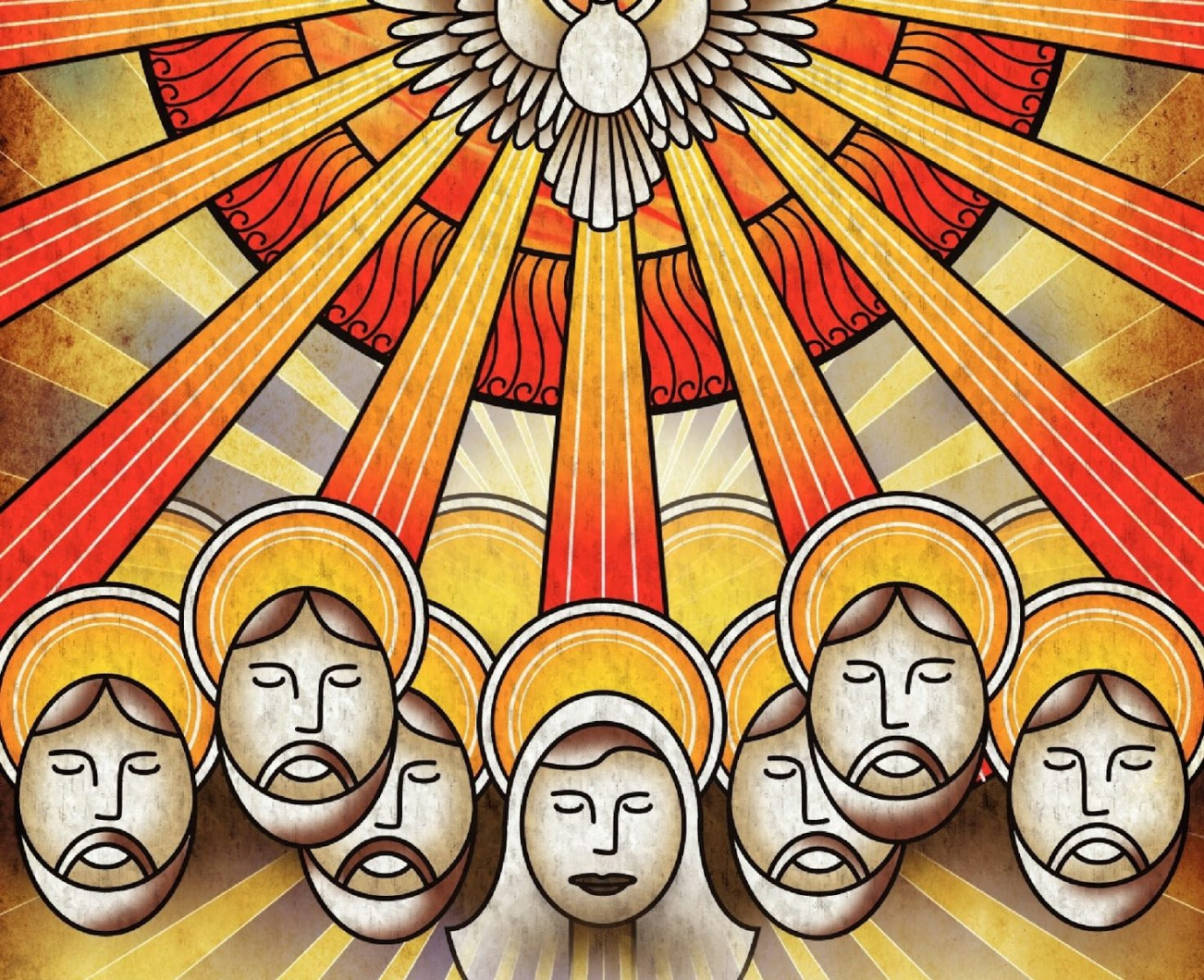
Today, in the church’s liturgical calendar, we celebrate the coming of the Holy Spirit and the birth of the universal church. Pentecost is a unique historic gospel event, arguably as central to the mission of the church as is the resurrection of Jesus.
British Anglican pastor-theologian John Stott observes that
Without the Holy Spirit, Christian discipleship would be inconceivable, even impossible. There can be no life without the life-giver, no understanding without the Spirit of truth, no fellowship without the unity of the Spirit, no Christlikeness of character apart from his fruit, and no effective witness without his power. As a body without breath is a corpse, so the church without the Spirit is dead.[1]
At first glance, Luke’s engaging story of the events that occurred on the Day of Pentecost, in Acts chapter 2, may appear to be an innovation in the life of the people of God.
But this is not entirely true. Pentecost is anticipated in the account of the Spirit resting upon the seventy elders in Numbers 11:24-30, which is our lectionary reading for today from the Hebrew Bible. Numbers 11 makes clear that the Day of Pentecost was not a novelty but the fulfilment and expansion of long-standing biblical expectations of the active presence of God’s Spirit among God’s people.
The story of Numbers 11 provides a remarkable insight into the gifts of the Spirit and the mission of God, and a practical vision for the ongoing life of the church today.
At its centre lies the crucial insight that the mission of God cannot be sustained by isolated leaders carrying impossible burdens alone. The mission of God requires a spiritually empowered community shaped by shared leadership, diverse gifts, courageous witness, and openness to change.
The setting for the story is Israel’s wilderness journey after the celebrated Exodus from Egypt. They have been miraculously liberated from slavery, but they are spiritually unstable and emotionally fragile. Complaints and unrest are spreading through the camp, so much so that Moses reaches exhaustion under the weight of leadership, and cries out to God, “I can’t carry all these people by myself. They are too much for me” (Num 11:14).
There’s often an assumption that the health of a community of faith depends primarily upon a single gifted leader – perhaps the pioneer, or an eloquent or charismatic preacher, or a contemplative giant. Here in Numbers 11, Moses functions simultaneously as pioneer, prophet, pastor, judge, mediator, and coach to the nation. Yet even Moses cannot sustain the community and keep all the balls in the air through personal strength alone.
The mission of God was never intended to rest upon a single hero. That way lies disaster, as the wreckage of church history reminds us.
How does God respond to Moses’s prayer of desperation? God does not give Moses super-human strength; he multiplies leadership. Moses identifies seventy responsible elders from the community, and has them gather around the Tent of Meeting (the precursor to the Jerusalem temple). And then something extraordinary happens:
Then the Lord descended in the cloud and spoke to him. He took some of the Spirit who was on Moses and placed the Spirit on the seventy elders. As the Spirit rested on them, they prophesied, but they never did it again (Num 11:25).
The same Spirit who empowered Moses is now shared among others, inspiring prophetic ministry and enabling collaborative leadership.
In Scripture, prophecy is not merely prediction of future events but includes encouragement, wisdom, truth-telling, discernment, teaching, warning, and public witness. It is about faithfully communicating the purposes of God for the sake of the community.
But that is not the end of the story.
Two potential leaders, Eldad and Medad, stayed in the camp rather than gathering at the Tent of Meeting. Yet the Spirit rests upon them as well, and they too prophesied! Joshua, the young future successor to Moses, becomes anxious about rules and regulations, and urges Moses to stop them (vv. 26-28).
And Moses replies, “If only all the Lord’s people were prophets and the Lord would place his Spirit on them!” (v. 29).
This is the same Spirit who later features in the vision of the prophet Joel (Joel 2:28f; cf Ac 2:17). And this is the same Spirit who unmistakably descends upon God’s people in the narrative in Acts chapter 2. Pentecost fulfils the expressed longing of Moses that the empowering presence of God would extend beyond a single person, or even beyond a small elite, to the whole people of God (Num 11:29).
The practical implications for us are profound. I have four points.
First, we need to model shared spiritual leadership.
Many congregations today risk becoming dependent upon a single minister, pastor, or charismatic personality. When leadership is concentrated in the hands of one person, what often follows, sooner or later, is exhaustion, discouragement, disempowerment, systemic fragility, and potential corruption and moral failure.
Numbers 11 presents a different model. God distributes spiritual responsibility across a wider body of gifted leaders. Healthy churches cultivate plurality rather than dependency. They celebrate team ministry rather than relying on prominent individuals. They identify, encourage, train, and release spiritually gifted people into ministry. They may not be spiritually mature, but they are growing in the right direction, and won’t reach their potential unless doors are opened and permission given to thrive.
This is not an argument against ordained ministry or theologically trained clergy. We need testing and discernment of the aspirations of potential leaders; we need an educated ministry.
But we also need a strong commitment to shared leadership structures. Wise leaders in the church equip others for ministry. The healthiest churches are those in which many people actively exercise their gifts in service, teaching, prayer, hospitality, evangelism, pastoral care, administration, justice work, and public witness.
Second, we need a better understanding of spiritual gifts.
In some church contexts, gifts of the Spirit are associated almost entirely with dramatic experiences or emotionally intense worship. This narrow focus and the privileging of high-profile giftedness may leave many of us feeling suspicious, excluded, or spiritually inferior.
The New Testament consistently promotes diversity rather than uniformity. The Spirit works in a multitude of ways.
A wise teacher, a compelling evangelist, a compassionate listener, a faithful intercessor, a courageous social justice advocate, a gifted organiser, or a person capable of deep reconciliation – each of these people exercises spiritual gifts essential to the mission of the church in the world. And each of them is becoming the person God intends and equips them to be.
The gifts of the Spirit are not badges of status or exclusivity. They exist for the “common good” (1 Cor 12:7).
Third, we need to discern what God is up to among us.
Both Numbers 11 and Acts 2 demonstrate that authentic spiritual empowerment originates with God rather than human performance. Moses does not manufacture prophecy in his community. The disciples do not orchestrate the miracles of Pentecost. God is at work in both communities.
We must learn to distinguish between genuine spiritual maturity and manipulative religious performance. Charisma alone is not evidence of spiritual depth. The true marks of the Spirit include humility, truthfulness, love, wisdom, holiness, courage, and Christlike character.
Fourth, we need to invest our gifts in the mission of God.
Pentecost teaches us that the gifts of the Spirit, graciously dispensed to all who follow Jesus, are missional gifts. The disciples are empowered to proclaim “the mighty works of God” across boundaries of language and culture. The Spirit pushes the church out into the world.
Spirit-filled leadership involves more than maintaining church activities. God calls us to embody the reconciling love of Christ in public life. And so we engage in boundary-shattering hospitality, defence of human dignity, care for the isolated, courageous engagement on social issues, and faithful evangelistic witness to Jesus.
The church flourishes when ordinary people discover that the Spirit of God has equipped them for active participation in the mission of God.
Moses discovered that the burden of leadership was not something that should be carried alone. God’s answer was not a stronger leader, or super-human abilities, but a Spirit-filled community of seemingly ordinary people shaped by an extraordinary vision, shared responsibility, and diverse gifts.
That vision remains central to the life of the church today.
The mission of God advances most effectively when we cultivate and empower spiritually gifted and missional leaders among us, enabling the church to be the church that God intends us to be, keeping in step with the Spirit, bearing faithful witness to the good news of Jesus.
Sermon 855 copyright © 2026 Rod Benson. Preached at North Rocks Community Church, Sydney, Australia, on Sunday 24 May 2026. Unless otherwise noted, Scripture quotations are from The Christian Standard Bible (Nashville: Holman Bible Publishers, 2020).
Rev Dr Rod Benson is General Secretary of the NSW Ecumenical Council and a minister of the Uniting Church in Australia serving at North Rocks Community Church in Sydney.
Taking it further
Reflection questions
- Why do you think Moses longed for all God’s people to receive the Spirit and exercise prophetic ministry, rather than concentrating leadership and influence in a few gifted individuals?
- How do you distinguish between genuine spiritual maturity and merely impressive religious performance? What qualities most clearly reveal the work of the Holy Spirit in a person’s life?
- When have you experienced the gifts, encouragement, wisdom, or ministry of an ordinary Christian in a way that significantly strengthened your faith or enriched the life of the church?
Application questions
- Where is God calling you to move from being primarily a spectator of ministry to becoming a more active participant in God’s work?
- The sermon argues that the Spirit pushes the church beyond its own boundaries into the world. What is one specific need, injustice, or opportunity for witness in your community that God may be calling you to engage?
- How can your congregation better identify, encourage, train, and release the gifts of a wider range of people, including those whose contributions are often overlooked?
Reference
[1] John Stott, The Message of Acts (Leicester: IVP, 1990), 60.
Image source: timehrhardt.com

