
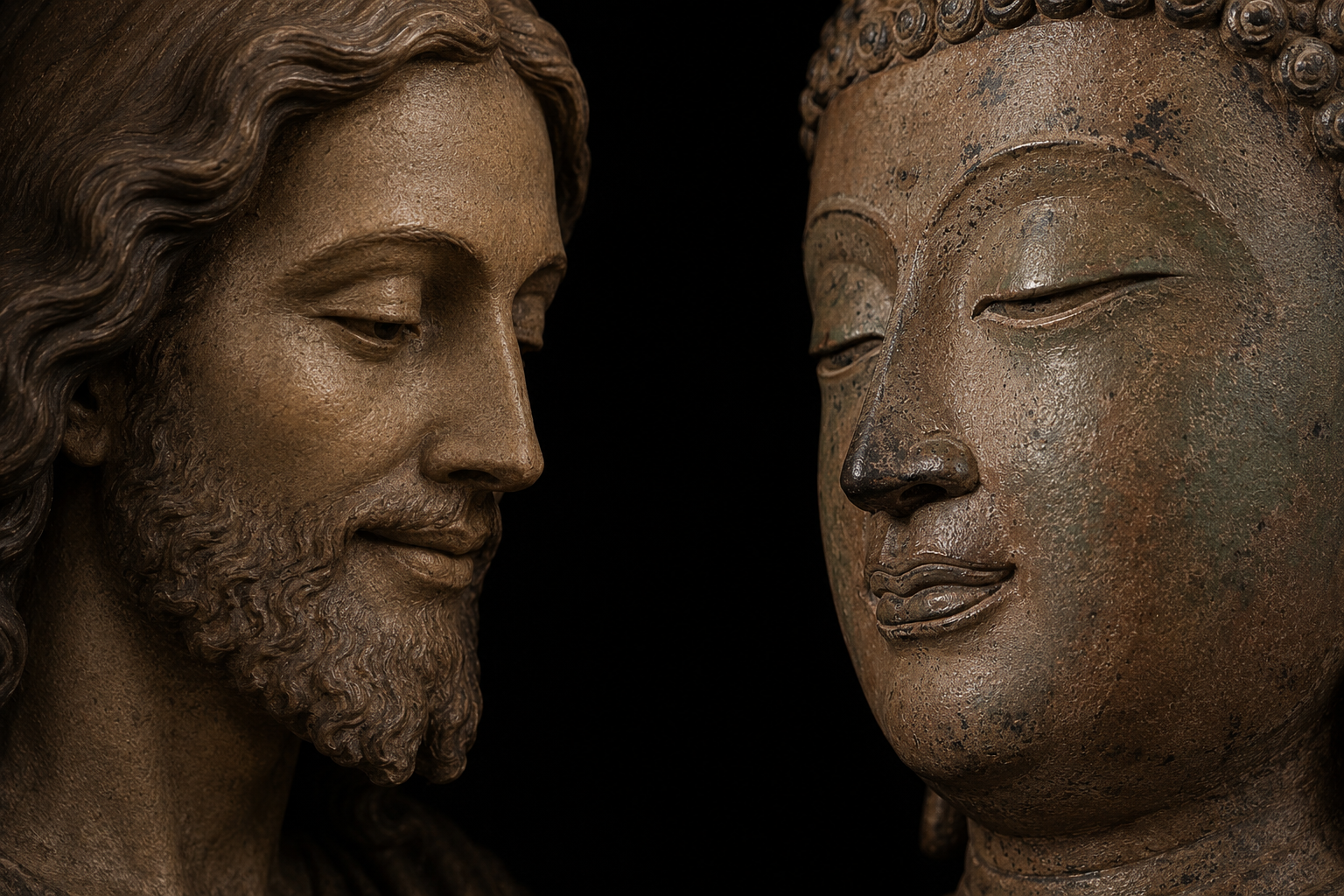
Our world often assumes that happiness is the highest human good. Happiness is measured, marketed, pursued, and celebrated. But what does it mean to live a truly fulfilled human life?
From both Christian and Buddhist perspectives, happiness is important to human wellbeing, but genuine and lasting happiness cannot be detached from truth, virtue, compassion, and transcendence. Both religious traditions challenge the modern tendency to identify the good life with pleasurable feelings or personal satisfaction. Instead, they direct attention to the formation of character, the transformation of desire, and transcendence of the self.
This insight is not unique to religion. From Aristotle onwards, many philosophers have argued that genuine happiness involves more than pleasure. Human flourishing requires the cultivation of virtue and the pursuit of meaningful ends. Christianity and Buddhism develop this insight in different but complementary ways.
A helpful framework is to map how parallel traditions distinguish between happiness, joy, well-being, and ultimate fulfilment. Generally speaking, Christianity describes such fulfilment as blessedness and communion with God, whereas Buddhism speaks of liberation, awakening, and freedom from attachment.
Happiness and joy
In everyday usage, happiness refers to positive feelings such as pleasure, enjoyment, comfort, or satisfaction. It often arises from favourable circumstances: friendship, health, achievement, security, beauty, or meaningful work. Happiness is a genuine good and should not be dismissed. Both Christianity and Buddhism affirm the goodness of many ordinary human joys: the kind of things that bring a smile to one’s face, a lightness of spirit, a sense of peace.
A difficulty arises when happiness becomes the ultimate goal of one’s life. Happiness is inherently fragile because it depends, at least in part, upon circumstances. Health may fail, relationships may fracture, and success may prove temporary. If fulfilment rests entirely upon favourable conditions, it will be vulnerable to disappointment.
Christian theology therefore distinguishes happiness from joy. Joy is deeper and more enduring because it is rooted in meaning, hope, gratitude, love, and faith. The New Testament repeatedly presents joy as something that can coexist with hardship. The Apostle Paul writes of rejoicing even while imprisoned (e.g., Php 1:12-19; cf 2:17f). Joy emerges not from possessing everything one desires but from confidence that one’s life is held within the purposes of God.
Within the Roman Catholic tradition, Thomas Aquinas argued that every human being seeks happiness because they are created by God for fulfilment. Yet finite goods cannot satisfy an infinite longing. Wealth, honour, power, and pleasure are good in themselves, but none can provide ultimate satisfaction. They point beyond themselves to God, who is the source of all goodness.
While in agreement with earlier Catholic thought on happiness, Protestant traditions emphasise that joy is grounded in divine grace rather than human achievement. Reformers such as Martin Luther and John Calvin, for example, taught that those who follow Jesus find joy through trusting God’s mercy and surrendering to God’s will rather than relying upon their own accomplishments.
Eastern Orthodox theologians typically emphasise joy as participation in divine life. Through prayer, worship, sacramental participation and spiritual discipline, the faithful are gradually transformed into the likeness of Christ. Joy becomes a sign of growing communion with God, ultimately expressed in theosis or union with God.
Well-being and human flourishing
Well-being is broader than either happiness or joy. It refers to the flourishing of the whole person: physically, emotionally, socially, morally, intellectually, and spiritually.
This wider perspective reminds us that flourishing is not reducible to feelings. A person may experience grief or illness and yet possess profound well-being because their life remains rich in meaning, love, purpose, and hope. Conversely, a person may experience pleasure while living in ways that ultimately diminish their flourishing.
Christian theology increasingly emphasises that well-being is both personal and social. Human beings flourish within relationships and communities. The biblical vision of shalom encompasses peace, justice, reconciliation, and harmonious relationships between persons, communities, and creation itself.
The prophets consistently linked worship of God with concern for justice. Jesus proclaimed good news to the poor and challenged systems that marginalised and excluded people. Consequently, questions of poverty, violence, inequality, and environmental degradation are not secondary concerns. They are directly related to human flourishing.
Buddhist traditions likewise recognise that flourishing has social dimensions. Compassion occupies a central place in Buddhist ethics. Within Mahayana Buddhism, for example, the ideal of the bodhisattva emphasises commitment to the welfare of all beings. Human flourishing is therefore not merely a private achievement but a shared and communal reality.
Blessedness and communion with God
If happiness refers to feelings, joy to meaning, and well-being to flourishing, what lies beyond them? Christianity answers with the language of blessedness. The Beatitudes provide one of the clearest expressions of this vision: “Blessed are the poor in spirit”; “Blessed are those who mourn”; “Blessed are the meek” (Mt 5:3-12).
These declarations are striking because they separate the experience of blessedness from immediate pleasure. Jesus does not identify the blessed with the successful, comfortable, or powerful. Instead, blessedness describes a life lived in communion with God and aligned with God’s kingdom.
Blessedness encompasses happiness when happiness is present, sustains joy when happiness disappears, and provides the deepest foundation for genuine well-being. It is ultimately grounded in relationship with God.
This conviction runs throughout Christian theology. In his autobiographical Confessions, Augustine of Hippo famously wrote, “The heart is restless until it finds its rest in [God].” In other words, people seek meaning, truth, beauty, goodness and love because they are created for God. Jesus expresses a similar vision when he declares, “I came that they may have life, and have it abundantly” (Jn 10:10).
Despite their differences, all three Christian traditions agree that ultimate fulfilment for humans is found not in pleasure but in communion with God.
Liberation and awakening in Buddhism
Buddhism offers a different but equally profound account of ultimate fulfilment. The Buddha began with the observation that ordinary life is marked by dissatisfaction and suffering. Human beings seek permanence in a world characterised by change. They cling to possessions, relationships, achievements, and identities as though these could provide lasting security. The result is frustration, anxiety, and suffering.
The Buddhist response is not despair but liberation. Through ethical conduct, meditation, mindfulness, wisdom, and compassion, practitioners gradually become free from ignorance and attachment.
A common misunderstanding portrays Buddhism as pessimistic because of its emphasis upon suffering. In reality, Buddhism offers a hopeful diagnosis and remedy. Its goal is not misery but freedom. It seeks a deeper form of happiness rooted not in possession but in liberation. Rather than being controlled by changing circumstances, individuals learn to respond with wisdom, compassion, and inner stability. The goal is not emotional numbness but equanimity or freedom from compulsive attachment.
Concepts such as nirvana and enlightenment differ significantly from Christian notions of communion with God. Buddhism generally does not affirm a creator God or an eternal soul. Nevertheless, both Christianity and Buddhism agree that lasting fulfilment requires profound transformation of the self rather than merely improved external circumstances.
Conclusion
Happiness is a gift; joy is a disposition rooted in meaning and hope; wellbeing is the flourishing of the whole person within a flourishing community. Yet both Christianity and Buddhism point beyond these realities towards a deeper fulfilment.
Christianity calls that fulfilment “blessedness”: participation in the life, love, and purposes of God. Buddhism speaks of liberation: freedom from ignorance, craving, and attachment through wisdom and compassion.
The differences between these traditions remain substantial. Yet both challenge the assumption that fulfilment can be found through consumption, comfort, or self-indulgence alone. Both insist that human flourishing involves the transformation of desire, the cultivation of virtue, commitment to compassion, and openness to realities greater than the self.
The deepest human fulfilment may be found in pursuing truth, goodness, beauty, wisdom, love, and compassion, and discovering that happiness follows in their wake.
Rev Dr Rod Benson is General Secretary of the NSW Ecumenical Council and a minister of the Uniting Church in Australia serving at North Rocks Community Church in Sydney.
Image source: author

