
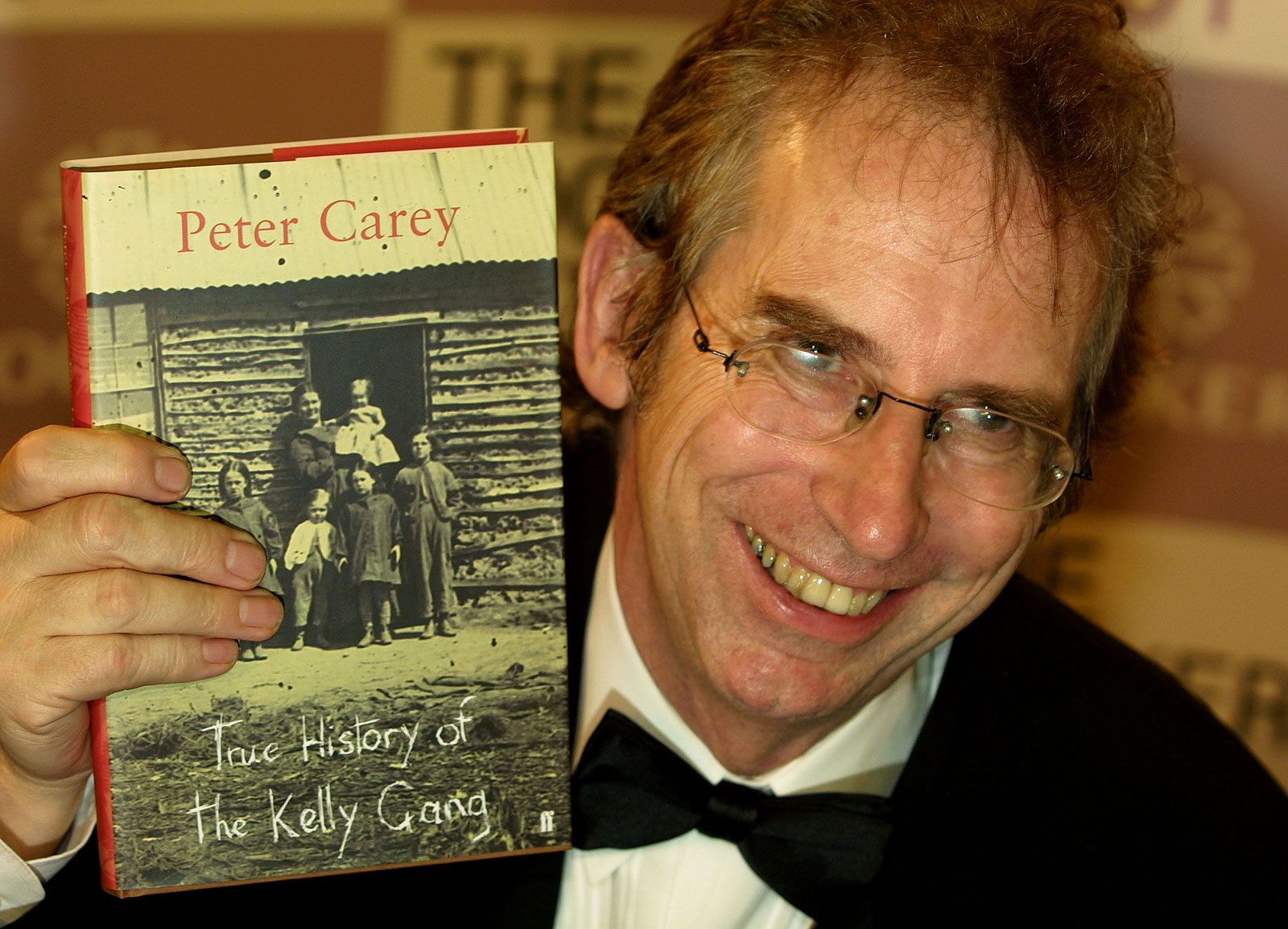
I recall opening Peter Carey’s True History of the Kelly Gang on its publication in 2000 and being struck by the absence of quotation marks around speech. I found it distracting. Dialogue merged into narration, and the visual markers that guide readers through conversations had disappeared. Why, I thought, would an accomplished novelist dispense with such a familiar prose convention?
The answer lies in a broader understanding of voice, consciousness, storytelling, and the relationship between writer and reader.
A convention, not a necessity
Modern readers often assume that quotation marks are an essential feature of written language, but they are a convention that emerged gradually. Earlier literary traditions employed various methods for indicating speech, and many texts functioned effectively without the typographical system familiar today.
Recognising this history helps place Carey’s practice in perspective. He is not simply breaking rules. Rather, he is reminding readers that literary conventions are choices rather than necessities.
Quotation marks serve useful functions. They distinguish speech from narration, improve clarity, and facilitate rapid reading. Yet they also create visible boundaries between different forms of discourse. Writers who abandon quotation marks often do so because they wish to explore what happens when those boundaries become less rigid.
Carey is far from alone in adopting quotation-free dialogue. Writers such as James Joyce, Virginia Woolf, William Faulkner, Samuel Beckett, José Saramago, and Cormac McCarthy all experimented with reducing or eliminating conventional dialogue markers.
Joyce and Woolf explored the representation of consciousness. Faulkner examined fragmented memory and multiple perspectives. Saramago used long, flowing sentences that blurred distinctions between narration and speech. McCarthy favoured a stripped-back minimalism.
Carey’s contribution lies not in adapting the technique to his own purposes. His fiction is often driven by voice, and his formal choices serve the creation of narrators whose speech, memory, and imagination organise the narrative world.
Voice, narrative continuity and consciousness
One effect of abandoning quotation marks is the creation of a more unified narrative surface. Speech, thought, memory, observation, and description appear within the same textual field rather than being separated by visible typographical boundaries.
In True History of the Kelly Gang, this effect is especially striking. The novel is presented as a sustained first-person memoir by Ned Kelly. Readers encounter events through Kelly’s language, perceptions and assumptions. The absence of quotation marks contributes to the impression that everything on the page emerges from a single narrative consciousness.
The technique also raises broader questions about how fiction represents human consciousness. Twentieth-century writers and critics devoted considerable attention to depicting the complexity of inner life. Stream-of-consciousness narration, interior monologue, and free indirect discourse all emerged as ways of capturing the fluid movement of thought.
Carey’s fiction participates in this wider conversation. Humans do not experience life in neatly separated categories. Speech, memory, imagination, perception, and reflection constantly overlap. We recall conversations, rehearse future encounters, reinterpret past events, and blend external experience with internal commentary.
The absence of quotation marks can encourage readers to experience something of this fluidity. Speech appears less as a formally presented event and more as part of a larger flow of consciousness. This does not necessarily make the representation more realistic, but it provides one powerful literary strategy for exploring subjective experience.
Reader participation and literary culture
Removing quotation marks also alters the reader’s role. Conventional punctuation directs readers by signalling where speech begins and ends. Without those markers, readers must rely more heavily upon context, rhythm, syntax, and voice.
This requires greater attentiveness and encourages readers to participate more actively in constructing meaning. Conversations are not simply presented; they must be interpreted. The reader becomes more conscious of the texture of the prose and the distinctive qualities of individual voices.
At the same time, the form itself contributes to meaning. Literary critics increasingly recognise that punctuation, typography, and narrative structure are not merely containers for content but help to shape it.
In True History of the Kelly Gang, the formal qualities of the prose reinforce the novel’s larger concerns with storytelling, memory, authority, and historical representation. Kelly’s voice competes with official accounts of history. The novel foregrounds the act of telling a story rather than presenting history as a detached record of facts.
It is also important to note that stylistic innovations emerge within broader literary cultures. Authors write within traditions shaped by publishers, editors, critics, and readers.
By the late twentieth century, quotation-free dialogue had become an established feature of serious literary fiction. Carey’s work participates in an ongoing conversation about narrative form rather than standing outside literary convention altogether.
A distinctive literary strategy
The omission of quotation marks in Peter Carey’s fiction is best understood as one literary strategy among many for shaping a reader’s experience of narrative voice.
Many great novels achieve similar goals while employing conventional punctuation. Carey’s achievement, whether intended or not, is not to prove that quotation marks are unnecessary, but to demonstrate how their absence can serve the distinctive demands of a particular narrative. What first appears as a minor typographical choice becomes an important element of the novel’s exploration of voice, memory, and the art of fiction.
Rev Dr Rod Benson is General Secretary of the NSW Ecumenical Council and a minister of the Uniting Church in Australia serving at North Rocks Community Church in Sydney. He likes to read.

