
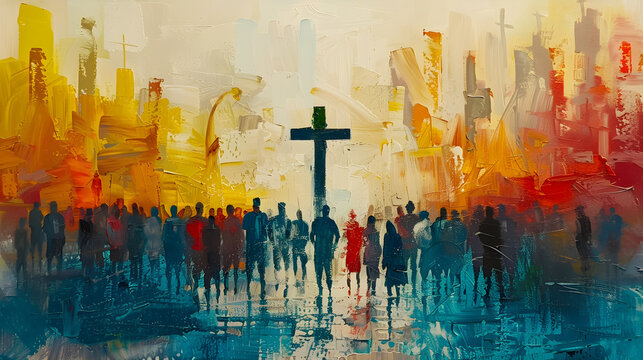
Ecumenism is the movement among Christians to seek greater unity, cooperation, and reconciliation across the many traditions of the Christian faith. Derived from the Greek word oikoumene, meaning “the whole inhabited world,” the term originally referred to the universal church spread throughout the world.
Today, ecumenism encompasses every effort to deepen relationships between churches, heal historic divisions, encourage common witness, and enable Christians to serve the world together while respecting legitimate theological diversity.
The biblical basis of ecumenism
The biblical foundations of ecumenism are both profound and extensive. The New Testament consistently presents the church as one body united in Christ despite differences of ethnicity, language, culture, and social status.
The clearest foundation is the prayer of Jesus in John 17. On the night before his crucifixion, Jesus prayed, “That they may all be one … so that the world may believe that you have sent me” (John 17:21). This prayer links Christian unity with mission. Unity is not merely an internal concern of the church; it is a visible testimony to the reconciling work of God in Christ.
The Apostle Paul develops this vision throughout his letters. In 1 Corinthians 12, he describes the church as one body with many members. Diversity is celebrated as a gift of the Holy Spirit, but division is condemned because every member belongs to Christ and depends upon the others.
Ephesians 4:3 similarly urges believers to “make every effort to maintain the unity of the Spirit in the bond of peace.” Paul grounds this appeal in seven affirmations that have become foundational for ecumenical theology: one body, one Spirit, one hope, one Lord, one faith, one baptism, and one God and Father of all.
The New Testament also acknowledges disagreement. The Jerusalem Council in Acts 15 demonstrates that serious theological and cultural conflicts need not lead to permanent separation. Through prayer, patient dialogue, careful discernment, humility, and openness to the Holy Spirit, the church reached a shared decision while preserving fellowship across profound differences. Ecumenism reflects a commitment to remain in communion despite inevitable disagreement between churches.
The history of the ecumenical movement
Throughout the first thousand years of its history, the church sought unity despite recurring theological controversies. The great ecumenical councils defended orthodox doctrine concerning the Trinity and the person of Christ while maintaining the visible unity of the church.
Major divisions emerged with the Great Schism of 1054 between Eastern and Western Christianity, followed by the Protestant Reformation of the sixteenth century, which produced multiple confessional traditions. Many of these divisions reflected deeply held theological convictions, but they also left lasting wounds that continue to shape Christian relationships.
The modern ecumenical movement emerged primarily through missionary cooperation during the nineteenth century. Protestant missionaries serving in Asia, Africa, and the Pacific increasingly recognised that denominational competition weakened Christian witness. This insight culminated in the 1910 World Missionary Conference in Edinburgh, often regarded as the birth of modern ecumenism.
After the devastation of two world wars, churches recognised the need for stronger international cooperation. In 1948 the World Council of Churches (WCC) was established as a worldwide fellowship of churches committed to pursuing visible unity, theological dialogue, common witness, and service.
The constitutional Basis of the WCC remains one of the most important ecumenical statements of the modern era: “The World Council of Churches is a fellowship of churches which confess the Lord Jesus Christ as God and Saviour according to the Scriptures, and therefore seek to fulfil together their common calling to the glory of the one God, Father, Son and Holy Spirit.”
This concise confession deliberately centres ecumenical cooperation upon shared faith in Christ rather than institutional uniformity. It allows churches from many traditions to participate while retaining their distinctive theological identities.
An equally significant milestone came through the Second Vatican Council. Its landmark Decree on Ecumenism, Unitatis Redintegratio (“The Restoration of Unity”), transformed Roman Catholic engagement with other Christians. Rather than viewing other churches solely through the lens of separation, the document affirmed that many elements of sanctification and truth are found beyond the visible structures of the Roman Catholic Church. It called Catholics to prayer, dialogue, theological study, mutual understanding, and practical cooperation with other Christians.
Although important doctrinal differences remained, Unitatis Redintegratio inaugurated a new era of ecumenical openness that continues today.
Major ecumenical dialogues and documents
One of the most influential bodies within the WCC is the Faith and Order Commission. Since the early twentieth century it has brought together theologians from Orthodox, Anglican, Protestant, Evangelical, and other traditions to examine the theological issues that divide the churches.
Its work has demonstrated that many historical disagreements were often intensified by differing terminology, historical circumstances, or misunderstandings rather than absolute contradiction. While significant differences remain, sustained dialogue has frequently produced deeper mutual understanding.
Perhaps its most influential achievement is the 1982 document Baptism, Eucharist and Ministry, commonly known simply as BEM or the “Lima Document.” This remarkable text sought convergence on three of the most significant issues dividing Christian churches.
On baptism, it affirmed baptism into Christ as the foundational sacrament of Christian initiation and recognised many shared convictions across traditions. On the Eucharist, it identified substantial common ground regarding thanksgiving, remembrance, communion, and participation in Christ, while acknowledging continuing differences concerning Christ’s presence and sacramental theology. On ministry, it explored episcopal, presbyteral, and diaconal ministries, apostolic continuity, and ordained leadership, encouraging churches to recognise one another’s ministries more fully where possible.
Although BEM did not resolve every disagreement, it remains one of the most successful ecumenical theological documents ever produced. Churches around the world formally responded to it, and its influence continues to shape bilateral dialogues and local ecumenical practice.
Conclusion
Ecumenism is far more than institutional diplomacy. It is a theological response to the gospel itself. Christians confess one Lord, share one baptism, receive one Holy Spirit, and belong to one body. They are therefore called to seek relationships marked by truth, charity, repentance, forgiveness, and common mission.
The great ecumenical documents of the modern era—from the Basis of the World Council of Churches to Unitatis Redintegratio and Baptism, Eucharist and Ministry—demonstrate that meaningful theological dialogue is both possible and fruitful. They remind Christians that unity is neither automatic nor inexpensive; it requires patience, honesty, humility, and hope.
Rev Dr Rod Benson is General Secretary of the NSW Ecumenical Council and a minister of the Uniting Church in Australia serving at North Rocks Community Church in Sydney.
Image source: Adobe stock

