
A biblical reconsideration of the views of Augustine and Calvin
By Rod Benson
I’ve been reading Rutger Bregman’s 2019 New York Times bestseller, Humankind: A Hopeful History, and it has me questioning my views about human nature and Christian anthropology. Of course, this is a good thing because engagement with fresh ideas and challenging perspectives is the chief way in which humans transcend poor thinking, faulty logic, and the deliberate misconstrual of facts by power elites. I’m interested in the truth about the world, and about my world.
Bregman’s main argument is that, contrary to deeply rooted assumptions about human selfishness and violence, most people are fundamentally cooperative, compassionate and inclined to help one another—and that societies flourish when they are organised around trust rather than suspicion. He gives numerous examples to support his claim, but could be accused of cherry-picking evidence, simplifying contested history and psychology, and discounting inconvenient examples of human violence or selfishness in order to sustain his optimistic account of human nature. Nevertheless, Rutger’s conclusions are valid and challenge much of what I was taught at theological college regarding theological anthropology. In particular, they challenge the core teaching of two great pillars of Christian theology: St Augustine of Hippo and John Calvin.
The Augustinian and Reformed traditions have profoundly shaped Western Christian understandings of human nature. Augustine emphasised the depth of sin, the disorder of the will and the absolute necessity of divine grace, while Calvin developed similar convictions within his account of fallen humanity, regeneration and salvation. Yet neither theologian is adequately represented by the crude proposition that fallen human beings are literally incapable of doing anything recognisably good. Their strongest claims concern humanity’s inability, apart from grace, to turn rightly toward God, overcome the dominion of sin or attain the righteousness necessary for salvation. Even so, some later and more absolute formulations of human inability have gone beyond what either Scripture or the more nuanced elements of these traditions require.
The biblical evidence presents a more differentiated anthropology. Scripture undoubtedly depicts humanity as universally implicated in sin and radically dependent upon divine grace. At the same time, fallen people remain bearers of the divine image and continue to display affection, justice, generosity, courage, moral discernment, creativity and responsible agency. The central question, therefore, is not simply whether humanity is “good” or “evil,” but what forms of goodness remain possible in a fallen condition, how such goods relate to God’s continuing grace, and what human beings remain incapable of accomplishing for themselves. The biblical evidence supports a doctrine of radical dependence upon grace without requiring the conclusion that fallen humanity has become incapable of every genuine good.
What does “incapable of good” mean?
The first clarification concerns the nature of human inability. Augustine did not deny the existence of human willing. In his mature anti-Pelagian theology, however, he insisted that fallen humanity cannot independently originate, sustain or perfect a rightly ordered movement toward God. Grace does not merely assist an already righteous intention; it makes such willing possible. Human beings continue to choose and act, but the will is disordered by sin and cannot heal itself. Augustine’s concern was therefore not primarily the disappearance of moral agency, but the inability of fallen human beings to restore themselves to righteousness before God.
Calvin likewise regarded human reason and will as deeply corrupted, particularly in relation to the knowledge and worship of God. Yet he explicitly distinguished between earthly and spiritual matters. Fallen human beings may demonstrate remarkable capacities in government, learning, art, medicine and social life, while remaining incapable of attaining saving knowledge of God apart from the illuminating work of the Spirit. His theology therefore allows for real intellectual and civic achievements among non-Christians without weakening his insistence upon humanity’s spiritual inability. The more precise Reformed claim is not that fallen people can never think, love or act well in any respect, but that natural capacities cannot reconcile humanity to God.
This distinction is decisive. There is a considerable theological difference between saying that human beings cannot save themselves and saying that they cannot perform a compassionate action, discover truth, create beauty, govern justly or love their children. Scripture gives strong support to the former claim. It offers much less support for the latter.
The image of God was not erased
One of the strongest biblical reasons for resisting an absolute doctrine of moral incapacity is the continuing image of God. Genesis 1:26–27 establishes humanity as created in the image and likeness of God, but Scripture continues to speak this way after the Fall. Genesis 9:6 grounds the prohibition of murder in the fact that human beings remain made in God’s image, while James 3:9 condemns the cursing of others because they are made in God’s likeness. The Fall therefore does not abolish human creatureliness or transform humanity into something ontologically evil.
This has important consequences for theological anthropology. Fallen human beings remain rational, relational, creative and morally responsible creatures. These capacities are damaged and distorted, but they are not extinguished. Indeed, moral responsibility itself would become difficult to explain if human beings no longer possessed meaningful agency. Sin corrupts what God has made; it does not erase the created identity upon which both responsibility and redemption depend.
The doctrine of creation therefore deserves greater weight than it sometimes receives in strongly Augustinian accounts of humanity. Genesis repeatedly declares creation good, and nothing in the subsequent biblical narrative suggests that creation becomes intrinsically evil after the Fall. Sin introduces alienation, violence, disorder and death, but it does so as a corruption of created goodness. Humanity must therefore be understood as simultaneously created and fallen. Any doctrine of depravity that overwhelms the goodness of creation risks making sin more determinative of human identity than creation itself.
This point is not foreign to Augustine. His account of evil as privation assumes that evil has no independent substance but exists as the corruption or deprivation of what is good. Grace therefore does not redeem an intrinsically evil nature; it heals and restores a wounded one. The theological dispute concerns the extent of that wound and what fallen humanity can do apart from restorative grace, not whether created nature has ceased to be good in any meaningful sense.
Jesus’ affirmation of human goodness
Jesus’ teaching provides some of the clearest biblical evidence that sinful human beings remain capable of recognisably good actions. In Matthew 7:11 he tells his hearers, “If you then, who are evil, know how to give good gifts to your children…” The juxtaposition is striking. Jesus can describe people as evil without denying the reality of their parental generosity. Human sinfulness and genuine creaturely goodness are not treated as mutually exclusive.
The same pattern appears in Luke 6:32–34. Jesus observes that sinners love those who love them, do good to those who do good to them and lend where repayment can be expected. His criticism is not that these actions are unreal or morally worthless. Rather, disciples are called beyond ordinary reciprocity toward the more radical generosity of loving enemies and expecting nothing in return. Jesus therefore acknowledges relative human goods while measuring them against the more demanding pattern of divine love.
His encounters with outsiders reinforce this picture. A Roman centurion is praised for remarkable faith, a Syrophoenician woman displays persistence and insight, and the Samaritan of Luke 10 becomes the exemplary neighbour because he demonstrates concrete mercy when religious insiders fail to do so. Tax collectors and other socially marginal figures are frequently more responsive to Jesus than recognised religious authorities. Such episodes do not establish autonomous human virtue, but they do undermine any simple identification of religious privilege with moral capacity.
Jesus’ moral teaching therefore assumes gradation. Mercy is better than cruelty, fidelity than betrayal, generosity than exploitation and parental care than neglect. Kingdom righteousness may surpass ordinary human virtue, but it does not require such virtue to be declared unreal. Instead, the teaching of Jesus takes existing human capacities for love, justice and generosity and calls them toward a more radical conformity to the character of God.
Paul and Gentile moral life
Romans 2:14–15 is especially important because Paul speaks of Gentiles who do not possess the Mosaic law yet may “by nature” do what the law requires. He says that the work of the law is written on their hearts and that their consciences bear witness, with their thoughts accusing or perhaps defending them. The precise interpretation of this passage remains debated. Some interpreters understand Paul to be describing actual non-Christian Gentiles, others regard the argument as hypothetical, and still others understand the Gentiles in view as Gentile believers. The passage should therefore not be made to carry more weight than it can sustain.
Nevertheless, Paul’s language treats Gentile fulfilment of the law as an intelligible category. If Paul has non-Christian Gentiles in view, the passage provides particularly strong evidence for continuing moral awareness outside explicit faith; if he means Gentile believers, its usefulness for that specific argument is considerably reduced. In either case, Romans 2 should be read alongside rather than cancelled by Romans 3.
Romans 3:9–20 establishes the universality of sin and denies that anyone can establish righteousness before God through works. It does not require the conclusion that every human action is equally corrupt or that no morally commendable action is possible outside explicit faith. Indeed, Romans 2:6–11 speaks of God judging people according to their deeds and distinguishes those who do good from those who do evil. Whatever role this language plays within Paul’s larger argument concerning judgment and justification, it assumes meaningful moral differentiation.
The episode of Cornelius in Acts 10 provides an even more concrete example. Before Peter arrives, Cornelius is described as devout, God-fearing, generous in giving alms and constant in prayer. The angel tells him that his prayers and gifts to the poor have come before God as a memorial. Luke does not depict these actions dismissively or as merely apparent goods. Cornelius still requires the proclamation of Christ and the gift of the Holy Spirit, but his prior devotion and generosity are treated positively.
The distinction is therefore essential. Moral goodness does not make salvation unnecessary, but neither does the necessity of salvation render all prior goodness fictitious. Scripture is capable of affirming both propositions at once.
Goodness beyond expected boundaries
The Hebrew Scriptures repeatedly recognise morally significant conduct beyond Israel. Rahab protects the Israelite spies and is remembered positively in later biblical tradition. Cyrus of Persia becomes an instrument of divine purpose and is even described as God’s “anointed” in Isaiah 45:1. The foreign sailors in Jonah act with considerable moral seriousness, while the people of Nineveh repent in response to prophetic warning. These narratives resist the assumption that virtue is confined to covenant insiders.
This feature becomes especially significant where outsiders expose the moral failures of insiders. Jonah resents a divine compassion that the Ninevites receive through repentance. The Good Samaritan later performs a similar narrative function in the teaching of Jesus. The moral outsider becomes the exemplary neighbour, while those expected to exemplify righteousness fail to act. Scripture repeatedly uses such reversals to unsettle complacent assumptions about who is capable of perceiving and doing the good.
The wisdom traditions of the Hebrew Scriptures reinforce the point. Proverbs assumes that human beings can acquire prudence, discipline, restraint and justice through learning, observation and correction. Wisdom cries publicly rather than being restricted to a spiritually regenerated elite. Human beings are treated as capable of learning from consequences and cultivating habits conducive to social flourishing.
The affinities between Proverbs 22:17–24:22 and the Egyptian Instruction of Amenemope are also significant, though the exact literary relationship remains debated. At minimum, biblical wisdom participates in a wider ancient Near Eastern environment of moral reflection. Israel’s distinctive theological commitments did not prevent its sages from engaging broader human traditions of insight concerning character, justice and responsible conduct.
Paul similarly engages non-Jewish intellectual culture in Acts 17, incorporating language associated with Greek poetic traditions. The point is not that pagan philosophy constitutes an alternative revelation sufficient for salvation, but that truth may be recognised beyond Israel and the church. Christian theology need not deny such insight in order to confess the uniqueness of the gospel.
Conscience, culture and moral ambiguity
Conscience provides another important biblical category. Romans 2 portrays conscience as bearing witness, while other New Testament passages acknowledge that conscience may be weak, defiled or seared. The very possibility of a distorted conscience presupposes the existence of moral perception. Fallen humanity is not without moral awareness; rather, human beings may recognise, suppress, rationalise or misinterpret the moral claims they encounter.
The continuing human vocation in creation makes a similar point. Genesis 1–2 portrays humanity as called to be fruitful, exercise dominion, cultivate and keep the garden, and name the creatures. Genesis 3 introduces toil, alienation and death, but it does not abolish cultural activity. Genesis 4 associates the lineage of Cain with pastoral development, music and metalworking even within a narrative increasingly marked by violence. Human civilisation is therefore depicted as morally ambiguous rather than uniformly evil.
This ambiguity is crucial. The same intelligence that cultivates land can organise warfare. Technical skill can create instruments for music or weapons for domination. Political institutions may protect the vulnerable or legitimise exploitation. Human creativity survives the Fall, but it is never morally self-authenticating. Its goodness depends upon the ends toward which it is directed.
The same is true of personal motives. Human actions often combine genuine goods with self-interest, pride or fear. A philanthropist may relieve real suffering while desiring recognition; a politician may enact a just reform while seeking power; parents may genuinely love their children while projecting their own ambitions upon them. Augustine’s account of disordered love remains valuable precisely because it explains how real goods can become distorted without ceasing to be goods altogether.
This insight cautions against replacing Augustinian pessimism with naïve optimism. Scripture is too realistic about violence, self-deception, idolatry and domination to support an uncomplicated celebration of human moral capacity. Yet mixed motives are not the same as the absence of goodness. Sin frequently corrupts by bending created goods toward distorted ends.
Scripture and human agency
The repeated biblical summons to repentance also deserves attention. Scripture continually addresses human beings as responsible agents: turn, seek, listen, obey, choose and repent. Augustine and Calvin rightly observed that a divine command does not by itself demonstrate an independent natural capacity to fulfil it. Obligation and ability are not identical. Nevertheless, the cumulative biblical rhetoric is strongly dialogical. God warns, invites, judges and reasons with people who are treated as genuine responders.
Deuteronomy 30:11–14 is particularly striking. Moses tells Israel that the commandment is neither inaccessible nor impossibly remote; the word is near them so that it may be obeyed. The passage belongs to a covenantal setting, and Paul later appropriates its language Christologically in Romans 10. It should therefore not be converted into a simple proof of autonomous free will. Even so, it portrays obedience as meaningful rather than fictitious.
Ezekiel 18 similarly distinguishes righteous and wicked conduct through concrete practices involving violence, exploitation, lending, justice and care for the vulnerable. The chapter concludes with an appeal to turn and live. Ezekiel does not offer a philosophical doctrine of free will, but he does treat human response as morally significant. Scripture consistently preserves both divine initiative and human responsibility without dissolving either into the other.
A deeper question emerges when Christians ask whether human beings can do good “naturally.” Scripture rarely imagines human beings as existing outside God’s sustaining action. Jesus speaks of God sending sun and rain upon both the evil and the good. Acts 14:17 describes God giving fruitful seasons, food and gladness to the nations. Acts 17:28 declares that human beings live and move and have their being in God, while James 1:17 identifies every good gift as coming from above.
This makes the opposition between human goodness and divine grace less straightforward than it first appears. A non-Christian doctor who heals, a neighbour who rescues a child, an artist who creates beauty or a judge who acts courageously for justice need not be understood as producing goodness independently of God. Christian theology may simultaneously affirm that the action is genuinely good and that all goodness ultimately depends upon divine sustaining grace.
Later Reformed theology commonly expressed this insight through the language of common grace. That mature technical doctrine should not simply be projected backwards onto Calvin, yet his theology provides important foundations for it. In Institutes II.2 he acknowledges natural gifts, civil capacities and genuine truth among non-Christian thinkers, while insisting that spiritual understanding of God requires the illumination of the Spirit.
Wesleyan theology approaches the problem differently through the doctrine of prevenient grace. John Wesley agreed that fallen humanity cannot initiate salvation independently of God, but argued that grace precedes human response and restores the possibility of meaningful repentance and faith. He could therefore insist that no actual person exists in a state of “mere nature” entirely untouched by divine grace. Even conscience and the first movements toward the good may be understood as effects of grace.
The Reformed and Wesleyan approaches differ over how divine grace enables response, particularly over the relation between effectual grace and universally enabling prevenient grace. Yet both reject the idea of autonomous human goodness existing independently of God. Their disagreement concerns the manner and extent of grace rather than whether grace is necessary.
A wider Christian anthropology
Eastern Christian theology offers another important perspective. Although Orthodox theology is not uniform across centuries and traditions, mainstream Eastern Orthodox accounts have generally emphasised mortality, corruption, disordered desire and loss of communion with God rather than some of the stronger Western formulations of inherited personal guilt and total depravity. Humanity bears the consequences of ancestral sin while continuing to bear the image of God.
Salvation is correspondingly described in terms of healing, transformation and participation in divine life, commonly expressed through the language of theosis. The contrast with Augustine should not be exaggerated, since Augustine himself speaks extensively of healing, participation and transformation. Nevertheless, Eastern theology demonstrates that the biblical material can be synthesised in ways that do not make absolute moral incapacity the controlling category.
The expression “total depravity” therefore requires careful definition. In responsible Reformed usage, “total” means that sin affects the whole human person rather than that every person is maximally wicked or incapable of every relative good. Intellect, desire, imagination, relationships and will are all distorted by sin. That differs considerably from saying that every human act is wholly evil.
Indeed, Calvin’s own account makes such a distinction unavoidable. A humanity capable of no truth, justice, loyalty, creativity or social order would be difficult to reconcile with the intellectual and civic achievements he himself acknowledges. The most defensible meaning of total depravity is therefore pervasive corruption, not moral annihilation.
None of this removes the formidable biblical evidence underlying Augustine’s and Calvin’s central concern. Genesis 6:5 portrays the inclination of the human heart in exceptionally bleak terms. Jeremiah 17:9 describes the heart as profoundly deceitful. Mark 7:21–23 identifies evil actions as arising from within the human person. Such texts prevent Christian theology from romanticising human moral capacity.
Romans 3:9–20 likewise gathers scriptural texts to place Jews and Gentiles alike under sin. Paul’s argument is universal: neither religious privilege nor moral achievement provides a ground for boasting before God. Romans 8:7–8 states that the mind governed by the flesh does not submit to God’s law, while John 6:44 declares that no one can come to Christ unless drawn by the Father. First Corinthians 2:14 similarly speaks of the inability of the natural person to receive the things of the Spirit.
These passages strongly support a doctrine of spiritual inability. Humanity cannot independently generate saving faith, overcome its alienation from God or create the conditions of its own redemption. Yet their principal concern is humanity’s relation to God, revelation, sin and salvation. Moving from these claims to the assertion that every action of an unregenerate person is devoid of genuine goodness requires a further theological argument.
Salvation and moral goodness are not the same
The distinction between justification and moral goodness is therefore essential. Paul insists that human beings cannot establish righteousness before God through works. Salvation is not the accumulated reward for sufficient generosity, civic virtue, intellectual achievement or religious devotion. In this respect the Augustinian and Reformation insistence upon the priority of grace rests upon powerful biblical foundations.
But “good works cannot justify” does not mean “no unregenerate person can perform a good action.” A compassionate act may be genuinely compassionate without reconciling its agent to God. A just decision may be genuinely preferable to an unjust one without overcoming the judge’s own sinfulness. Once justification becomes the only category by which all human action is assessed, soteriology begins to swallow anthropology.
Scripture appears more willing to distinguish these questions. Human beings can perform relative goods while remaining universally dependent upon grace. Their moral achievements neither erase sin nor remove the need for redemption. But neither must every instance of courage, mercy or fidelity be re-described as merely apparent goodness in order to protect the doctrine of salvation by grace.
Christ, not fallen Adam, defines humanity
Christian anthropology should finally be Christological rather than governed exclusively by the Fall. Colossians 1:15 describes Christ as the image of the invisible God, while Romans 5 deliberately places Adam and Christ in relation to one another. Humanity’s predicament is disclosed through Adam, but the New Testament progressively discloses humanity’s destiny through Christ.
Hebrews 2 likewise interprets Psalm 8 through Jesus. Humanity’s vocation to glory and honour is not yet fully realised, but Christians “see Jesus,” in whom that vocation reaches fulfilment. Taken together with Romans 5, resurrection theology and the wider New Testament theme of conformity to Christ, this means that Genesis 3 cannot be allowed to become the final word on human nature. Sin reveals the depth of humanity’s disorder; Christ reveals what humanity, by grace, is called and destined to become.
The same point becomes eschatological. Romans 8 describes creation as groaning for liberation rather than awaiting abandonment. First Corinthians 15 locates Christian hope in resurrection, and Revelation culminates in renewed creation and the dwelling of God with humanity. Grace therefore restores and transforms creaturely existence rather than replacing it with something unrelated to what God originally made.
This does not minimise the radical character of redemption. New creation is something humanity cannot produce for itself. Yet transformation presupposes continuity between creation and redemption. God redeems creatures because created life remains, despite its corruption, the object of divine love and purpose.
Radical dependence without moral annihilation
Three propositions should therefore be carefully distinguished. First, human sinfulness is universal. No person stands outside the condition of sin, and religious privilege provides no exemption. Scripture strongly affirms this. Second, human beings are radically dependent upon divine grace for salvation. They cannot reconcile themselves to God, conquer sin or manufacture saving righteousness through moral effort. Scripture strongly affirms this as well.
The third proposition is stronger: fallen human beings are incapable of any genuinely good action whatsoever. This is much more difficult to establish from the biblical evidence. Jesus acknowledges good gifts given by people he calls evil. Luke portrays Cornelius’s prayers and generosity positively. The Hebrew Scriptures and the teachings of Jesus repeatedly recognise mercy, courage, wisdom and repentance beyond expected religious boundaries. Romans 2 may also contribute to this case, although its force depends upon how the identity of Paul’s Gentiles is understood.
The biblical anthropology that emerges is therefore neither optimistic nor despairing. Human beings remain image-bearers and sinners simultaneously. They are capable of profound compassion and profound cruelty, moral insight and self-deception, creativity and destruction. Their moral capacities persist but are unreliable; their freedom remains but is disordered; their created goodness survives but is wounded.
A more adequate theological formulation is that sin radically compromises human goodness without extinguishing the goodness of human creatureliness. This preserves the biblical seriousness about sin while refusing to make sin more fundamental than creation. Human beings may participate in relational, civic, intellectual, cultural and moral goods precisely because they remain creatures sustained by God.
None of these goods, however, resolves humanity’s deepest predicament. Intelligence cannot overcome sin, culture cannot reconcile humanity to God, philanthropy cannot produce resurrection, and civic virtue cannot bring about the kingdom of God. At this point Augustine and Calvin remain indispensable witnesses to the biblical refusal of human self-salvation.
The strongest biblical alternative to an absolute doctrine of human incapacity is therefore not confidence in autonomous human goodness. It is radical dependence without moral annihilation. Humanity is wounded rather than erased, corrupted rather than converted into something intrinsically evil, morally responsible yet incapable of saving itself. Grace does not rescue a creature from whom every trace of created goodness has disappeared. It judges, heals, liberates and fulfils the human creature whom God continues to sustain.
Does the Bible teach total depravity? You be the judge. The final measure of human nature is neither human achievement nor fallen Adam, but Jesus Christ, in whom the New Testament discloses both the true image of God and the destiny toward which redeemed humanity is drawn.
Rev Dr Rod Benson is General Secretary of the NSW Ecumenical Council and a minister of the Uniting Church in Australia serving at North Rocks Community Church in Sydney.
Reference
Rutger Bregman, Humankind: A Hopeful History (translated from the Dutch by Elizabeth Manton & Erica Moore; New York: Little, Brown & Co., 2019).
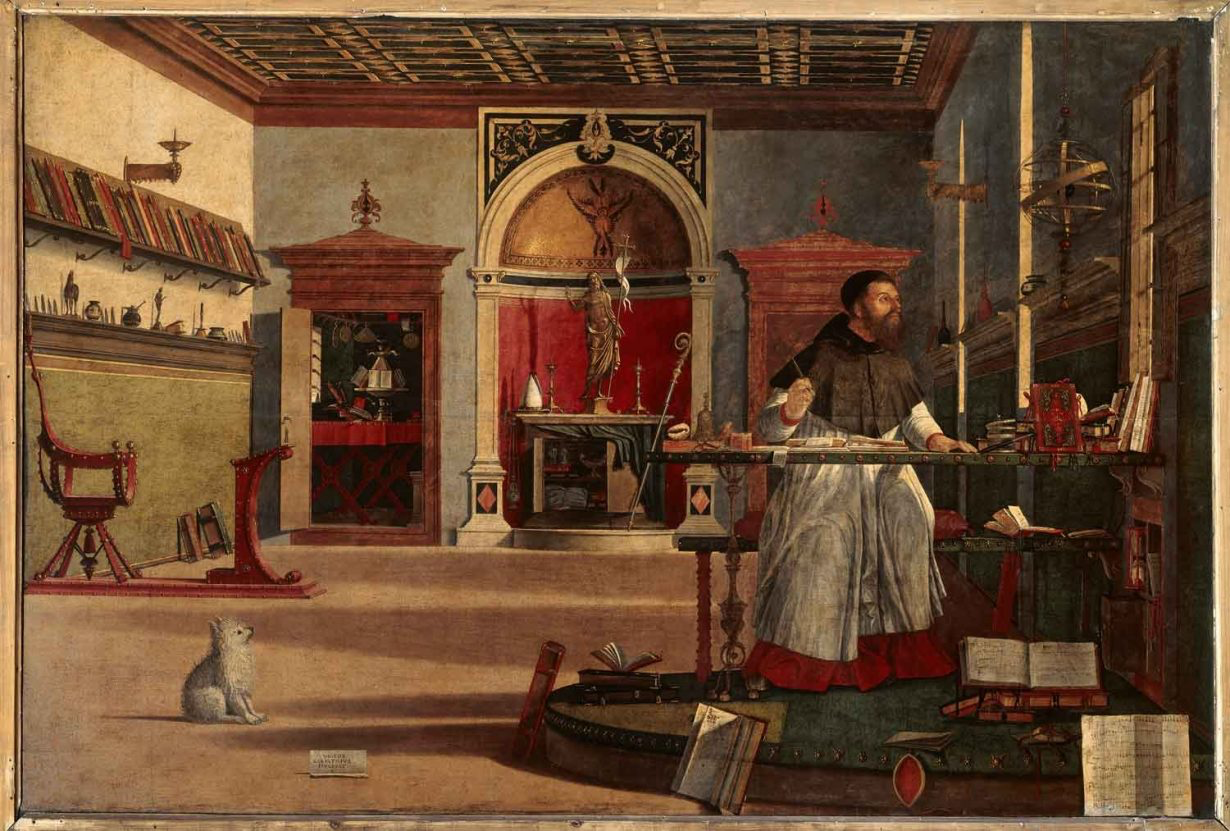
Image source: Vittore Carpaccio, Saint Augustine in His Study, 1507. Scuola di San Giorgio degli Schiavoni. © 2013. Photo: Scala, Florence.

