
By Rod Benson
Just after sunset on 1 October 2026, I watched a swarm of thousands of moths making landfall at Barrenjoey Point, on Sydney’s northern coastline. They were generally flying westward from over the South Pacific Ocean, presumably after having been swept out to sea by prevailing westerly winds from their fragile breeding grounds in north-western New South Wales, or farther north in southern Queensland.
My unexpected encounter coincided with a remarkable influx of Bogong moths across coastal New South Wales, suggesting that my winged companions were indeed Bogongs, and offering a glimpse of what may be an encouraging ecological recovery.[1]
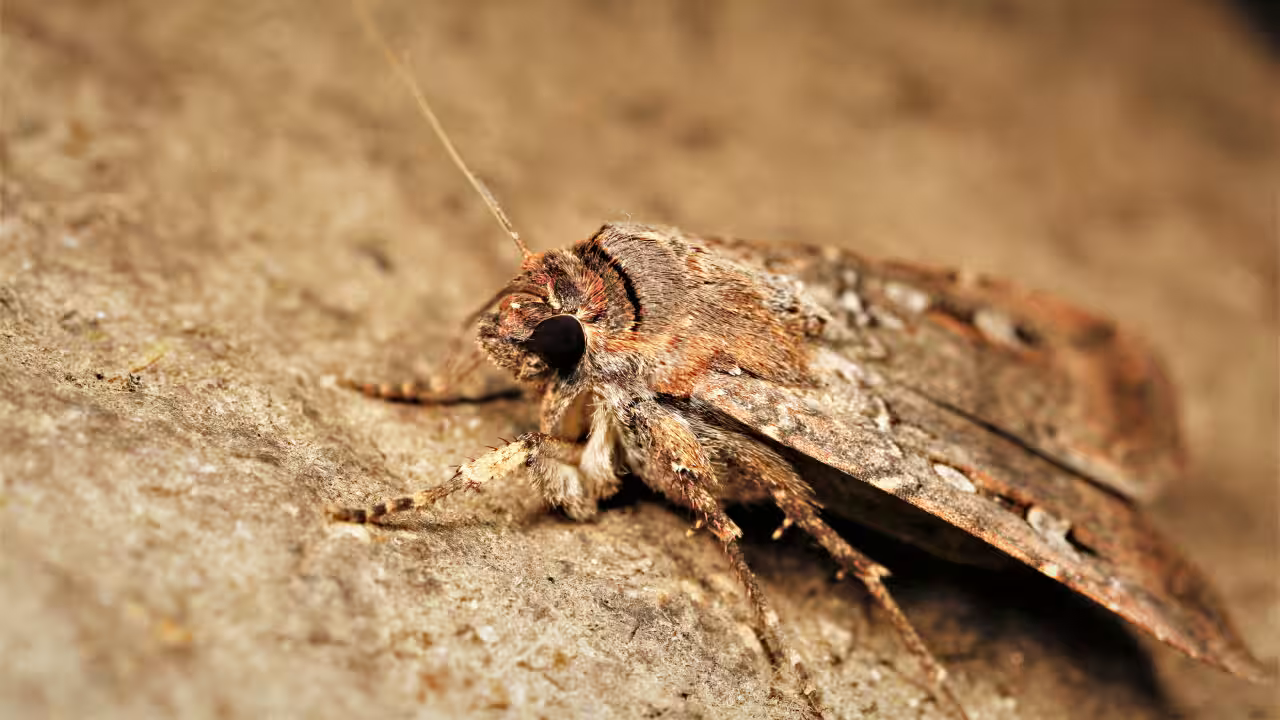
Their apparent size was consistent with that of adult Bogongs: the often-quoted five centimetres refers to wingspan, whereas body length is approximately 2.5–3.5 centimetres, which accords with my observations. Since other brown moths resemble Bogongs, wing markings are more useful for identification than flight direction. Despite the fading twilight, the markings I observed matched typical descriptions of Bogong moths and those visible in the image above.[2]
Guided by the stars
The Bogong moth (Agrotis infusa) is an Australian native whose modest appearance conceals extraordinary abilities. Its grey-brown forewings carry darker streaks and two characteristic spots, one approximately circular and another kidney-shaped. This colouring provides camouflage during daylight rest. Adults feed on nectar, accumulating energy for migration and summer survival. Their seasonal journeys connect inland plains with alpine ecosystems hundreds of kilometres away.
The annual cycle begins in lowland breeding areas, including southern Queensland, inland New South Wales and western Victoria. Adults returning from the mountains mate in autumn, and females can lay approximately 2,000 eggs. Their caterpillars feed on low-growing vegetation, including pasture plants and crops. Known as cutworms because they can sever stems near ground level, they shelter beneath the soil during daylight and emerge to feed at night. Winter rainfall supports the vegetation on which they depend.
After pupating underground, the new adults emerge around spring and migrate up to 1,000 kilometres towards the Australian Alps. They have never visited their destination. Nevertheless, research published in Nature in 2025 demonstrated that they use the starry sky as a compass, complementing their magnetic sense. Scrambling the arrangement of stars in experimental simulations disrupted their orientation. These insects possess an inherited navigational capacity that enables astonishing journeys.[3]
In cool caves and rock crevices, moths gather at densities sometimes reaching approximately 17,000 per square metre. They enter aestivation, a summer dormancy that allows them to escape lowland heat. After several months, survivors return to their breeding grounds, reproduce and die. The same individuals complete both migrations. Their survival requires suitable conditions across extensive breeding and migration areas, alongside dependable mountain refuges.[4]
The migration delivers a seasonal supply of nutrients to alpine ecosystems. Mountain pygmy-possums depend heavily on moths after emerging from winter hibernation. When moth arrivals failed in spring 2018, more than 95 per cent of females in the worst-affected possum population lost their young. The moth’s decline therefore threatens other species and relationships throughout the mountain food web.[5]
Bogong moths also have deep Aboriginal cultural significance. Seasonal harvesting supported gatherings, feasting and ceremony, linking communities with alpine Country. The National Museum of Australia identifies their place in local songline stories. These relationships continue through contemporary collaborations between researchers and Traditional Owner organisations, combining Traditional Knowledge with scientific monitoring. Conserving the moth also means respecting these living cultural connections.[6]
A mysterious disappearance
Large gatherings are documented across the twentieth and twenty-first centuries. Ian Common’s observations at Mount Gingera in the early 1950s established a baseline of abundant summer colonies. Historical research suggests relatively stable numbers until around 1980, followed by fluctuations and an overall decline. Australians remember conspicuous swarms around Canberra’s new Parliament House in 1988 and during Sydney’s 2000 Olympics. In 2013, thousands of Bogongs again invaded Parliament House, even triggering fire alarms.[7]
Then the unimaginable happened. A catastrophic collapse of the Bogong moth population occurred during the 2017–18 and 2018–19 seasons, rendering formerly occupied alpine shelters almost empty. The widely reported estimate of a decline of up to 99.5 per cent conveys its severity. Much of the evidence for the catastrophic decline comes from monitored summer sites. Breeding-ground abundance remains less thoroughly understood.[8]
Severe drought across inland breeding areas was strongly implicated. Reduced plant growth deprives caterpillars of food, undermining the next generation before migration begins. Longer-term pressures include habitat loss, agricultural change and insecticides. Climate change threatens breeding conditions and cool alpine refuges, while artificial lighting can divert adults and expose them to predators or pest control. The relative contribution of these pressures remains uncertain.[9]
In 2021, the International Union for Conservation of Nature classified the species as Endangered. That may seem surprising for an insect capable of appearing in billions. However, its assessment reflects restricted summer habitat and continuing threats, rather than simply a small population. Concentrating enormous numbers in limited refuges creates vulnerability: abundance alone cannot guarantee security.[10]
From spectacular return to secure recovery
Encouraging signs of return emerged before this spring. Some monitored alpine sites showed renewed abundance in 2022–23, possibly associated with higher rainfall. Bogong Watch reports that summer 2025–26 numbers returned to levels expected before the crash, estimating approximately four billion arrivals. Recovery has nevertheless varied between sites and seasons.[11]
The September 2026 swarms reported along Australia’s east coast strengthen that optimism. Researchers suggest rainfall, winter temperatures and winds may help explain them. Yet coastal visibility also reflects displacement, attraction to lights and increased public reporting. Demonstrating durable recovery requires consistent monitoring of alpine occupancy, migration and breeding over successive seasons.[12]
Sustaining recovery means protecting caterpillar food plants and soils, nectar sources along migration routes, and cool summer shelters. Farmers face legitimate crop damage from cutworms; accurate identification, monitoring and targeted control offer a constructive approach. Households can plant native flowers, reduce unnecessary night lighting, gently release trapped moths and report sightings.
Last night’s Barrenjoey experience was my first encounter with a Bogong swarm. It sharpened my awareness of the fascinating migratory journeys of these small airborne creatures. Protecting the conditions for their successful breeding and survival could turn today’s welcome swarms into enduring, resilient abundance. The prospect may not bring joy to the hearts of security staff at Canberra’s Parliament House, but mountain pygmy possums will be delighted.
Rod Benson lives in Sydney and writes about a range of topics from books and local history to food, faith, philosophy, ethics, research skills, and everyday life. Away from the keyboard, he enjoys cooking for friends, walking in the Australian bush, exploring a beach, discovering new restaurants, and reading philosophy, fiction and poetry. He is married to Emma.
References
[1] https://www.abc.net.au/news/2026-09-28/bogong-moths-increase/107202604
[2] https://museumsvictoria.com.au/melbournemuseum/resources/wild/alps/bogong-moth/
[3] https://pmc.ncbi.nlm.nih.gov/articles/PMC12286839/
[4] https://journals.biologists.com/jeb/article/228/15/jeb251207/368688/Extraordinary-creatures-bogong-moths
[5] https://www.zoo.org.au/moth-tracker
[6] https://www.nma.gov.au/learn/diy/moth
[7] https://pmc.ncbi.nlm.nih.gov/articles/PMC7986410/
[8] https://onlinelibrary.wiley.com/doi/full/10.1111/aen.12517
[9] https://journals.biologists.com/jeb/article/228/15/jeb251207/368688/Extraordinary-creatures-bogong-moths
[10] https://www.iucnredlist.org/species/190513532/196183274
[11] https://www.dcceew.gov.au/sites/default/files/documents/consultation-document-agrotis-infusa.pdf
[12] https://www.abc.net.au/news/2026-09-28/bogong-moths-increase/107202604
Image source: SBS

